What Size Solar System Do I Need in New York?
Three inputs set the right system size: twelve months of your own kilowatt-hours, what your roof can actually carry, and the loads you have not added yet.
On this page 8 sections
- 01Start with a year of kilowatt-hours, not a month
- 02Ask for the monthly shape, not just the annual total
- 03The roof, not the spreadsheet, sets the ceiling
- 04Size for the house you are about to have
- 05The uncomfortable part: bigger is not automatically better
- 06Sanity checks before you accept a number
- 07What is available in 2026
- 08Frequently Asked Questions
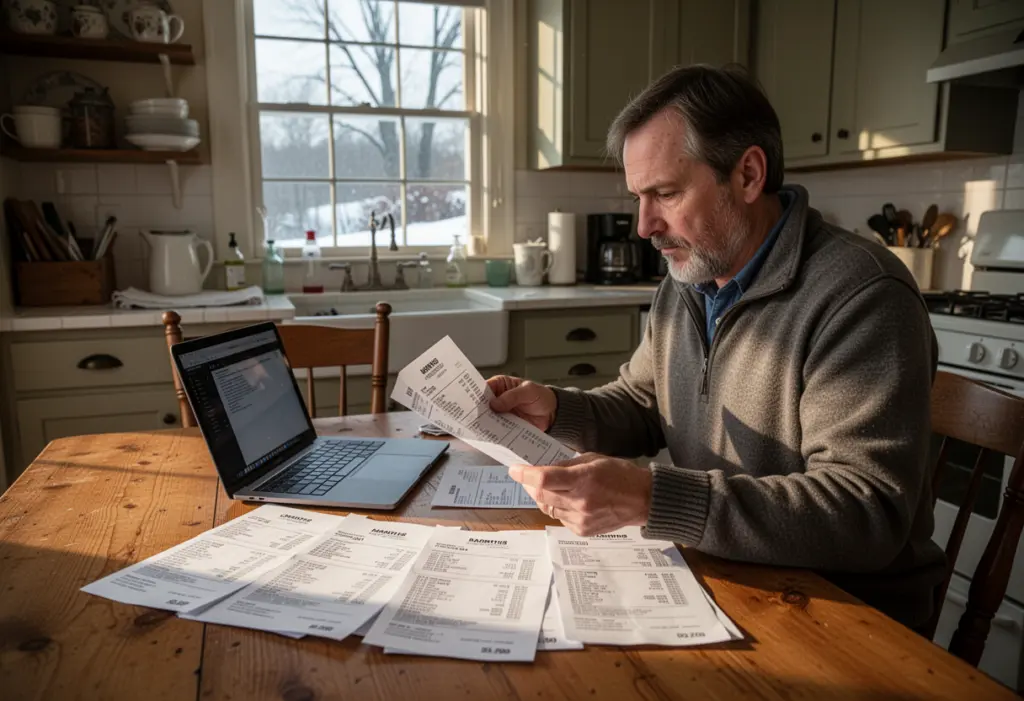
System size is not a preference, it is an arithmetic result, and three inputs produce it: twelve months of your own consumption, what your roof planes will actually carry, and the loads you intend to add later. Everything else in a proposal is downstream of those three.
Start with a year of kilowatt-hours, not a month
Pull twelve consecutive months of bills and add the kWh. A single summer bill overstates a house with air conditioning and understates one with electric heat, and a proposal built on three months is built on a season.
Then ask the installer for the modelled annual kWh per kW DC for your specific roof, not a regional average. That figure moves with pitch, azimuth and shading, and it is the number that converts your consumption into a capacity. Ask what shading assessment produced it, because a satellite model and an on-site assessment disagree most on exactly the roofs that need the answer.
Ask for the monthly shape, not just the annual total
Two systems with the same annual production can behave very differently in a New York winter. Ask for the modelled December and January figures specifically, and ask what snow cover assumption sits inside them. Under Phase One net metering, exports are credited at the full retail rate and the structure holds for 20 years from interconnection, so summer surplus does carry winter consumption. But you are still entitled to know how deep that seasonal swing is before you sign.
The roof, not the spreadsheet, sets the ceiling
- Usable plane area. Obstructions, setbacks required by the reviewing authority, and vents all remove area that a first pass drawing keeps.
- Orientation of each plane. A north facing plane may be technically fillable and still be a poor place to buy capacity.
- Structural capacity and roof age. A roof near the end of its life should be replaced before an array goes on it.
- Electrical service headroom. The service panel, not the roof, is often what caps a design, and a service upgrade is a real cost that belongs in the quote rather than in a surprise.
Size for the house you are about to have
If a heat pump, an EV charger, an induction range or a heat pump water heater is coming, model the load after those additions. Sizing from historic bills produces an array for a house that will no longer exist. If those additions are years away, ask now what the array would need to be, whether the roof and the inverter have headroom for it, and what a later expansion involves in permitting and interconnection terms.
The uncomfortable part: bigger is not automatically better
An oversized array builds credits you never consume, and you paid for the panels that made them. It also carries a permanent monthly cost. The Customer Benefit Contribution is charged on DC capacity regardless of production, on systems interconnected on or after 1 January 2022. On RG&E the 2026 residential rate is $1.31 per kW-month, so three unnecessary kilowatts cost 3 x $1.31, about $3.93 a month or roughly $47 a year, for as long as you own the system. The rate is recalculated annually, so that is not a fixed figure either.
There is a second ceiling that almost never appears in a sales conversation. New York State’s credit is 25% of qualified expenditure capped at $5,000 on Form IT-255. The cap binds at $20,000 of qualified expenditure, because 25% of $20,000 is exactly $5,000. Every dollar of system price above that point receives no state credit at all. The credit also requires the system to serve your principal residence in New York — a seasonal house, a second home or a rental does not qualify — and it is limited by your actual New York State tax liability, with unused amounts carrying forward.
So the marginal kilowatt on a large system is more expensive than the average kilowatt on a small one: no state credit against it, a monthly capacity charge on it, and credits it generates that you may never draw down. That is the argument for sizing to the load rather than to the roof.
Sanity checks before you accept a number
- Ask what percentage of your modelled annual consumption the design covers, and why that percentage was chosen.
- Ask what the design assumes about future loads, and get it stated explicitly.
- Ask what the monthly capacity charge will be for the proposed DC size under your own utility, and check it against your bill.
- Confirm which utility actually serves the address before applying any of this. A municipal electric utility customer sits outside Public Service Commission jurisdiction, with no state net metering rule, no Customer Benefit Contribution and no state interconnection process, so sizing advice written for the utilities the state rules cover does not transfer.
What is available in 2026
The federal residential credit is gone. Section 25D was terminated for expenditures made after 31 December 2025, and the operative test is when the original installation is completed. What remains for a purchase is the state credit above, the state sales tax exemption on residential solar equipment, and the RPTL 487 property tax exemption on added value, which runs 15 years, requires the system to be constructed before 1 January 2030, and applies only where your municipality, your county and your school district have each not opted out. NY-Sun is not on that list: as of September 2026 NYSERDA has no open NY-Sun block for homes in any utility territory, and its Affordable Solar blocks for lower-income households have closed too; check NYSERDA’s NY-Sun dashboard for a new one. Confirm each with NYSERDA and the Department of Taxation and Finance before signing, because programme terms move.
Frequently Asked Questions
How do I work out what size solar system I need?
Add twelve consecutive months of kilowatt-hours from your own bills, then ask the installer for modelled annual kWh per kW DC for your specific roof. Consumption divided by that figure gives the capacity your house actually needs.
Should I oversize my system for future electrification?
Model the load after the heat pump, EV charger or induction range rather than sizing from historic bills. If those additions are years off, ask what the array would need to be and whether the roof, inverter and service panel have headroom.
Is there a point where a bigger system stops paying?
Yes. New York's 25% credit caps at $5,000, which binds at $20,000 of qualified expenditure, so price above that gets no state credit. Extra capacity also pays the monthly Customer Benefit Contribution regardless of what it produces.
What does extra unused capacity cost per month?
It depends on your utility. On RG&E at $1.31 per kW-month for 2026, three unnecessary kilowatts cost about $3.93 a month, roughly $47 a year. The rate is recalculated annually and is charged on DC size, not on production.
This article is general information, not tax, legal or financial advice. Incentive amounts, eligibility rules and deadlines change and depend on your utility, your tax situation and your property. Confirm current terms with NYSERDA, your utility and a qualified tax professional before making a decision.
NY Solar Incentives
Independent New York solar research. We summarise NYSERDA, NY-Sun and federal programme rules from published sources and state plainly when a figure is an estimate. We are not a government agency and do not sell equipment.
Run the arithmetic on your own system
Check the dated program table and your arrangement before counting an incentive. Standard residential NY-Sun blocks are closed; Long Island Affordable Solar has a conditional income-verification route. The NY credit depends on qualified costs and tax liability, while the NYC abatement reduces future property-tax bills. The estimator keeps those timings separate.