Questions to Ask a Solar Installer in New York
Most of what decides a New York solar project is settled in the first conversation. These are the questions that settle it, and the answers that should worry you.
On this page 9 sections
- 01Start with the utility, read from the bill
- 02Questions about the number on the front page
- 03The charge that will not be on the quote
- 04Questions about the tax lines
- 05Questions about the roof and the estimate
- 06Questions about who does what
- 07Two questions with uncomfortable answers
- 08Before you sign
- 09Frequently Asked Questions
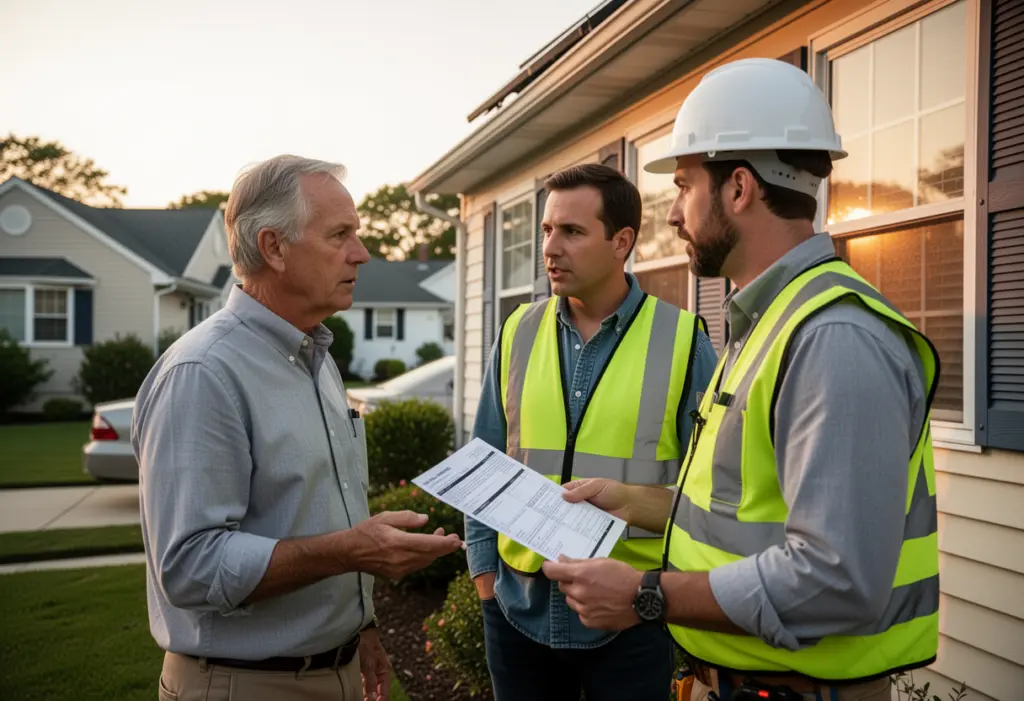
The useful questions are the ones with a checkable answer. Ask an installer whether they are any good and you learn nothing. Ask which utility serves your address, what the monthly capacity charge will be on the system being proposed, and whether the price in front of you nets off a NY-Sun incentive, which as of September 2026 has no open block for homes, and every answer can be checked against a bill, a rate table or a programme page. Start with the utility, because in New York it decides everything downstream.
Start with the utility, read from the bill
Which utility serves this address, as printed on my bill. Not inferred from the county, because New York’s territory boundaries do not follow county lines cleanly. The answer sets your net metering terms, your interconnection process and your monthly capacity charge.
And if the answer is a municipal electric utility, that has to be said plainly rather than glossed over. Municipal utilities sit outside Public Service Commission jurisdiction, which means no PSC net metering, no Customer Benefit Contribution and no state interconnection process. The terms are whatever that utility sets, and they have to be asked for directly. An installer who cannot tell you which utility you are on has not looked at your bill.
Questions about the number on the front page
- Does this price net off a NY-Sun incentive, and from which open block? As of September 2026 NYSERDA has no open NY-Sun block for homes in any utility territory, so a deduction on a quote today has to be checked against NYSERDA’s NY-Sun dashboard before I count on it.
- What is the cash price and what is the financed price, as two separate figures? A low advertised loan rate normally carries a dealer fee inside the system price.
- What is the DC size in watts and what is the AC size? Both, because they are different numbers and one of them sets my monthly charge.
- What is excluded: service panel upgrade, tree removal, roof repair, structural work?
The charge that will not be on the quote
What will my Customer Benefit Contribution be, per month and per year. It is billed on the DC size of the system regardless of what it produces, for systems interconnected on or after 1 January 2022. For 2026 the residential rates are 0.97 dollars per kW-month on National Grid, 1.00 on Orange & Rockland, 1.13 on LIPA and PSEG Long Island, 1.19 on NYSEG, 1.29 on Con Edison, 1.31 on RG&E and 1.67 on Central Hudson.
A 7 kW system on Con Edison is 9.03 dollars a month, about 108 a year. The same system on National Grid is 6.79, about 81. Ask for it as an annual figure inside the savings model rather than as a footnote, and note that the rates are recalculated annually rather than fixed at interconnection, so a twenty-year model holding it flat is wrong.
Questions about the tax lines
Does this quote show a federal 30 percent credit anywhere. If it does, ask why, because section 25D was terminated for expenditures made after 31 December 2025 and an expenditure is treated as made when the original installation is completed. A 2026 proposal built on that line is materially wrong, and the difference is thousands of dollars of assumed benefit that does not exist.
Then the state credit. Is this my principal residence in New York, because a seasonal home, a second home or a rental does not qualify. The credit is 25 percent of qualified expenditure capped at 5,000 dollars on Form IT-255, and it is limited by my actual New York State tax liability rather than granted in full to everyone. If you are being offered a lease or a power purchase agreement, ask whether the term is at least ten years, since the ten-year minimum applies to a lease as well as to a PPA, and note that for those arrangements the 5,000 dollars is a lifetime ceiling for the agreement rather than an annual figure.
Questions about the roof and the estimate
- Was anyone actually on the roof, or does this come from imagery?
- What are the December and January production figures, not the annual total?
- What snow assumption is inside the estimate?
- How old is the roof, what is left on its warranty, and what does it cost to remove and reinstall the array if it is replaced?
- What does the shading look like in fifteen years when the trees are taller?
Questions about who does what
Who pulls the electrical and building permits, and in whose name. The correct answer is the installer’s own name, and a request that you pull it yourself is a transfer of liability onto you. Who submits the interconnection application to the utility, and will you receive the reference number. Is the crew employed or subcontracted. Which legal entity signs the contract, which holds the workmanship warranty, and what happens to that warranty if that entity stops trading. And whether the system falls under the New York State Unified Solar Permit, which covers systems of 25 kW DC and under and has been adopted by over 300 authorities having jurisdiction, or goes through the New York City Department of Buildings instead.
Two questions with uncomfortable answers
Should I add a battery. Under Phase One net metering exports are credited at the full retail rate and that structure holds for 20 years from interconnection, so a battery in New York is largely a resilience purchase rather than an economic one. It buys power during an outage, not a materially better bill. An installer who presents a battery as a saving should be asked to show the arithmetic line by line.
And is this array larger than my consumption. An oversized array builds credits you never consume, and you pay the capacity charge on its DC size every month regardless. Ask what annual consumption the design is sized to and where that figure came from, and if the answer is a projection rather than your own twelve months of bills, ask what it assumes.
Before you sign
Ask about the property tax exemption specifically. Have my municipality, my county and my school district each declined to opt out of RPTL 487, because those are three separate checks with three separate answers, and the exemption requires construction before 1 January 2030. In New York City, Buffalo, Rochester, Syracuse and Yonkers the school district levies no separate property tax, so there are two checks rather than three.
If your household is income-qualified, do not count on the Affordable Solar incentive either: NYSERDA’s Affordable Solar blocks for homes have closed as well, so ask the installer to show you an open block before it appears on a quote. Then confirm everything you were told at source: NYSERDA for NY-Sun, the New York State Department of Taxation and Finance for the credit, your assessor for the exemption and your utility for the tariff. Programmes change, and none of them changes because a salesperson is in a hurry.
Frequently Asked Questions
What is the first question to ask a New York solar installer?
Which utility serves the address, read from the bill rather than inferred from the county. It sets your net metering terms, your interconnection process and your monthly capacity charge. If the answer is a municipal electric utility, none of the state process applies at all.
How do I check whether a quote is out of date?
Look for a federal 30% credit line. Section 25D was terminated for expenditures made after 31 December 2025, with an expenditure treated as made when the original installation is completed, so a 2026 proposal showing it as your benefit is materially wrong.
Should I ask for a battery?
Ask, but expect an honest answer to be about resilience rather than money. Under Phase One net metering exports are credited at the full retail rate for 20 years from interconnection, so a battery buys power during an outage rather than a materially better bill.
What should I ask about a solar lease or PPA?
Whether the term is at least ten years, because New York's credit reaches leases and power purchase agreements only at ten years or more, and the ten-year minimum applies to the lease as well as the PPA. For those agreements the $5,000 is a lifetime ceiling, not an annual figure.
This article is general information, not tax, legal or financial advice. Incentive amounts, eligibility rules and deadlines change and depend on your utility, your tax situation and your property. Confirm current terms with NYSERDA, your utility and a qualified tax professional before making a decision.
NY Solar Incentives
Independent New York solar research. We summarise NYSERDA, NY-Sun and federal programme rules from published sources and state plainly when a figure is an estimate. We are not a government agency and do not sell equipment.
Run the arithmetic on your own system
Check the dated program table and your arrangement before counting an incentive. Standard residential NY-Sun blocks are closed; Long Island Affordable Solar has a conditional income-verification route. The NY credit depends on qualified costs and tax liability, while the NYC abatement reduces future property-tax bills. The estimator keeps those timings separate.