Solar on a New York Warehouse Roof: The Real Constraints
A warehouse offers a very large roof over a very small load. Roof age, snow load and how the surplus is paid for decide whether that is an opportunity or a trap.
On this page 8 sections
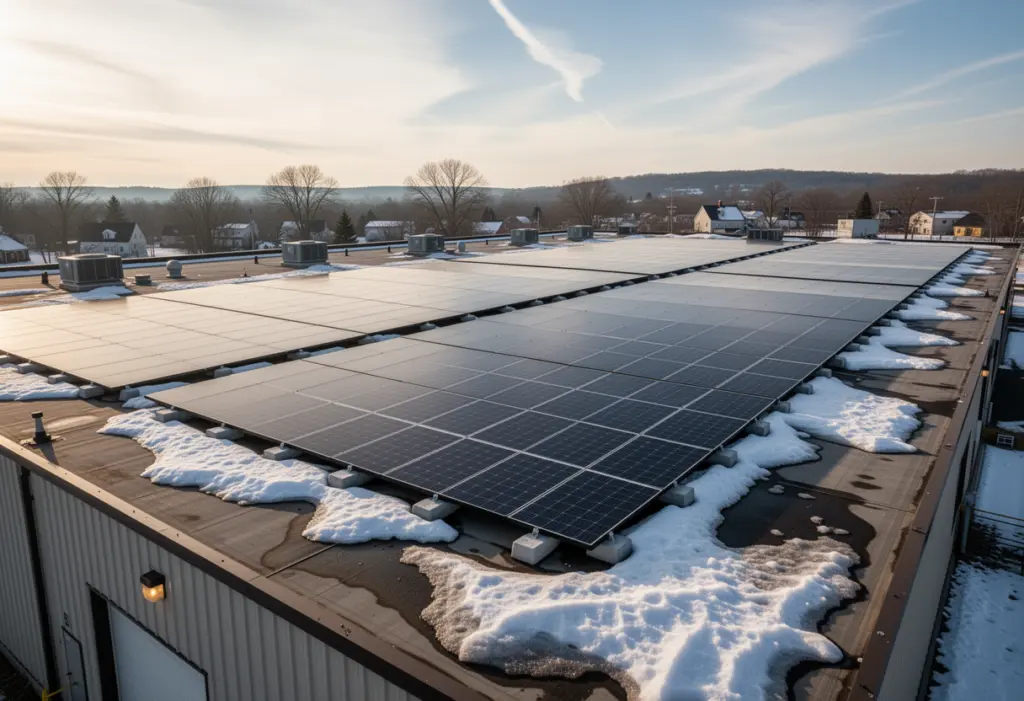
A warehouse is the one building type where the roof is far larger than the load beneath it. Lighting, some heating and cooling, dock equipment and compressors do not consume what acres of flat membrane can produce. So the decisive questions for a warehouse are not about panels at all. They are how old the roof is, what it can carry with snow on it, and how the electricity you do not use gets paid for.
The roof decides the project
Ask for the roof’s installation date, the remaining term on the membrane warranty, and the manufacturer’s written position on penetrations and on ballasted racking. A twenty-year membrane with seven years left underneath a twenty-five year array is a commitment to remove and reinstall the entire system mid-life, and that cost belongs in the model at the start rather than arriving as a surprise in year eight.
If the roof is due for replacement anyway, doing both together is usually the cheaper sequence, and it is worth asking for it to be priced that way explicitly rather than discovering the option later.
Snow load is a New York question, not a formality
Design snow load varies enormously across New York, and a roof structure carrying a ballasted array has to take both at once. Require a stamped structural review by a New York licensed professional engineer for the actual building, not a general assurance that flat roofs are fine.
- What ballast weight does the design use, and where is it concentrated?
- What wind uplift zone is the building in, and what setbacks does that force at the edges?
- How does the array clear roof drains, and what happens when snow drifts against rows of modules?
- Who is responsible for the roof if a leak appears under the array in year six?
You will export, so ask how exports are paid
A large roof over a small load produces a surplus, and a surplus is worth only what the compensation mechanism pays for it. Most residential rooftop customers in New York are on Phase One net metering, which credits exports at the full retail rate and holds that structure for 20 years from interconnection. The Value Stack is the mechanism for community distributed generation and for larger and commercial projects. Which applies to a warehouse-scale system on your account is the number the entire payback rests on, and the residential answer must not be assumed. Get it in writing from the utility or from the interconnection application.
Size to the load, not to the roof
The temptation with a big roof is to fill it. Resist that until the export answer is in hand. An oversized array builds credits you never consume, and holding it is not free: you paid for the modules, and the Customer Benefit Contribution is charged on the DC size of the system regardless of what it produces, for systems interconnected on or after 1 January 2022.
For 2026 the net-metered small commercial rates are 1.83 dollars per kW-month on Central Hudson, 1.47 on Con Edison, 1.38 on National Grid, 1.19 on LIPA and PSEG Long Island, 1.14 on NYSEG, 0.96 on RG&E and 0.88 on Orange & Rockland; a project compensated under the Value Stack sits on a separate and lower schedule, which is one more reason to settle the export question before the system size. A 100 kW array on a NYSEG account that pays it comes to 114 dollars a month, about 1,368 a year, for capacity whether or not the building uses it. Accounts with a demand charge do not pay it, and community solar projects, being front of the meter, pay none of it. Establish which of those describes your account before you agree a system size, and note that the rates are recalculated annually rather than fixed at interconnection.
The demand charge is where the savings are, or are not
Commercial bills frequently carry a demand charge billed on the highest short interval of draw in the month. Solar reduces the energy you consume. Whether it reduces billed demand depends entirely on when your peak occurs: a cold morning start-up peak before the array is producing is not reduced at all, while a summer afternoon peak may be. Ask for interval data and require the model to show the demand line separately from the energy line. A proposal that folds the two together is hiding the part you cannot verify.
Property tax, and the deadline
RPTL 487 exempts the added value of a solar system from real property tax for fifteen years, but only where the municipality, the county and the school district have each separately not opted out. Three separate checks with your assessor, and the answer can differ across a town line. The system must be constructed before 1 January 2030. In New York City, Buffalo, Rochester, Syracuse and Yonkers the school district levies no separate property tax, so there is no separate school check in those five.
Tax and incentives
Do not accept a proposal that shows the 30 percent federal residential credit. Section 25D was terminated for expenditures made after 31 December 2025, with an expenditure treated as made when the original installation is completed, and it was residential in any case. Business projects fall under a different provision, and the right person to price that is your own accountant with the ownership structure in front of them rather than the vendor who wrote the proposal.
New York State’s 25 percent credit on Form IT-255 is capped at 5,000 dollars and requires a principal residence, so it has no application to a warehouse. NY-Sun is applied by the contractor as a price reduction and steps down in blocks, so ask what the figure is on the day and whether it is already deducted from the price you were shown. And confirm the utility from the bill: a municipal electric utility sits outside Public Service Commission jurisdiction, which means no PSC net metering, no Customer Benefit Contribution and no state interconnection process at all.
Every programme named here changes, and none of it should be taken from a proposal on trust. Confirm the current NY-Sun block and per-watt figure with NYSERDA, the credit position with the New York State Department of Taxation and Finance, the three opt-out answers with your assessor, and the tariff, the export compensation and the interconnection queue with your utility, before you sign rather than after.
Frequently Asked Questions
What is the first thing to check on a warehouse roof?
The roof itself. Installation date, remaining membrane warranty, and the manufacturer's written position on penetrations and ballast. A membrane with seven years left under a twenty-five year array means removing and reinstalling the system mid-life, and that cost belongs in the model from the start.
Should I fill the whole roof with panels?
Not before you know how exports are paid. An oversized array builds credits you never consume and still carries the capacity charge every month. A 100 kW array on a NYSEG account that pays the 2026 small commercial rate is $114 a month, about $1,368 a year, regardless of what the building uses.
Does solar cut a warehouse demand charge?
Only if the billed peak falls while the array is producing. A cold morning start-up peak is not reduced at all. Ask for interval data and insist the demand line and the energy line are modelled separately.
Does snow load really matter for a flat roof array?
Yes. Design snow load varies widely across New York and the structure carries both the snow and the ballast. Require a stamped structural review by a New York licensed professional engineer for the actual building, covering ballast weight, wind uplift setbacks and drainage.
This article is general information, not tax, legal or financial advice. Incentive amounts, eligibility rules and deadlines change and depend on your utility, your tax situation and your property. Confirm current terms with NYSERDA, your utility and a qualified tax professional before making a decision.
NY Solar Incentives
Independent New York solar research. We summarise NYSERDA, NY-Sun and federal programme rules from published sources and state plainly when a figure is an estimate. We are not a government agency and do not sell equipment.
Run the arithmetic on your own system
Check the dated program table and your arrangement before counting an incentive. Standard residential NY-Sun blocks are closed; Long Island Affordable Solar has a conditional income-verification route. The NY credit depends on qualified costs and tax liability, while the NYC abatement reduces future property-tax bills. The estimator keeps those timings separate.