Solar on a Landmarked Building in New York: The Route
On a landmarked building the question is rarely whether you can have solar. It is where it can go, and visibility from the public way is what decides that.
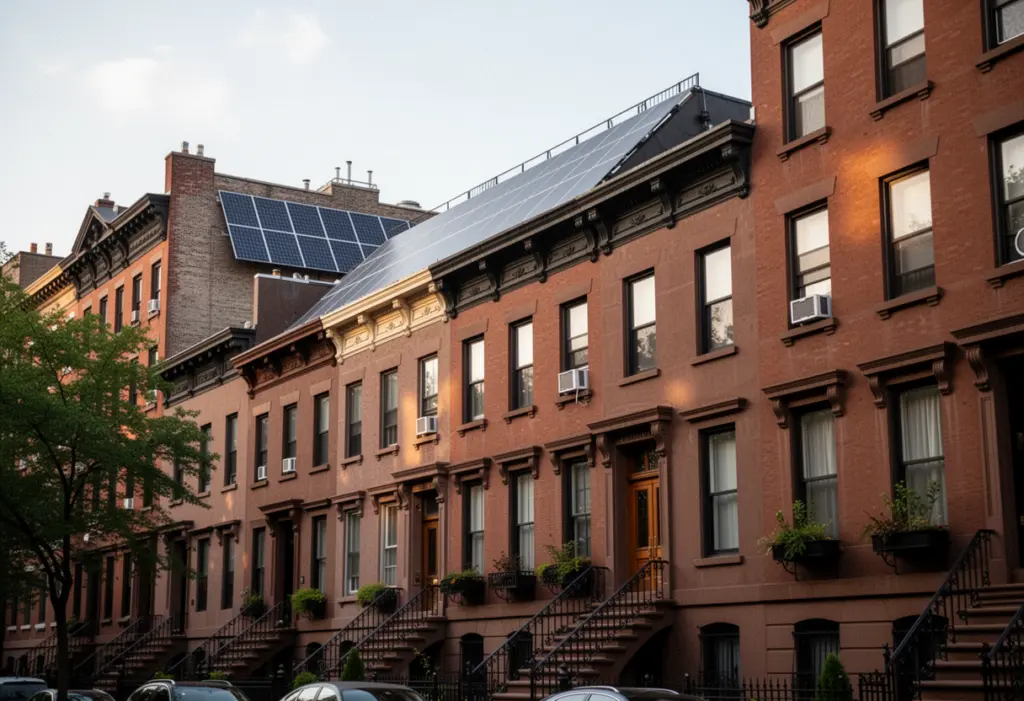
On a landmarked or historic-district building the question is rarely whether you can install solar. It is where, and the answer usually turns on how visible the array is from the public way. That review is a separate approval from your building permit, it runs on its own timetable, and it should be settled before anyone orders equipment.
Two different designations, often confused
Local landmark designation or a local historic district is administered by a municipal commission, and that is the body whose approval you need before work proceeds. Listing on a state or national register is a different thing with different consequences, and it does not automatically create the same local approval requirement. People conflate the two constantly and reach the wrong conclusion in both directions. Establish which applies to your property by asking your municipality directly rather than inferring it from a plaque or a neighbour.
What reviewers actually care about
- Visibility from the street. The single largest factor in most decisions, and the reason rear slopes and inner courtyards are where approvals concentrate.
- Reversibility. Whether the installation can be removed later leaving the historic fabric intact.
- Attachment and penetration method, particularly on slate, tile, standing seam metal or original decking.
- Profile and colour. Flush mounting and black-on-black hardware read as far less intrusive than a tilted rack on rails.
- Where the equipment goes. The inverter, conduit and disconnect on a street-facing wall can be the objection even when the panels are not.
Design moves that tend to get through
Rear roof slopes and secondary wings. Low-profile flush mounting set back from the ridge. Matching frames, rails and modules to a dark, uniform appearance. Routing conduit inside where the building allows it. And where the roof simply cannot work, a ground mount or an array on a garage or accessory structure — which moves the question from the historic commission to the zoning code, a different review with a different timetable.
Expect to lose some production to this, and price it honestly. A rear slope that faces the wrong way produces less than the front slope you were not allowed to use, and any proposal that shows you front-slope production alongside a rear-slope layout is not describing your project.
In the five boroughs
Permitting runs through the Department of Buildings rather than the NYS Unified Solar Permit, which does not apply in New York City. Where the property is landmarked or in a historic district, the landmarks review sits alongside that. Build both into the schedule from the start: photographs, elevations and a layout showing sightlines are the sort of material these reviews want, and preparing them after a rejection wastes a season.
The property tax picture, which is better in the city than most people assume
RPTL 487, the 15-year exemption on the value a solar system adds, is not limited to outside New York City. The NYC Department of Finance administers it in the five boroughs as the Clean Energy Systems Exemption, on form RP-487, preceded by a Notice of Intent to Construct Clean Energy Systems. Section 487 requires construction before 1 January 2030, and outside the city it survives only where the municipality, the county and the school district have each not opted out. In New York City, Buffalo, Rochester, Syracuse and Yonkers there is no separate school district check, because those districts are fiscally dependent and levy no separate property tax of their own.
The New York City property tax abatement is a separate and additional benefit rather than the city’s version of section 487. It sits under RPTL Title 4-C, is filed on form PTA4 with the Department of Buildings, and is taken over a four-year compliance period. Placed in service is the correct operative language for that abatement and for the state tax credit; it is only the wrong test for the terminated federal credit.
The rest of the arithmetic
The New York State credit is 25 percent of qualified expenditure capped at $5,000 on Form IT-255, for equipment at your principal residence in New York, and it reaches leases and power purchase agreements of ten years or more — a shorter lease qualifies for nothing. The flat 25 percent describes a purchase or a power purchase agreement: on a lease the annual credit is that year’s payments, capped by 25 percent of the total contracted payments or $5,000, whichever is less. The 30 percent federal residential credit is gone — section 25D was terminated for expenditures made after 31 December 2025, with an expenditure treated as made when the original installation is completed.
The Customer Benefit Contribution is charged monthly on DC capacity for systems interconnected on or after 1 January 2022. Con Edison serves Manhattan, the Bronx, Brooklyn, Staten Island and most of Queens at $1.29 per kW-month for 2026, so the modest 5 kW array a constrained rear slope often permits carries about $6.45 a month, near $77 a year. The Rockaway Peninsula is PSEG Long Island territory rather than Con Edison, so confirm the utility from the name on your own bill before applying any of this.
Frequently Asked Questions
Can I put solar panels on a landmarked building in New York?
Usually yes, but not necessarily where you first wanted them. Visibility from the public way is the main factor, so approvals concentrate on rear slopes, secondary wings and low-profile flush mounting set back from the ridge.
Is the landmarks review the same as the building permit?
No, it is a separate approval on its own timetable, and it should be settled before equipment is ordered. In the five boroughs, Department of Buildings permitting runs alongside it and the NYS Unified Solar Permit does not apply.
Does the property tax exemption apply in New York City?
Yes. RPTL 487 is not limited to outside the city; the NYC Department of Finance administers it as the Clean Energy Systems Exemption on form RP-487. The city abatement under Title 4-C, filed on form PTA4, is additional to it rather than a substitute.
Will a rear-slope array produce less?
Generally yes, and the proposal should model the layout you will actually be allowed to build. A production figure calculated for a street-facing slope you cannot use is not a figure about your project.
This article is general information, not tax, legal or financial advice. Incentive amounts, eligibility rules and deadlines change and depend on your utility, your tax situation and your property. Confirm current terms with NYSERDA, your utility and a qualified tax professional before making a decision.
NY Solar Incentives
Independent New York solar research. We summarise NYSERDA, NY-Sun and federal programme rules from published sources and state plainly when a figure is an estimate. We are not a government agency and do not sell equipment.
Run the arithmetic on your own system
Check the dated program table and your arrangement before counting an incentive. Standard residential NY-Sun blocks are closed; Long Island Affordable Solar has a conditional income-verification route. The NY credit depends on qualified costs and tax liability, while the NYC abatement reduces future property-tax bills. The estimator keeps those timings separate.