Solar for a Car Dealership in New York
Dealerships have the roof area, the daytime load and the charging demand that make solar look obvious. Whether it pays turns on a line on your bill most owners have never examined.
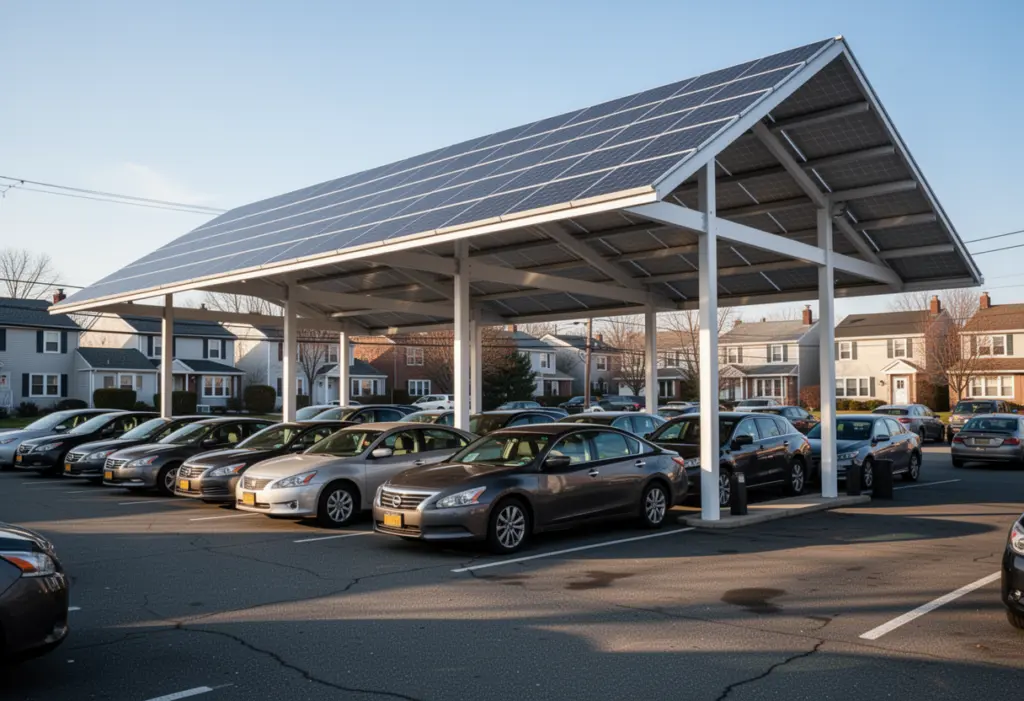
A dealership looks like an ideal solar host: a large low-slope roof, a lot that can take canopies, showroom and service load that runs through the daylight hours, and an EV charging demand that is only going one direction. Before any of that matters, look at one line on your utility bill. Does the account carry a demand charge? The answer changes both what solar can save you and what it will cost you every month.
Energy and demand are two different bills
Solar reduces the kilowatt-hours you buy. Whether it reduces your demand charge depends on when your peak occurs, because that charge is set by your highest measured draw in an interval, not by your total consumption. A peak set on a winter evening, or by a compressor starting while the lot lights are on, is not a peak that a solar array will shave.
So the first concrete action is not to get a quote. It is to ask your utility for interval data for the account, and to have whoever is designing the system show you, against that data, what happens to both parts of the bill. A proposal that models only kilowatt-hours on a demand-billed account has answered the easier half of the question.
One useful consequence: commercial accounts with a demand charge are not subject to the Customer Benefit Contribution at all. If your account is instead billed as small commercial, the charge applies on DC size regardless of production, on systems interconnected on or after 1 January 2022. On RG&E’s 2026 small commercial rate of $0.96 per kW-month, a 40 kW array pays 40 x $0.96 = $38.40 a month, about $461 a year. Worth noting that RG&E’s small commercial rate is below its residential $1.31, as are NYSEG’s and Orange & Rockland’s compared with theirs; three utilities run that way in 2026, not two.
Roof or canopy, and why the answer is usually the roof first
Canopies over customer or inventory parking are attractive and they do more than generate: shade, weather protection and a structure to hang charging equipment from. They are also considerably more involved. A canopy is a structure, which means foundations, structural engineering, lighting integration, snow and wind loading, and a permitting path that has nothing to do with a rooftop application.
On the roof, three questions come before capacity:
- Who holds the roof warranty, and does the array void it? Get the manufacturer’s written position before anyone fastens anything.
- Penetrating or ballasted? Ballast adds weight the structure has to carry; penetrations add sealing details someone must guarantee.
- How many years of roof are left? Removing and refitting an array to replace a membrane is money spent twice.
Permitting is not the homeowner path
The NYS Unified Solar Permit standardises permitting for systems of 25 kW DC and under and has been adopted by more than 300 authorities having jurisdiction, but it does not apply in the five boroughs, where the Department of Buildings runs its own process. A dealership array is usually well above that threshold, so ask your installer explicitly which permit path they are on and what the local authority requires, rather than inheriting a residential timeline.
Interconnection is the same story. A project of this size enters a study process where the utility examines what the circuit can accept and what upgrades the project would trigger, and those upgrades land in your budget. And read the utility name off your own bill: territory does not follow county lines, and a site served by a municipal electric utility is outside Public Service Commission jurisdiction entirely, with no state interconnection process and terms set by the municipality.
Charging changes the sizing question
If chargers are coming, size against the load you will have rather than the load you had. Chargers are a large, controllable, daytime-capable load, which is unusually good news for a solar host: consumption that can be shifted into production hours is worth more than consumption that cannot. Ask whether the charging management system can actually do that shifting, because many can and it is rarely configured by default.
Where the tax and incentive answers come from
Not from a residential page. The 30% federal residential credit under section 25D is gone, terminated for expenditures made after 31 December 2025 with the expenditure treated as made when the original installation is completed, and it never applied to business property. Business projects sit under separate provisions, and depreciation, credit eligibility and the effect of your ownership structure are questions for your accountant with the real documents in hand.
On the state side, NY-Sun is applied by the contractor as a price reduction and steps down as each regional megawatt block fills, and RPTL 487 exempts the added value from property tax for fifteen years where the municipality, the county and the school district have each not opted out, for systems constructed before 1 January 2030. Verify each of those with NYSERDA, your assessor and your accountant before they appear in a business case, because all of them change from year to year.
Frequently Asked Questions
Will solar reduce my dealership demand charge?
Only if your peak occurs when the array is producing. The demand charge is set by your highest measured draw in an interval, not by total consumption, so a peak set on a winter evening will not be shaved. Ask the utility for interval data before commissioning a design.
Does a dealership pay the Customer Benefit Contribution?
Commercial accounts with a demand charge are not subject to it. On a small commercial account it applies on DC size regardless of production: 40 kW on RG&E's 2026 small commercial rate of $0.96 per kW-month is $38.40 a month, roughly $461 a year.
Is a solar canopy over the lot worth it?
It adds shade, weather protection and a structure for charging equipment, but it is a building project rather than a roof project, with foundations, structural engineering, snow and wind loading and its own permit path. Most dealerships should price the roof first.
Does the Unified Solar Permit cover a dealership system?
Usually not. It standardises permitting for systems of 25 kW DC and under across more than 300 authorities having jurisdiction, and it does not apply in the five boroughs. Ask your installer which permit path the project is actually on.
This article is general information, not tax, legal or financial advice. Incentive amounts, eligibility rules and deadlines change and depend on your utility, your tax situation and your property. Confirm current terms with NYSERDA, your utility and a qualified tax professional before making a decision.
NY Solar Incentives
Independent New York solar research. We summarise NYSERDA, NY-Sun and federal programme rules from published sources and state plainly when a figure is an estimate. We are not a government agency and do not sell equipment.
Run the arithmetic on your own system
Check the dated program table and your arrangement before counting an incentive. Standard residential NY-Sun blocks are closed; Long Island Affordable Solar has a conditional income-verification route. The NY credit depends on qualified costs and tax liability, while the NYC abatement reduces future property-tax bills. The estimator keeps those timings separate.