MACRS Depreciation on Solar for a New York Business
Depreciation is usually the largest number in a commercial solar proposal and the least examined. It is not a discount on the price. It is an estimate of your own tax position.
On this page 7 sections
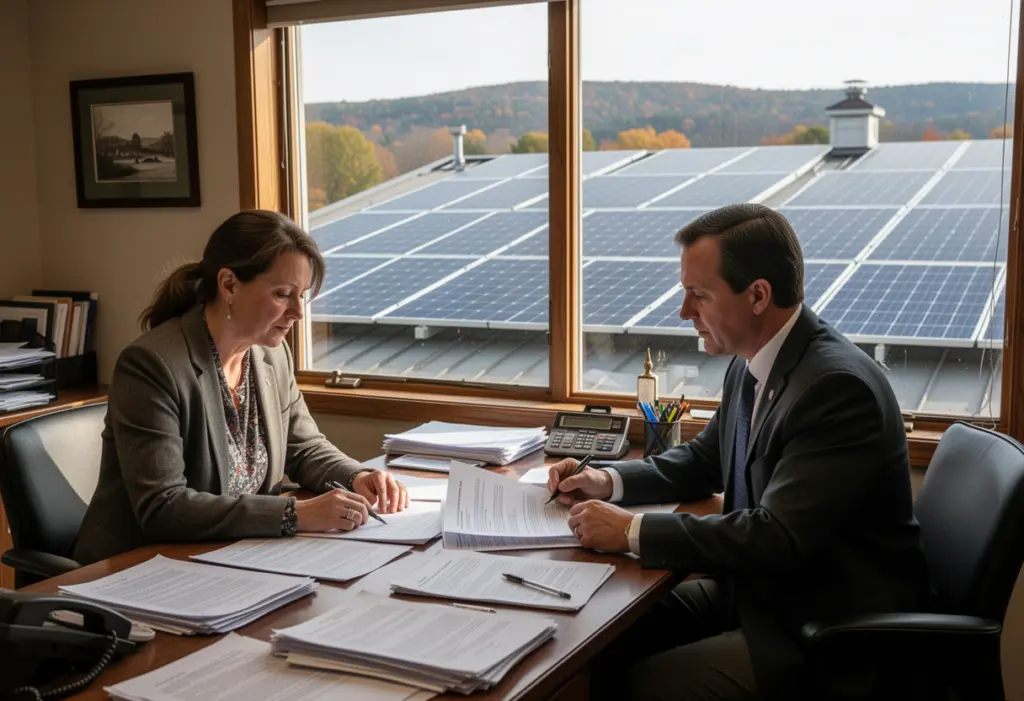
In most commercial solar proposals the depreciation line, usually labelled MACRS after the Modified Accelerated Cost Recovery System, is the largest single number after the price, and it is the one nobody checks. It is worth being blunt about what it is: depreciation is not a discount, a rebate or a payment. It is a deduction that reduces taxable income, and its value to you is the deduction multiplied by your own marginal rate, in a year when you actually owe tax. A proposal that prints a depreciation benefit has forecast your tax return without having seen it.
The arithmetic that makes the point
A deduction of $10,000 does not put $10,000 anywhere. It reduces taxable income by $10,000. At an illustrative marginal rate of 25% that is worth $2,500. At a marginal rate of 15% it is worth $1,500. In a year when the entity has no taxable income at all, it is worth nothing that year, and what happens to it after that depends on rules that turn on your entity type and your other activity.
So the same proposal, with the same equipment, produces a genuinely different result for a profitable operating company, for a business having a loss year, for a partnership passing items through to individuals with different circumstances, and for an organisation that pays no income tax at all. None of that is visible in the sales spreadsheet.
Why this page does not tell you the recovery period or the rate
Because getting it wrong would cost you more than not knowing. The depreciation treatment of energy property, the interaction with any business credit claimed on the same asset, the basis you actually depreciate, the availability of any accelerated first-year deduction, and how New York State treats all of it on your state return are questions with specific statutory answers that move with legislation and that depend on facts about your business. That is what a CPA is for, and this is a case where the fee is small against the exposure.
What this page can usefully do is tell you what to walk into that meeting with.
What to bring to your accountant
- The full proposal, including the depreciation schedule the vendor used and the assumptions behind it, in writing.
- Your entity structure and, if it is a pass-through, who the owners are and what their situations look like.
- The ownership plan. Buying the system outright, financing it, leasing it or signing a power purchase agreement are four different tax questions, because in two of them somebody else owns the asset.
- Any incentive already applied. NY-Sun is paid through the contractor as a reduction in the price rather than to you, so the number that reaches your books is not the sticker figure.
- The expected in-service timing, because a project that slips across a year end lands in a different tax year with different income against it.
The question that reorders the whole decision
Ask your accountant plainly whether your business can use these deductions in the years the model assumes. If the answer is that it probably cannot, the arithmetic of ownership changes, and a third-party ownership structure where a taxable owner holds the asset becomes worth pricing rather than dismissing. That is a conversation to have before signing, not after the first tax season.
Do not import the homeowner numbers
The 30% federal residential credit is gone. Section 25D was terminated for expenditures made after 31 December 2025, with an expenditure treated as made when the original installation is completed, so a homeowner buying today claims nothing federally. Business and farm projects sit under different provisions with their own conditions. If a vendor stacks a residential credit next to a depreciation line in the same table, the table is wrong and everything built on it is suspect.
New York’s 25% credit on Form IT-255, capped at $5,000, requires the taxpayer’s principal residence, so it plays no part in a business project either.
The costs depreciation does not touch
Two recurring items sit outside the tax conversation and belong in the same model. The Customer Benefit Contribution is billed monthly on the DC size of the system regardless of production, for systems interconnected on or after 1 January 2022, and it is recalculated annually rather than fixed. On National Grid’s 2026 small commercial rate of $1.38 per kW-month, a 60 kW rooftop pays 60 x $1.38 = $82.80 a month, or about $994 a year. Note that commercial accounts carrying a demand charge are not subject to it at all, so establish your rate class before this line goes into a forecast.
The second is property tax. RPTL 487 exempts the added value for fifteen years, but the town or city, the county and the school district can each opt out separately, and the system must be constructed before 1 January 2030. Three separate checks, all of them local records. Confirm the current position of every one of these with NYSERDA, your assessor and your accountant before it becomes a number in a business case, because all of them move.
Frequently Asked Questions
Is depreciation on solar a discount off the price?
No. It is a deduction that reduces taxable income, so its value is the deduction multiplied by your marginal rate, in a year you actually owe tax. A $10,000 deduction at an illustrative 25% marginal rate is worth $2,500, and in a loss year it is worth nothing that year.
How long is the depreciation period for commercial solar?
That is a question for your CPA rather than a sales proposal. The recovery period, the basis you actually depreciate, any interaction with a business credit on the same asset and the New York State treatment all turn on statute and on facts about your business.
What should I bring to my accountant?
The full proposal including the vendor's depreciation schedule and its assumptions, your entity structure and owners, the ownership plan, any NY-Sun incentive already applied through the contractor as a price reduction, and the expected in-service timing.
Can my business also claim the 30% federal residential credit?
No. Section 25D was a residential provision and it was terminated for expenditures made after 31 December 2025. Business and farm projects fall under different provisions. A proposal stacking a residential credit beside a depreciation line is wrong.
This article is general information, not tax, legal or financial advice. Incentive amounts, eligibility rules and deadlines change and depend on your utility, your tax situation and your property. Confirm current terms with NYSERDA, your utility and a qualified tax professional before making a decision.
NY Solar Incentives
Independent New York solar research. We summarise NYSERDA, NY-Sun and federal programme rules from published sources and state plainly when a figure is an estimate. We are not a government agency and do not sell equipment.
Run the arithmetic on your own system
Check the dated program table and your arrangement before counting an incentive. Standard residential NY-Sun blocks are closed; Long Island Affordable Solar has a conditional income-verification route. The NY credit depends on qualified costs and tax liability, while the NYC abatement reduces future property-tax bills. The estimator keeps those timings separate.