What New York Farmers Get Paid for a Solar Lease
The rent on a farm solar lease is set by how much capacity a developer can actually interconnect at that spot, not by the size of the field. That is why two neighbouring farms get very different offers.
On this page 8 sections
- 01What actually sets the payment
- 02Why there is no per-acre rate on this page
- 03The clauses that decide what you actually keep
- 04Property tax is three separate checks, not one
- 05Do not read the homeowner tax pages for a farm project
- 06The monthly charge, and when it does not apply
- 07Where the state programmes sit
- 08Frequently Asked Questions
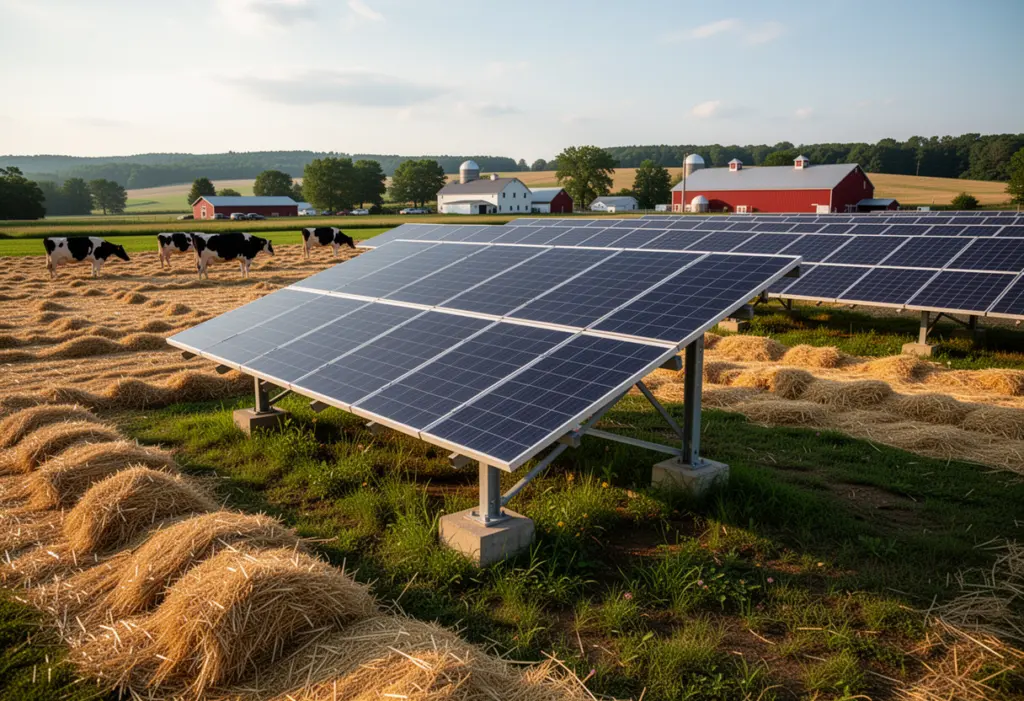
A farm solar lease pays for grid access as much as it pays for land. What drives the offer is how much capacity a developer can actually interconnect at that point on the distribution system, how long the term runs, and what the escalator does across twenty or thirty years. Acreage matters, but a large flat field on a constrained circuit is worth less to a developer than a smaller parcel beside a substation with room in it. That is why two farms on the same road get offers that look nothing alike, and why comparing the per-acre headline is the wrong comparison.
What actually sets the payment
- Interconnection capacity at that node. The project only exists if the utility can accept its output. Ask the developer what capacity they are targeting and whether they have run a screening study yet.
- Distance to the point of interconnection. Every additional pole line is cost the project has to carry, and it comes out of what is left to pay you.
- Term, escalator and renewal. A rent that never rises is a rent that falls in real terms for three decades. The escalator clause is worth more argument than the opening figure.
- The option period. Most agreements begin with an option, sometimes years long, during which the land is tied up. Ask what you are paid during the option, not only after construction.
- Whether the project is community solar. A community solar array sells subscriptions rather than serving your farm, which changes both the economics and the tax questions below.
Why there is no per-acre rate on this page
Any single figure quoted as the going rate for New York farmland is a marketing number. Rents are negotiated deal by deal against the factors above, and a page that prints one range teaches you to accept it. The useful move is to get more than one offer on the same parcel, and to have an agricultural attorney read the agreement before the option is signed rather than after. The option is the document that binds you; the lease is often attached as an exhibit to it.
The clauses that decide what you actually keep
- Decommissioning security. Who removes the array at end of life, what financial instrument guarantees it, and who holds that instrument.
- Soil, drainage and tile. Construction traffic and trenching cross field tile. Get restoration standards written in, with a survey of existing drainage before work starts.
- Screening and setbacks. Local conditions imposed on the project can land on your remaining acreage. Establish whose land carries them.
- Assignment. The company that signs with you is frequently not the one that builds or operates. Assignment is normal in this industry; unrestricted assignment to anyone at all is not.
- Access roads. Who builds, maintains, plows and eventually removes them.
Property tax is three separate checks, not one
New York offers a fifteen-year real property tax exemption on the added value of a solar installation under RPTL 487, but a county, city, town or village may opt out by local law and a school district may opt out by resolution. Those are three separate opt-out checks, and the answer for your parcel is a matter of local record rather than of state policy. Section 487 also requires the system to be constructed before 1 January 2030. Ask, in writing and before the option is signed, which of the three taxing jurisdictions have opted out and who bears any resulting tax.
Do not read the homeowner tax pages for a farm project
The 30% federal residential credit under section 25D is gone. It was terminated for expenditures made after 31 December 2025, with an expenditure treated as made when the original installation is completed, so a homeowner buying a system today claims nothing federally. A farm or business project sits under a different provision entirely, and the treatment of lease income, depreciation and any business credit is a question for your accountant with the actual documents in front of them, not something to infer from a residential page.
New York’s own 25% credit on Form IT-255 is capped at $5,000 and requires equipment installed and used at the taxpayer’s principal residence, so it does not reach a field. A rooftop array on the farmhouse is a separate question with a separate answer.
The monthly charge, and when it does not apply
A behind-the-meter array that serves the farm pays the Customer Benefit Contribution on its DC size every month, whatever it produces, on systems interconnected on or after 1 January 2022. On NYSEG’s 2026 small commercial rate of $1.14 per kW-month, a 25 kW farm array pays 25 x $1.14 = $28.50 a month, about $342 a year. A front-of-the-meter project such as community solar does not pay it at all, and neither do commercial accounts that carry a demand charge. If your farm is served by a municipal electric utility, none of the state interconnection or net metering framework applies and the terms come from the municipality directly.
Where the state programmes sit
NY-Sun incentives are applied by the contractor as a reduction in price and step down as each regional megawatt block fills, so the figure available today is not the figure available next quarter. The state sales tax exemption is written around residential solar equipment, which means a farm business purchase needs its own answer from the Tax Department rather than an assumption. Incentive rules move: confirm the current position with NYSERDA and the Department of Taxation and Finance before you rely on any of it.
Frequently Asked Questions
How much does a solar lease pay per acre in New York?
There is no reliable single figure, and any page quoting one is teaching you to accept it. Rent is negotiated against interconnection capacity at that point on the grid, distance to the point of interconnection, term length and the escalator. Get more than one offer on the same parcel.
Will a solar lease raise my property tax?
RPTL 487 gives a fifteen-year exemption on the added value, but the town or city, the county and the school district can each opt out separately. Ask in writing which of the three have opted out for your parcel, and who bears any tax that results.
Can I claim the federal solar tax credit on leased farmland?
No. The 30% residential credit under section 25D was terminated for expenditures made after 31 December 2025. Farm and business projects fall under a different provision, and the treatment of lease income and any business credit is a question for your accountant.
Does the Customer Benefit Contribution apply to a leased solar field?
A front-of-the-meter project such as community solar does not pay it. A behind-the-meter array serving the farm does, billed monthly on DC size: 25 kW on NYSEG's 2026 small commercial rate of $1.14 per kW-month is $28.50 a month, roughly $342 a year.
This article is general information, not tax, legal or financial advice. Incentive amounts, eligibility rules and deadlines change and depend on your utility, your tax situation and your property. Confirm current terms with NYSERDA, your utility and a qualified tax professional before making a decision.
NY Solar Incentives
Independent New York solar research. We summarise NYSERDA, NY-Sun and federal programme rules from published sources and state plainly when a figure is an estimate. We are not a government agency and do not sell equipment.
Run the arithmetic on your own system
Check the dated program table and your arrangement before counting an incentive. Standard residential NY-Sun blocks are closed; Long Island Affordable Solar has a conditional income-verification route. The NY credit depends on qualified costs and tax liability, while the NYC abatement reduces future property-tax bills. The estimator keeps those timings separate.