Solar Incentives in Broome County, NY
In Broome County the southern horizon decides more projects than the budget does. Here is what to check before anything else.
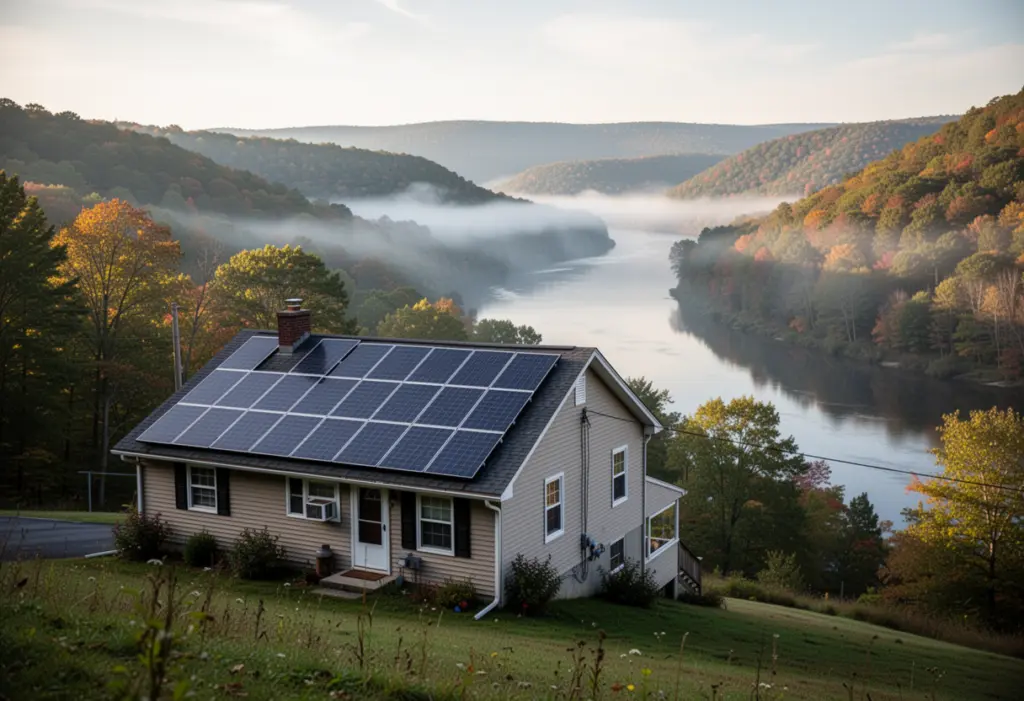
Broome County sits where the Susquehanna and Chenango rivers meet — Binghamton, Vestal, Johnson City, Endicott, Endwell, Conklin, Chenango. ZIP codes here begin 137 and 138, with Binghamton at 13901. It is hill country, and that fact governs solar here more than any other.
Shading is the deciding variable
Houses sit on valley slopes with hills to the south, mature hardwoods are everywhere, and the low winter sun means an obstruction that is irrelevant in July blocks the array for hours in December.
The practical consequence: a proposal for a Broome County house without a real on-site shading assessment is not a proposal you can rely on. Two installers can differ by a fifth on annual production for the same roof, and one of them is wrong.
Ask specifically what the model assumes about December and January, not just the annual figure. And take an honest no seriously — where shading is severe, the right answers are a smaller array, a different roof plane, a ground mount if there is land, or community solar. An installer who reaches one of those conclusions is being straight with you.
NYSEG, and a question worth asking early
Broome County is NYSEG territory. Beyond the interconnection application and permission to operate, that sets the Customer Benefit Contribution: a monthly charge on the DC size of the system for anyone interconnecting on or after 1 January 2022, at $1.19 per kW-month for 2026 — about $9.52 a month on an 8 kW system, roughly $114 a year. Billed on capacity regardless of production and recalculated annually.
NYSEG’s rural and semi-rural circuits are also where hosting capacity questions arise. Ask whether your installer checked the hosting capacity information for your circuit before designing the system — an application that comes back needing a study or a distribution upgrade is far better discovered before your roof is drilled than after.
Housing and roofs
Southern Tier housing stock is old, and roof age is the quiet gate: under roughly ten years of shingle life left means re-roof first, because removing and reinstalling an array later costs considerably more. Snow load in Broome County is moderate by upstate standards but racking must still be specified for it.
Household consumption here is often higher than a template assumes — electric hot water and supplementary electric heat are both common in older housing. Get twelve months of NYSEG usage before accepting any design.
What is claimable in 2026
Not the 30% federal credit. Section 25D was terminated for expenditures made after 31 December 2025, with an expenditure treated as made when the original installation is completed — so a system finished in December 2025 still qualifies even where permission to operate came afterwards.
Still available:
- New York’s 25% credit, capped at $5,000, on Form IT-255. Non-refundable but carried forward five years, which matters where tax liability is modest.
- The state sales tax exemption on residential solar equipment.
- RPTL 487, the 15-year property tax exemption on the added value, where your town, the county and your school district have not opted out. The RPTL 487 exemption is not automatic: file form RP-487 with your assessor by the taxable status date (March 1 in most towns; January 2 in Nassau towns; May 1 or June 1 in Westchester towns; set by charter in cities; usually January 1 in villages), and the system must be built before January 1, 2030 (RP-487 instructions). Check all three.
Not available now: NY-Sun and Affordable Solar. NYSERDA’s Upstate residential NY-Sun block 14 closed on 17 December 2025, and its Upstate Affordable Solar round for lower-income households ran from 18 December 2025 to 9 March 2026. As of September 2026 NYSERDA has no open NY-Sun block for homes in any utility territory; check NYSERDA’s NY-Sun dashboard for a new one. If a quote still subtracts a NY-Sun incentive, ask which open block it relies on.
If the roof will not work
Community solar operates in NYSEG territory, needs no roof and no up-front cost, and its subscribers pay no Customer Benefit Contribution at all. In a county where shading rules out a substantial number of roofs, it is the option that actually works rather than a fallback.
Frequently Asked Questions
Is Binghamton good for solar?
It depends far more on your specific roof than on the county. Valley topography and mature hardwoods make the southern horizon the deciding variable, so an on-site shading assessment matters more here than almost anywhere in New York.
What does NYSEG charge Broome County solar customers?
The Customer Benefit Contribution at $1.19 per kW-month of DC system size for 2026 — about $9.52 a month, roughly $114 a year, on an 8 kW system. It is billed on capacity regardless of production and recalculated annually.
Can a NYSEG interconnection be refused in rural Broome County?
An application can come back requiring a study or a distribution upgrade where a circuit already carries substantial distributed generation. Ask whether hosting capacity was checked for your circuit before the system was designed.
What are the options if a Broome County roof is too shaded?
A smaller array, a different roof plane, a ground mount where there is land, or community solar — which needs no roof and whose subscribers pay no Customer Benefit Contribution.
This article is general information, not tax, legal or financial advice. Incentive amounts, eligibility rules and deadlines change and depend on your utility, your tax situation and your property. Confirm current terms with NYSERDA, your utility and a qualified tax professional before making a decision.
NY Solar Incentives
Independent New York solar research. We summarise NYSERDA, NY-Sun and federal programme rules from published sources and state plainly when a figure is an estimate. We are not a government agency and do not sell equipment.
Run the arithmetic on your own system
Check the dated program table and your arrangement before counting an incentive. Standard residential NY-Sun blocks are closed; Long Island Affordable Solar has a conditional income-verification route. The NY credit depends on qualified costs and tax liability, while the NYC abatement reduces future property-tax bills. The estimator keeps those timings separate.