Heat Pumps in a New York Landmark District
Landmark review looks at street visibility and historic fabric, not at your equipment. Which designation you are under decides whether you need a permit at all.
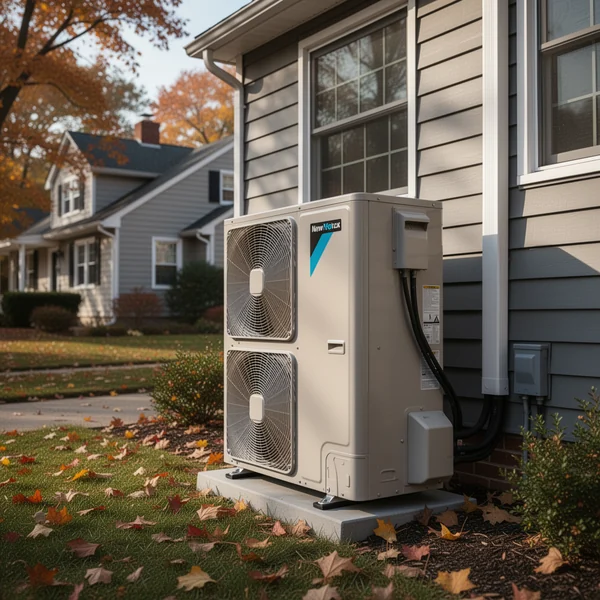
Installing a heat pump in a New York landmark district is almost always possible — what changes is where the outdoor unit can sit, how the refrigerant lines get into the building, and how many weeks of review sit in front of you. The reviewing body is looking at visibility from the street and at damage to historic fabric, not at the equipment itself.
The first thing to establish is which of three completely different regimes you are actually in, because homeowners routinely assume the strictest one applies when it does not.
Three kinds of “historic,” and only two of them stop you
- Locally designated landmark or local historic district. This is the one with teeth. In New York City that means the Landmarks Preservation Commission. Upstate it means a municipal preservation commission or architectural review board — Albany, Saratoga Springs, Hudson, Kingston’s Stockade district, Cooperstown, Buffalo’s Allentown, Rochester’s East Avenue and dozens of village boards operate their own versions. If your property is locally designated, exterior work generally needs their permit before the building department will act.
- State or National Register listing, with no local designation. Register listing is an honour and a gateway to certain tax programmes. On its own it generally does not stop a private owner spending private money on their own house. Many homeowners in Register districts believe they need approval they do not need. Confirm with your municipal building department which designations actually apply to your parcel.
- A deed restriction, HOA covenant or conservation easement. Private, and entirely separate from public landmark law. These can be stricter than either of the above and they do not show up on a city map.
Call the building department, give them the address, and ask plainly: “Is this parcel locally designated, and do I need a preservation permit for exterior mechanical equipment?” Get the answer before you take a quote.
What the review actually cares about
Preservation review is not an efficiency review. It is a visibility and fabric review. In practice, three questions decide most heat pump applications in a New York landmark district:
- Can it be seen from a public thoroughfare? A condenser in a rear yard behind a fence, or on a flat roof set back behind a parapet so it is not visible from the sidewalk across the street, is a very different application from one bolted to a front façade.
- What gets cut, removed or covered? Line-set penetrations through a historic masonry wall, removal of original window sash to fit a through-wall unit, or brackets fastened into brownstone are the details that draw objections. Penetrations through a mortar joint rather than through the brick face, and routing through an existing chase, are the details that get approvals.
- Is it reversible? Preservation bodies think in terms of whether a future owner can undo the work and leave the building as it was. Frame your proposal in those terms and it lands better.
The NYC route, specifically
In New York City, LPC approval comes before Department of Buildings work permits, and the type of LPC permit depends on how much the work affects protected features. The Commission issues staff-level permits for work that meets its rules and does not affect significant protected features, and routes more substantial changes to a Certificate of Appropriateness, which goes before the Commission at a public hearing. That distinction is the whole schedule: staff-level review is weeks, a public hearing is months.
What tends to keep a brownstone or rowhouse heat pump at staff level:
- Condensers in the rear yard, at grade, or on a rear extension roof, not visible from the street.
- Line sets run inside the building, or on a rear façade, painted to match.
- No removal of historic windows, ironwork, cornice or stoop elements.
- Penetrations kept minimal, located in mortar joints or existing openings, and documented on the drawings.
What pushes it to a hearing: anything on the front façade, anything visible above a parapet from the opposite sidewalk, removal of original sash, or a roof array of equipment on a low building on a narrow street. LPC publishes its own permit guidance — use that, and talk to the preservation architect or expediter your contractor works with. The parallel case for panels, including how visibility is assessed, is covered in Solar Panels in a Historic District in New York.
The neighbour problem
In a Brooklyn or Manhattan rowhouse district, rear yards are small and adjacent. A condenser twelve feet from a neighbour’s bedroom window generates complaints regardless of what LPC says, and some municipalities have separate noise ordinances that apply at the property line. Ask for the manufacturer’s published sound rating for the specific model, plan for a mount that isolates vibration from the structure, and consider talking to the neighbour before you file rather than after they see the drawings.
Equipment choices that make approval easier
Preservation constraints push you toward particular configurations, and it helps to know that before you shop:
| Constraint | What tends to work |
|---|---|
| No visible outdoor unit from the street | Rear yard or rear-roof condenser; a single larger multi-zone outdoor unit rather than several small ones |
| No wall penetrations on visible façades | Ductless heads on interior walls with line sets run through existing chases, closets or a disused chimney flue |
| Original sash must stay | Ductless or ducted systems rather than through-wall or window units |
| No exterior equipment at all | Ground source, where the lot allows — the loop is buried and there is no outdoor condenser |
| Plaster ceilings and walls must survive | High-static ducted units in a dropped soffit, or ductless heads, rather than opening ceilings for large trunk ducts |
Money: the incentives do not change, the calendar does
A landmark designation does not disqualify you from anything on the incentive side. NYS Clean Heat is administered by NYSERDA with seven sponsoring utilities — Central Hudson, Con Edison, National Fuel Gas, National Grid, NYSEG, Orange & Rockland and RG&E — and eligibility turns on the equipment and the contractor, not on your façade. Rebate amounts are not published as a single statewide table; check your address at cleanheat.ny.gov/find-available-rebates and have a participating contractor claim it against your invoice.
What designation does change is timing. A Certificate of Appropriateness can add months, and rebate schedules and budget allocations move. Do not sign a proposal whose numbers assume a rebate that may be on a different schedule by the time you have approval — ask the contractor how the rebate is confirmed and at what point it is locked.
On the federal side, be clear-eyed: both federal residential energy credits ended for property placed in service after 31 December 2025. Section 25C, which carried a $2,000 annual cap for heat pumps and heat pump water heaters, and Section 25D, the 30% clean energy credit, are both gone for a 2026 install. A New York household installing this year gets nothing federal. If your contractor’s proposal shows a 30% federal line, it is wrong — the same change we documented in The Federal Solar Tax Credit and New York: What Changed.
Historic rehabilitation tax credit programmes are a separate track with their own rules and their own review, and mechanical work is treated differently from the building envelope. If your property is Register-listed and you are contemplating a larger rehabilitation, ask the State Historic Preservation Office how mechanical upgrades fit before you start, not after.
What to do next
- Confirm with your municipal building department whether the parcel is locally designated, or only Register-listed. The answer changes everything that follows.
- If it is locally designated, read the commission’s own guidance on mechanical equipment before you take quotes, and ask what qualifies for staff-level review in your district.
- Walk the property and identify a rear-yard or non-visible roof location for the condenser, plus a route for the line set that avoids cutting through visible historic fabric.
- Get quotes from contractors who have filed in your district before, and ask them for two configurations: the one they would build anywhere, and the one designed for review.
- Check your Clean Heat sponsor at the address finder and confirm your contractor is enrolled with that sponsor.
- Build the review timeline into your schedule before you commit to a heating season deadline.
NY Solar Incentives
Independent New York solar research. We summarise NYSERDA, NY-Sun and federal programme rules from published sources and state plainly when a figure is an estimate. We are not a government agency and do not sell equipment.
Run the arithmetic on your own system
Check the dated program table and your arrangement before counting an incentive. Standard residential NY-Sun blocks are closed; Long Island Affordable Solar has a conditional income-verification route. The NY credit depends on qualified costs and tax liability, while the NYC abatement reduces future property-tax bills. The estimator keeps those timings separate.