Solar Incentives in Nassau County, NY
Nassau's dense suburban grid, small lots and dozens of villages shape solar here more than the weather does. Here is what to expect and what you can claim.
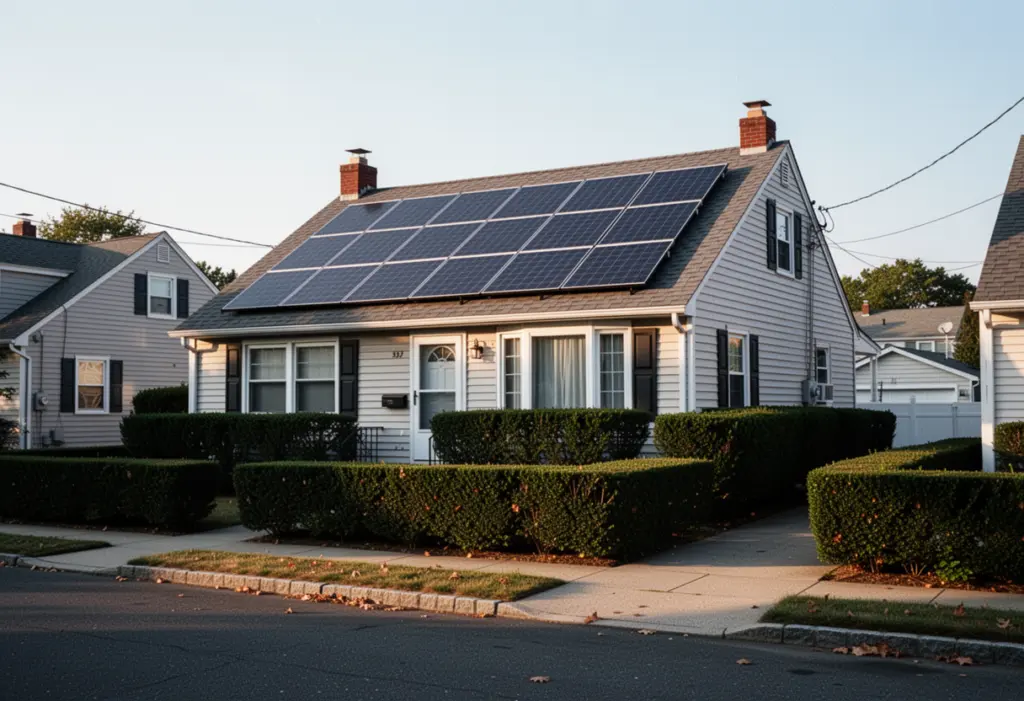
Nassau County is the dense inner half of Long Island — Hempstead, North Hempstead and Oyster Bay, plus a very large number of incorporated villages. ZIP codes here begin 110, 115 and 116. It is one of the most heavily solar-adopted parts of New York State, and the reason is high retail electricity rates meeting a landscape of owner-occupied detached houses.
Why the economics work here
Phase One net metering credits every exported kilowatt-hour at the full retail rate, and Long Island retail rates are high. Each unit your roof sends back is therefore worth more than the same unit upstate. A system interconnected today holds that arrangement for 20 years.
The PSEG Long Island position
Most of the system is owned by LIPA and operated by PSEG Long Island. The village utilities of Freeport, Rockville Centre and Greenport, and Fishers Island, are the exception: they run their own municipal electric utilities, so the LIPA metering rules and charge on this page do not describe them; ask the village utility for its own metering and interconnection rules. The Customer Benefit Contribution — the monthly charge on DC system size for anyone interconnecting on or after 1 January 2022 — is $1.13 per kW-month for 2026.
- A 6 kW system: $6.78 a month, about $81 a year.
- An 8 kW system: $9.04 a month, about $108 a year.
- A 10 kW system: $11.30 a month, about $136 a year.
It is billed on capacity regardless of output, recalculated annually rather than fixed at interconnection, and it will not appear in most sales proposals. Note also that mass-market LIPA projects cannot opt into the Value Stack, so net metering is the arrangement rather than one of two choices.
Small roofs are the Nassau constraint
Nassau’s housing stock is dominated by post-war Capes, ranches and split-levels on small lots. Two consequences:
- Usable roof area is often the limit, not your electricity consumption. A household that would justify a 12 kW system may only fit eight. Ask what the array is limited by — if it is roof area, that is a different conversation about expectations than if it is budget.
- Complicated roof planes. Dormers, additions and hips are common, and an array split across planes needs module-level electronics (microinverters or optimizers) so the orientations do not drag on each other.
Neighbouring houses are close together, so shading from a neighbour’s roofline or trees is a real factor at the low winter sun angle. An on-site shading assessment is worth insisting on.
Villages, and why the permit varies so much
Nassau has three towns and an unusually large number of incorporated villages, each of which may issue its own building permits with its own requirements and turnaround. Two houses a mile apart can face entirely different processes.
Ask which authority is issuing your permit and what it is currently running at. Several villages also operate architectural review, which happens before the municipal permit and long before the utility is involved.
Coastal wind
Wind load is the design factor on Long Island rather than snow. Racking and attachment must be specified for the local wind zone. Ask what load the system is designed to and who confirmed it.
What is claimable in 2026
Not the federal 30% credit. Section 25D was terminated for expenditures made after 31 December 2025, and an expenditure counts as made when the original installation is completed. A Nassau County installation finished in December 2025 still qualifies even where permission to operate came later; a purchase today does not.
New York’s 25% credit, capped at $5,000, on Form IT-255 — and importantly on Long Island, reaches leases and PPAs of ten years or more as well as purchases, which the federal credit never did. Third-party ownership is common here, so this is often the only tax benefit in the deal for the homeowner.
No NY-Sun block is open for homes. NY-Sun was paid through the contractor as a price reduction. On Long Island NYSERDA’s last standard residential block closed on 17 April 2016. NYSERDA’s April 2026 NY-Sun Program Manual still lists one home incentive on Long Island that is not tied to a block: the Affordable Solar Residential Incentive of $0.40 per watt for income-qualified homeowners, paid to a participating NY-Sun contractor, who must pass it on in your contract. Ask the contractor to confirm funding is still available. As of September 2026 NYSERDA has no open NY-Sun block for homes in any utility territory; check NYSERDA’s NY-Sun dashboard for a new one.
The state sales tax exemption on residential solar equipment.
RPTL 487, the 15-year property tax exemption on the added value, where the municipality has not opted out. The RPTL 487 exemption is not automatic: file form RP-487 with your assessor by the taxable status date (March 1 in most towns; January 2 in Nassau towns; May 1 or June 1 in Westchester towns; set by charter in cities; usually January 1 in villages), and the system must be built before January 1, 2030 (RP-487 instructions). In Nassau the town, any village, the county and your school district each decide for their own levy — and Nassau school taxes are a large share of the bill, so start there.
If the roof will not take it
Community solar operates on Long Island, requires no roof, no equipment and no up-front cost, and its subscribers are exempt from the Customer Benefit Contribution entirely. On small Nassau roofs where an array cannot be sized to cover the house, a smaller rooftop system plus a community solar subscription is a combination worth asking about.
Frequently Asked Questions
What is the Nassau County solar charge in 2026?
The LIPA Customer Benefit Contribution is $1.13 per kW-month of DC system size. A 6 kW system pays about $81 a year, an 8 kW system about $108, billed on capacity rather than on production.
Why is my Nassau County solar system smaller than I expected?
Usable roof area is frequently the limit rather than your electricity consumption. Post-war Capes, ranches and split-levels on small lots often cannot fit an array sized to the household. Ask your installer specifically what is limiting the array.
Who issues solar permits in Nassau County?
Your town or, very often, your incorporated village. Nassau has an unusually large number of villages, each with its own requirements and turnaround, and several also operate architectural review before the permit stage.
Can I combine rooftop solar with community solar?
It is worth asking about where a small roof cannot cover the household's usage. Community solar needs no roof or up-front cost, and its subscribers are exempt from the Customer Benefit Contribution that rooftop owners pay.
This article is general information, not tax, legal or financial advice. Incentive amounts, eligibility rules and deadlines change and depend on your utility, your tax situation and your property. Confirm current terms with NYSERDA, your utility and a qualified tax professional before making a decision.
NY Solar Incentives
Independent New York solar research. We summarise NYSERDA, NY-Sun and federal programme rules from published sources and state plainly when a figure is an estimate. We are not a government agency and do not sell equipment.
Run the arithmetic on your own system
Check the dated program table and your arrangement before counting an incentive. Standard residential NY-Sun blocks are closed; Long Island Affordable Solar has a conditional income-verification route. The NY credit depends on qualified costs and tax liability, while the NYC abatement reduces future property-tax bills. The estimator keeps those timings separate.