What Happens at a Solar Electrical Inspection in New York
The panels going on the roof is not the milestone. The electrical inspection is, because until it is signed off the array stays switched off and none of your clocks have started.
On this page 8 sections
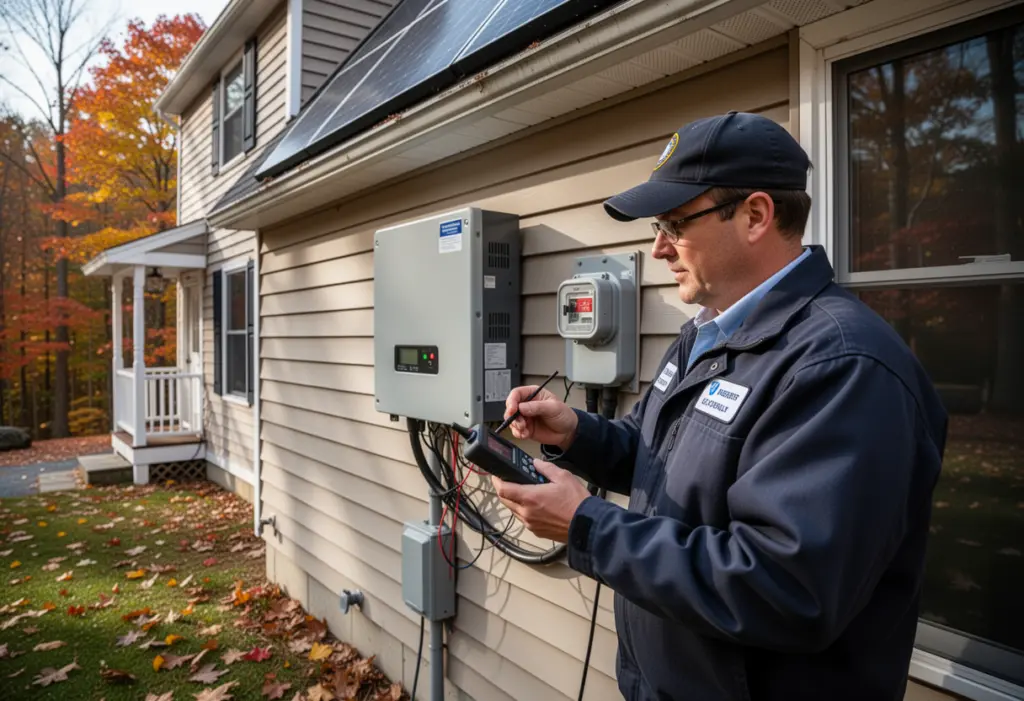
The electrical inspection is the gate between a finished installation and permission to operate. Until an inspector signs off the wiring and the utility acts on that sign-off, the array stays switched off, produces nothing and earns nothing — no matter how complete it looks from the street.
Who actually inspects it
Ask your building department this directly, because it varies across New York. In many jurisdictions the electrical inspection is carried out by an approved third-party electrical inspection agency rather than by the building department itself, and the certificate that agency issues is the document the utility wants to see. In others the municipality does it. In the five boroughs the Department of Buildings runs its own process. Whichever applies to you, find out who schedules the visit and who pays for it before the crew arrives, and get the answer from the authority rather than from a salesperson.
What the inspector is looking at
- Grounding and bonding of the modules, the racking and the equipment, and the continuity of it all.
- Conductor sizing and overcurrent protection, including how the array is tied into your existing service and whether the panel board can legitimately accept it.
- Rapid shutdown equipment and its labelling, which is a first responder safety item and a frequent source of correction notices.
- The AC disconnect — that it exists, that it is where the utility expects it, that it is accessible and that it can be secured.
- Labels and placards. Unglamorous, and one of the most common reasons a visit ends without a sign-off.
- Workmanship: conduit support, penetrations sealed, enclosures closed, nothing temporary left in place.
What a failed visit usually means
Almost always a correction notice rather than a refusal. Missing labels, an inaccessible disconnect, a busbar question or unfinished trim work are fixed and re-inspected. What matters to you is the contract: establish before signing whether re-inspection fees and a second mobilisation are the installer’s cost or yours. Silence in a contract on that point tends to resolve in the contractor’s favour.
Then, and only then, permission to operate
The signed certificate goes to your utility, which issues permission to operate and, where needed, exchanges or reprograms the meter. Do not let anyone switch the system on before that. Producing into the grid without permission to operate is a genuine problem with the utility, and it is not a shortcut worth the argument.
Why the interconnection date is worth a note in your file
Two things in New York key off that date rather than off the day the panels went up.
Phase One net metering credits exports at the full retail rate, and the arrangement holds for 20 years from interconnection. That is the structure most residential rooftop customers are on, and the twenty years starts from a specific date you should be able to name.
The Customer Benefit Contribution applies to systems interconnected on or after 1 January 2022. It is billed monthly on the DC size of the system regardless of what it produces, and it is recalculated annually rather than fixed at interconnection. For 2026 the residential rates run from $0.97 per kW-month on National Grid to $1.67 on Central Hudson. A 9 kW array is therefore about $8.73 a month on National Grid, near $105 a year, and roughly $10.17 a month on PSEG Long Island at $1.13, about $122 a year. A system interconnected before 2022 does not pay it at all, and community solar subscribers pay none of it.
What to collect on the day it passes
- The electrical inspection certificate, with the agency or department named on it.
- The closed permit, and the final inspection record if they are separate documents.
- The permission to operate letter from the utility, and the interconnection date on it.
- Your monitoring login, set up in your own name and email rather than the installer’s.
Those four items are what a future buyer’s attorney, your insurer and your own accountant will ask for, and they are far harder to obtain two years later from a company that has moved on.
Checking your own position
Confirm the utility from the name printed on your bill. A customer of a municipal electric department is outside Public Service Commission jurisdiction: no state interconnection process, no Customer Benefit Contribution and no PSC net metering, with terms set by the department and available only by asking it. For the New York State credit, 25 percent of qualified expenditure capped at $5,000 on Form IT-255 at your principal residence, keep the paperwork above with your tax records. And note that the 30 percent federal residential credit at section 25D is gone, terminated for expenditures made after 31 December 2025, with an expenditure treated as made when the original installation is completed.
Frequently Asked Questions
Who carries out the electrical inspection for solar in New York?
It varies by jurisdiction. In many New York municipalities an approved third-party electrical inspection agency does it rather than the building department, and in the five boroughs the Department of Buildings runs its own process. Ask your building department directly.
Can I turn the system on once it passes inspection?
Not yet. The certificate goes to your utility, which then issues permission to operate and exchanges or reprograms the meter if needed. Producing into the grid before permission to operate is a real problem with the utility, not a shortcut.
What are the most common reasons an inspection is not signed off?
Missing or incorrect labels and placards, an AC disconnect that is not accessible or not where the utility expects it, rapid shutdown labelling, questions about the panel board, and unfinished trim work. Nearly all of it is a correction notice, not a refusal.
Why does the interconnection date matter?
Phase One net metering holds for 20 years from interconnection, and the Customer Benefit Contribution applies to systems interconnected on or after 1 January 2022. Record the date from your permission to operate letter.
This article is general information, not tax, legal or financial advice. Incentive amounts, eligibility rules and deadlines change and depend on your utility, your tax situation and your property. Confirm current terms with NYSERDA, your utility and a qualified tax professional before making a decision.
NY Solar Incentives
Independent New York solar research. We summarise NYSERDA, NY-Sun and federal programme rules from published sources and state plainly when a figure is an estimate. We are not a government agency and do not sell equipment.
Run the arithmetic on your own system
Check the dated program table and your arrangement before counting an incentive. Standard residential NY-Sun blocks are closed; Long Island Affordable Solar has a conditional income-verification route. The NY credit depends on qualified costs and tax liability, while the NYC abatement reduces future property-tax bills. The estimator keeps those timings separate.