Solar Panel Installation in White Plains, NY: What to Ask
White Plains is a city, so one building department handles the permit. What varies is the roof you own, the board that controls it, and three separate tax checks.
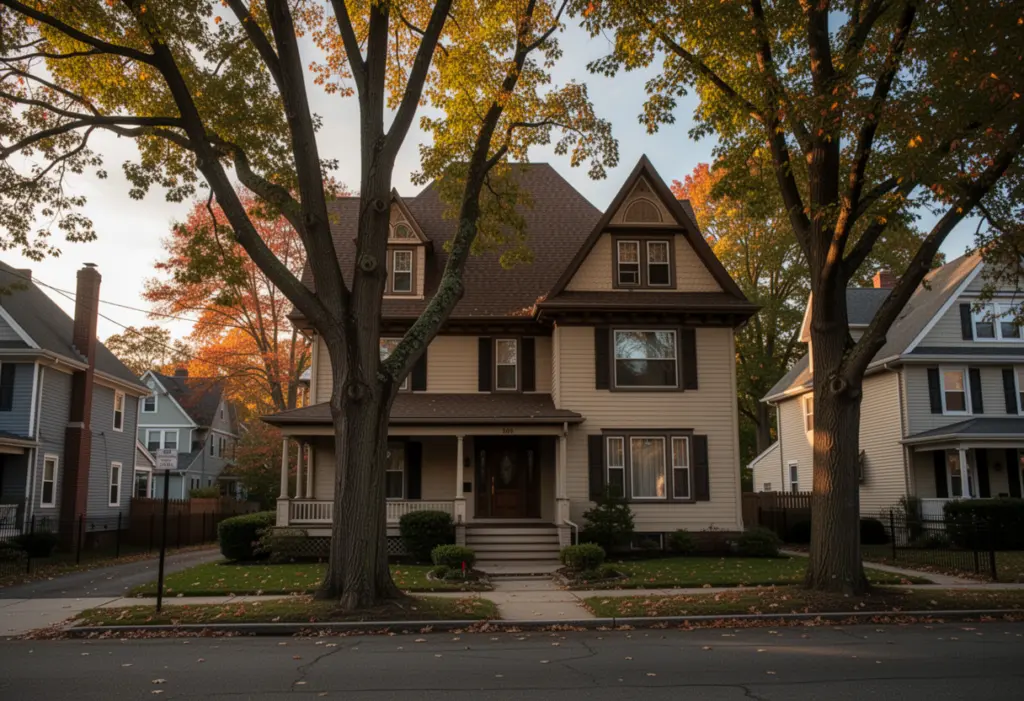
White Plains is a city, which simplifies the first question a Westchester homeowner usually has to untangle. There is no village layer and no town layer to work out: the City of White Plains building department is the authority having jurisdiction for every parcel inside the city line, across 10601, 10603, 10605, 10606 and 10607. Everything else about a solar project here is less uniform than that, and it is worth knowing which parts before a salesperson gets to the roof.
Permit and process
Ask the installer whether the city uses the New York State Unified Solar Permit. It standardises residential permitting for systems of 25 kW DC and under and has been adopted by over 300 authorities having jurisdiction statewide. Where it is used, the application and its checklist are predictable; where it is not, the local form governs. Note that the Unified Solar Permit does not apply in the five boroughs, which run through the New York City Department of Buildings — a distinction that matters if you are comparing notes with family a few miles south.
Ask also who files, who schedules the electrical inspection, and what the installer’s own timeline assumption is between contract and permission to operate. A contract that is silent on that is a contract with no deadline in it.
Con Edison, and the charge billed on capacity
Westchester County is Con Edison territory, and White Plains sits squarely inside it. Confirm the name printed on your own bill regardless — that is the only check that settles it. Under Public Service Commission rules, Phase One net metering credits your exports at the full retail rate and a system interconnected today holds that structure for 20 years.
The offsetting line is the Customer Benefit Contribution, billed monthly on the DC size of the array rather than on production, and applying to systems interconnected on or after 1 January 2022. Con Edison’s 2026 residential rate is $1.29 per kW-month, the third highest residential rate in the state behind Central Hudson and RG&E. A 9 kW array therefore carries $11.61 a month, roughly $139 a year, in every year the system operates. Rates are recalculated annually and are not fixed at interconnection, so treat any twenty-year projection that holds this figure constant with suspicion.
Because the charge follows capacity and not output, an oversized array is charged twice over: once in what you paid for the panels, and again every month for kilowatts producing credits you never consume.
Three property tax checks, and why Yonkers is different
RPTL 487 exempts the added value of a solar installation from real property tax for 15 years, where the taxing authority has not opted out. In White Plains that is three separate questions: Westchester County, the City of White Plains, and the White Plains City School District. All three levy, and each opts out independently — a county that has not opted out tells you nothing about the school district.
The reason to state this specifically is that the answer is different a few miles down the Bronx River Parkway. Yonkers is one of the Big Five city school districts, which are fiscally dependent and levy no separate property tax, so there is no separate school check there at all. White Plains is not one of them. Ask for all three answers by name, and note that the system must be constructed before 1 January 2030 to qualify.
The roof you own, and the board that controls it
White Plains housing splits into two very different problems. Downtown and along the corridors, a large share of residents own apartments in co-ops and condominiums. In a co-op the corporation owns the building including the roof, and in a condominium the roof is normally common element — either way an individual owner cannot install, and the route to solar runs through the board, a professional engineer’s report and a shared-benefit arrangement rather than through a residential contract. For most apartment owners and every renter, community solar is the realistic path: it credits your own Con Edison bill without touching the building, and community solar subscribers pay no Customer Benefit Contribution at all.
In the detached neighbourhoods the constraints are physical. Older housing here carries mature street trees and deep lots, so the southern horizon is frequently the binding limit rather than roof area — ask for a shade assessment taken on site rather than a satellite estimate, and ask what it assumes for December and January. Slate and tile roofs need attachment hardware and flashing details that not every crew carries, and a steep roof of any material changes the labour. Older homes may still be on a 100 amp service, which becomes the first cost rather than the last if you also intend to add a heat pump or an electric vehicle charger.
The incentive position in 2026
Federal help for a purchaser is gone: section 25D was terminated for expenditures made after 31 December 2025, with an expenditure treated as made when the original installation is completed. What remains is state-level. The New York credit is 25% of qualified expenditure capped at $5,000 on Form IT-255, for a principal residence, non-refundable but carried forward five years, and reaching a lease or power purchase agreement of ten years or more. NY-Sun is not available: as of September 2026 NYSERDA has no open NY-Sun block for homes in any utility territory, and its income-based Affordable Solar track has closed as well; check NYSERDA’s NY-Sun dashboard for a new one. Residential solar equipment and its installation are exempt from the 4% state sales tax and the MCTD tax, but White Plains is listed in Part 1 of Publication 718-S, the jurisdictions that do not provide the exemption, so local sales tax still applies there. Because the $5,000 cap bites at $20,000 of qualified expenditure, a large array in a high-consumption household gets no additional state credit for the kilowatts above that point — worth putting into the arithmetic before agreeing to size. Verify all of it with NYSERDA and the New York State Department of Taxation and Finance before signing.
Frequently Asked Questions
Who issues a solar permit in White Plains?
The City of White Plains building department, for every parcel inside the city line. Unlike much of Westchester there is no town or village layer, so there is only one authority to identify.
What does Con Edison charge for a solar system in 2026?
The Customer Benefit Contribution is $1.29 per kW-month residential, billed on the DC size of the array rather than on production. A 9 kW system pays $11.61 a month, about $139 a year, and the rate is recalculated annually.
Does the property tax exemption apply in White Plains?
RPTL 487 exempts the added value for 15 years, but Westchester County, the City of White Plains and the White Plains City School District each opt out independently, so all three need checking. Yonkers differs — its school district levies no separate tax.
Can I install solar on a co-op or condo in White Plains?
Not as an individual owner. The roof is owned by the corporation or held as common element, so it is a board decision. Community solar credits your own Con Edison bill without any installation and carries no Customer Benefit Contribution.
This article is general information, not tax, legal or financial advice. Incentive amounts, eligibility rules and deadlines change and depend on your utility, your tax situation and your property. Confirm current terms with NYSERDA, your utility and a qualified tax professional before making a decision.
NY Solar Incentives
Independent New York solar research. We summarise NYSERDA, NY-Sun and federal programme rules from published sources and state plainly when a figure is an estimate. We are not a government agency and do not sell equipment.
Run the arithmetic on your own system
Check the dated program table and your arrangement before counting an incentive. Standard residential NY-Sun blocks are closed; Long Island Affordable Solar has a conditional income-verification route. The NY credit depends on qualified costs and tax liability, while the NYC abatement reduces future property-tax bills. The estimator keeps those timings separate.