Solar Panel Installation in Warwick, NY
The Town of Warwick contains three incorporated villages, so four separate authorities issue permits inside it. On farmland, the ground mount question comes next.
On this page 7 sections
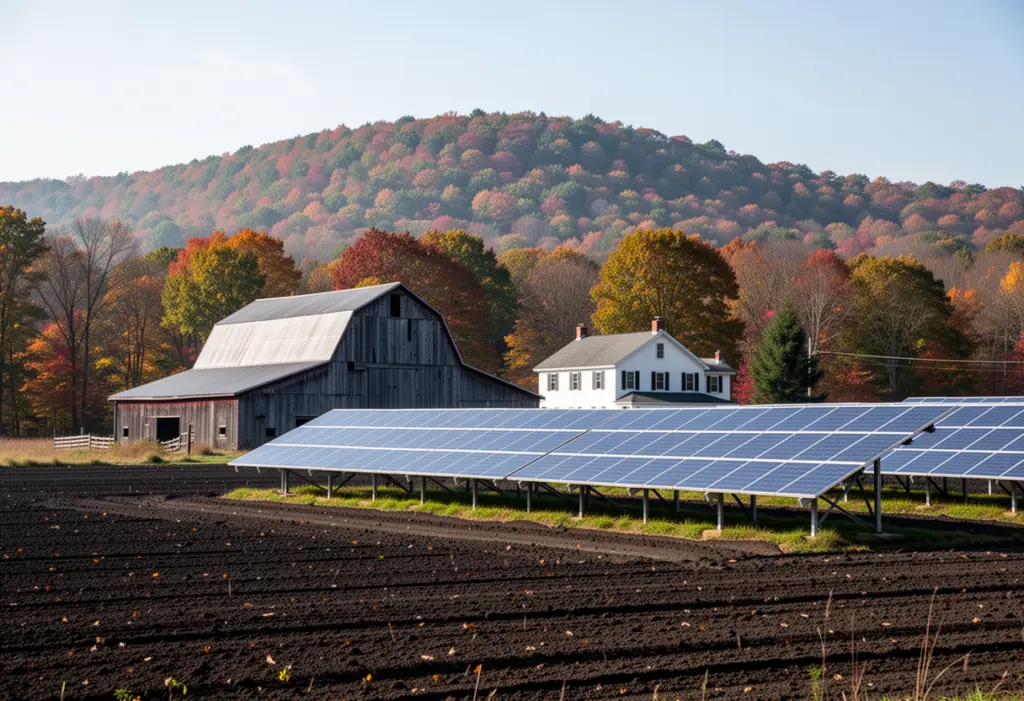
Warwick is a large agricultural town in the south-western corner of Orange County, containing three incorporated villages and a good deal of working farmland. ZIP codes include 10990 for Warwick, 10921 for Florida and 10925 for Greenwood Lake. The first practical question here is not about panels at all.
Four building departments inside one town
There are four separate authorities having jurisdiction inside the Town of Warwick: the town itself, covering the unincorporated areas and the hamlets, and the Villages of Warwick, Florida and Greenwood Lake, each running its own building department with its own schedule and fee sheet. A Warwick mailing address does not tell you which one covers your parcel, and a permit lodged with the wrong office costs weeks. The same four-way split governs RPTL 487, the fifteen-year exemption on the added value of a solar system: inside a village, the village, the town, Orange County and your school district each decide separately, and outside the villages there are three. The village level is the one most often forgotten, because village taxes are the smallest of the bills. Ask for the position on each authority for your specific parcel, in writing. Construction must be complete before 1 January 2030.
Ground mounts on farmland
Where there is open land the array does not have to go on the house at all, and on a farm it frequently should not: you pick the bearing and the tilt instead of accepting whatever a builder chose decades ago, the condition of the roof stops mattering, and anything that needs sweeping or shovelling is at standing height. Price it around four questions. How far does the trench run from the array back to the house, since that scales with distance and is the line most often understated in a first quote? What is the foundation design based on, meaning what soil it assumes, what depth it uses relative to frost, and whether anyone tested the ground on your parcel rather than working from a template, given how sharply soils change between the valley farmland and the slopes? How much clearance sits under the lowest row, since an array set low is buried in drifted snow for weeks? And does it need site plan review or a setback variance, which is a schedule cost as much as a money one?
Which meter, and which house
The state credit — 25% of qualified expenditure, ceiling $5,000, claimed on Form IT-255 — attaches to a principal residence in New York State and to nothing else, and on a farm that decides whether it exists at all. An array behind the farm business meter — barns, wells, cooling, irrigation — is not equipment at a principal residence, and IT-255 is not the instrument for it. Where a property carries more than one meter, settle which one the array connects behind before a design is drawn, because a system offsets only the meter it sits behind. Take the tax treatment to your own accountant rather than to the sales proposal. The running charge follows the same fork: the Customer Benefit Contribution rates set for small commercial accounts in 2026 are not the residential ones, at $0.88 per kW-month on Orange & Rockland against the $1.00 residential figure, and $1.83 on Central Hudson against $1.67.
Ridges, and what a satellite estimate misses
Warwick lies in a valley with wooded ridgelines on most sides of it, and a ridge is not a tree: it is a fixed obstruction several hundred feet high that nobody is going to trim. What it takes is winter production specifically, because that is when the sun tracks lowest across the southern sky and when a credit balance is being spent rather than accumulated. Aerial modelling reads roof planes and the trees on your own lot well, and the skyline beyond your boundary badly, so ask in plain terms whether the horizon was measured on site, and ask for December and January as separate numbers. Where two installers differ sharply about the same property, the difference is usually that one of them came and stood on it.
Orange and Rockland, or Central Hudson
Two utilities divide this county between them, so the name printed on your bill is what decides the running cost. An Orange & Rockland address pays a dollar per kilowatt of DC capacity each month under the 2026 residential rate: $10.00 for a 10 kW roof array, about $120 across the year, or $16.00 for a 16 kW ground mount, about $192. The same 16 kW array on Central Hudson, at $1.67, costs $26.72 a month, roughly $320 a year. Anyone who connected from 1 January 2022 onward pays it, the amount follows capacity rather than output, and it is recalculated each year. Exports meanwhile earn the full retail rate under Phase One net metering, locked in for two decades from the day you interconnect.
What is left in 2026, and the seasonal-home question behind it
Greenwood Lake sits inside this town, and where a house is a second home or a seasonal property the largest state incentive simply does not exist. Form IT-255 asks where you live, not where the meter is: a principal residence in New York State qualifies, a weekend house does not, and a rental you own does not either. Settle that before anything else, because a proposal built around $5,000 of state credit on a seasonal property is built on nothing at all. Where the house does qualify, the credit is 25% of qualified expenditure capped at $5,000, limited by your actual New York State tax liability with unused credit carrying forward for five years, and available on a lease or power purchase agreement as well as a purchase provided the agreement runs at least ten years.
The incentive that does not turn on that test is the state sales tax exemption on residential solar equipment, on which localities may elect separately on their own share. RPTL 487 turns on the four levels above rather than on where you sleep. NY-Sun and the Affordable Solar incentive for households at or below 80% of area median income, both once delivered as a reduction on the contractor’s price, are not available to homes at present. As of September 2026 NYSERDA has no open NY-Sun block for homes in any utility territory; check NYSERDA’s NY-Sun dashboard for a new one.
The federal credit turns on nothing at all, because it has ended. Section 25D reached expenditures made up to 31 December 2025 and no further, with the expenditure dated to completion of the original installation, so there is no version of a 2026 purchase that produces a federal credit. Any proposal still carrying a 30% federal line is materially wrong. Check the current position on everything else before you commit.
Frequently Asked Questions
Which authority issues a solar permit in Warwick?
One of four. The Town of Warwick covers the unincorporated areas, and the Villages of Warwick, Florida and Greenwood Lake each run their own building department. A Warwick mailing address does not tell you which one covers your parcel.
How many levels of the property tax exemption apply?
Four inside a village — village, town, Orange County and school district — and three outside one. Each opts out separately, and the village level is the one most often forgotten because village taxes are the smallest bill.
Does the state credit reach a second home at Greenwood Lake?
No. Form IT-255 requires the equipment to be installed and used at your principal residence in New York State, so a weekend or seasonal house does not qualify however much of the year you spend there, and neither does a rental you own.
Is the utility charge different behind a farm meter?
Yes. The 2026 Customer Benefit Contribution rates for small commercial accounts are $0.88 per kW-month on Orange and Rockland and $1.83 on Central Hudson, against residential rates of $1.00 and $1.67. Which meter the array sits behind therefore changes the running cost as well as the tax treatment.
This article is general information, not tax, legal or financial advice. Incentive amounts, eligibility rules and deadlines change and depend on your utility, your tax situation and your property. Confirm current terms with NYSERDA, your utility and a qualified tax professional before making a decision.
NY Solar Incentives
Independent New York solar research. We summarise NYSERDA, NY-Sun and federal programme rules from published sources and state plainly when a figure is an estimate. We are not a government agency and do not sell equipment.
Run the arithmetic on your own system
Check the dated program table and your arrangement before counting an incentive. Standard residential NY-Sun blocks are closed; Long Island Affordable Solar has a conditional income-verification route. The NY credit depends on qualified costs and tax liability, while the NYC abatement reduces future property-tax bills. The estimator keeps those timings separate.