What Solar Costs in Fishkill, NY: Village or Town Matters
The first thing to settle about a Fishkill quote is whether the address is inside the Village of Fishkill or in the town around it, because the permit, the inspection and sometimes the design review all differ.
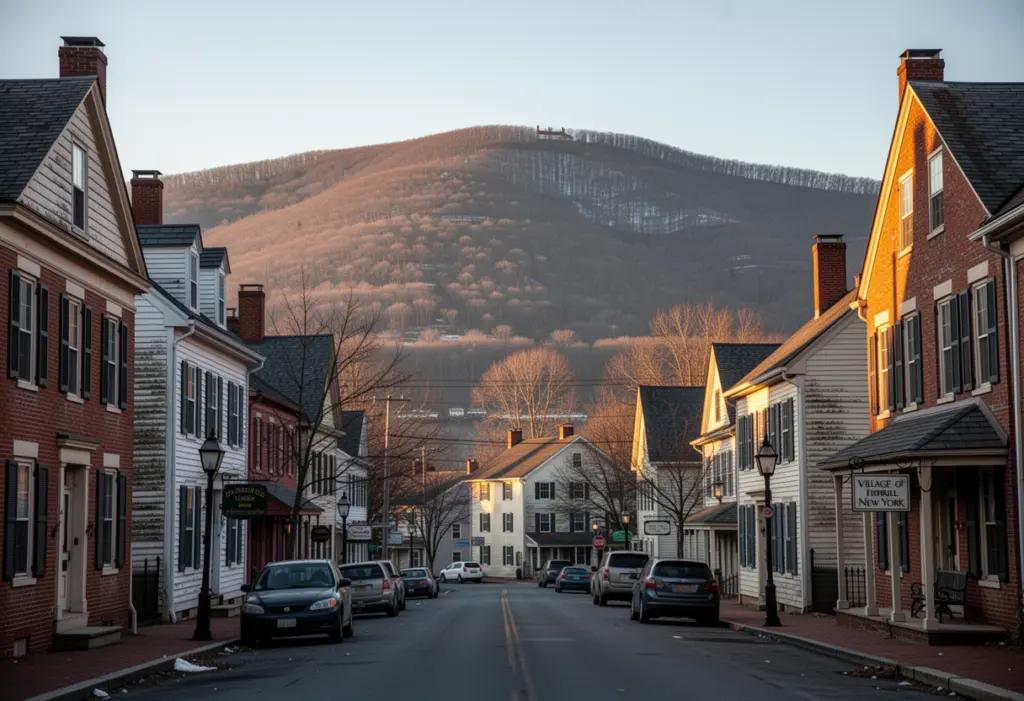
The first thing to settle about a Fishkill quote is whether the address sits inside the Village of Fishkill or in the Town of Fishkill around it. The permit, the inspection and sometimes an additional design review differ between the two, and the mailing address does not tell you which applies. The 12524 postal area straddles both, and the town also takes in Glenham around 12527 and the corridor along Interstate 84.
The permit question, settled first
Inside the village, the village building department handles the application. Outside it, the Town of Fishkill does. Ask which office applies, then ask whether it works to the New York State Unified Solar Permit, which standardises residential permitting for systems of 25 kW DC and under. Village properties near the historic core along the old main street may also face a design or landmarks review; ask the building department what applies to your parcel before the panel layout is drawn, because moving an array after a review is a redesign rather than an adjustment.
The age split that decides the real cost
Fishkill contains two very different housing stocks, and the same array is not the same price on them.
- The village core and older hamlets. Pre-war construction, smaller service panels, complex roof geometry and roofs that are often closer to replacement than the owner thinks. Here the cost drivers are a service upgrade and roof work, not modules.
- The later subdivision stock in the town. Simpler roof planes, larger unbroken south faces, and modern service capacity. These sites usually take a larger array for less labour, and the quote reflects it.
Two questions cover most of the risk on either: what is the amp rating on the existing service, and how many years of life does the roof have left. Both are cheap to answer before design and expensive to discover after.
The ridge to the south and west
The Hudson Highlands and the Fishkill Ridge rise on the southern and western side of the town. Properties tight against that terrain lose late-afternoon winter sun, and terrain shading is the thing automated tools model worst. Ask for a horizon profile taken from the roof, and ask what the December and January production figures are rather than accepting only the annual total, because those are the months a Hudson Valley heating load is highest.
The capacity charge, and why array size matters more here
Fishkill is in Central Hudson territory, whose 2026 residential Customer Benefit Contribution rate of $1.67 per kW-month is the highest of the seven New York utilities that charge one. The charge is billed on the DC size of the array every month, for systems interconnected on or after 1 January 2022, whatever the array actually produces.
A 6.5 kW array works out at $10.86 a month, roughly $130 a year. The same array under Orange & Rockland’s $1.00 rate would be $6.50 a month. The practical lesson is not that Central Hudson is expensive, it is that in this territory rounding a system up by two modules you do not need is a decision you pay for monthly for as long as the system is connected. Ask what consumption the size was based on, and whether that includes a load you have not added yet.
Incentives that apply to a Fishkill purchase
RPTL 487 exempts the added value of the system from property tax for fifteen years, and the checks stack by jurisdiction: Dutchess County, the Town of Fishkill, the Village of Fishkill if you are inside it, and your school district. Each can opt out separately, so a neighbour’s answer is not yours if you are on the other side of the village line. Construction must be before 1 January 2030.
New York’s equipment credit is 25 percent capped at $5,000 on Form IT-255, for a principal residence, and it reaches leases and power purchase agreements of ten years or more — the ten-year minimum applying to the lease as well. On a $16,000 qualified expenditure the credit is $4,000 and the cap does not bind; above $20,000 it does, and the effective percentage starts falling. The state sales tax exemption applies to residential solar equipment. As of September 2026 NYSERDA has no open NY-Sun block for homes in any utility territory; check NYSERDA’s NY-Sun dashboard for a new one. The income-qualified Affordable Solar incentive has closed as well: outside Con Edison and Long Island it ran from 18 December 2025 to 9 March 2026.
The federal 30 percent residential credit is gone, terminated for expenditures made after 31 December 2025 with an expenditure treated as made when the original installation is completed. If a 2026 quote in Fishkill still shows it, the bottom line on that page is wrong by thousands. Phase One net metering does survive, crediting exports at the full retail rate for twenty years from interconnection. Confirm the current position yourself at tax.ny.gov and nyserda.ny.gov, and confirm your utility from your own bill.
Frequently Asked Questions
Village of Fishkill or Town of Fishkill for the permit?
It depends on which side of the village boundary the property sits. The 12524 postal area covers both, so confirm the jurisdiction with the building department before the array is designed.
Which utility serves Fishkill?
Fishkill is in Central Hudson's mid-Hudson territory, but boundaries in the Hudson Valley do not follow municipal lines cleanly, so confirm the utility name printed on your own bill.
How much is the Customer Benefit Contribution in Fishkill?
At Central Hudson's 2026 residential rate of $1.67 per kW-month, a 6.5 kW array is $10.86 a month, about $130 a year. It is charged on DC capacity regardless of production.
Does an older Fishkill house need an electrical upgrade for solar?
Frequently, yes. Older village housing often has a smaller service panel, and a service upgrade can be the largest single line in the quote. Ask for the amp rating before design rather than after.
This article is general information, not tax, legal or financial advice. Incentive amounts, eligibility rules and deadlines change and depend on your utility, your tax situation and your property. Confirm current terms with NYSERDA, your utility and a qualified tax professional before making a decision.
NY Solar Incentives
Independent New York solar research. We summarise NYSERDA, NY-Sun and federal programme rules from published sources and state plainly when a figure is an estimate. We are not a government agency and do not sell equipment.
Run the arithmetic on your own system
Check the dated program table and your arrangement before counting an incentive. Standard residential NY-Sun blocks are closed; Long Island Affordable Solar has a conditional income-verification route. The NY credit depends on qualified costs and tax liability, while the NYC abatement reduces future property-tax bills. The estimator keeps those timings separate.