Solar Panel Installation in Malone, NY
Malone sits on the northern edge of the Adirondack Park, and which side of that line your parcel falls on can add weeks to the schedule.
On this page 8 sections
- 01Which side of the Park line is your parcel on?
- 02Village or town
- 03The Salmon River
- 04Farmland makes ground mounts realistic
- 05Cold and snow are design inputs, not weather
- 06Two utilities, and several villages that are neither
- 072026: ask your school district, not just your town
- 08Frequently Asked Questions
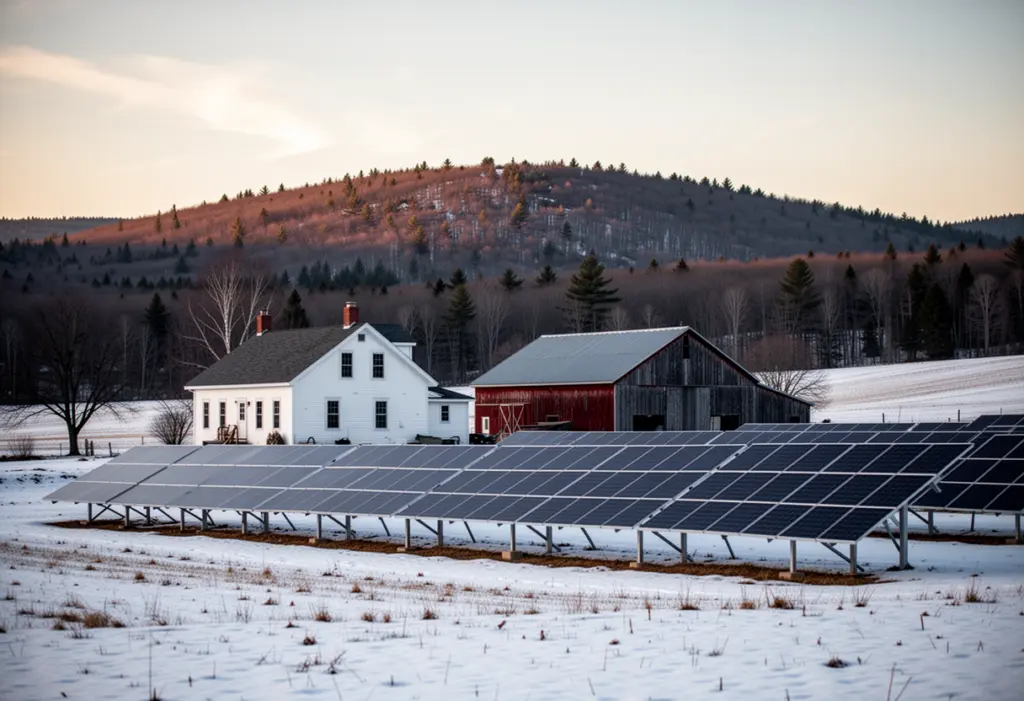
Malone is a village inside the Town of Malone, the county seat of Franklin County, on the Salmon River. ZIP code 12953. It sits in the farmland between the Canadian border and the northern edge of the Adirondack Park, and that position raises a question no downstate solar guide has any reason to ask.
Which side of the Park line is your parcel on?
The Adirondack Park boundary runs through this part of Franklin County. A property inside it answers to the Adirondack Park Agency as well as to the town or village, which is a second review running in parallel with the ordinary building permit.
For a flush rooftop array on an existing house that review is normally routine rather than an obstacle. What it is not is instantaneous, and the delay is where it costs people money:
- Out-of-region installers routinely fail to schedule for it, so a quote built on a downstate timeline can be weeks short before work has even begun.
- A project pushed across a year boundary can be completed under terms it was not quoted under. The federal credit expired at precisely such a boundary at the end of 2025, and RPTL 487 reaches only systems constructed before 1 January 2030.
- Ground mounts and tree clearing attract more scrutiny than a flush roof array, so raise either at the first conversation rather than after a design exists.
Establish at the outset whether your address is inside the Park and what the Agency requires for your particular project, then have the installer put that time into the written schedule.
Village or town
The Village of Malone and the Town of Malone permit separately. Confirm which one covers your address before an installer files anything, and treat the electrical inspection as its own step. Where crews travel a long way, a missed inspection window means another journey rather than another afternoon.
The Salmon River
The river runs through the village, and low-lying property beside it can fall inside mapped flood plain. What that governs is the mounting height of the electrical equipment — inverter, disconnects, production meter, battery — all of which normally has to clear a specified elevation. On these parcels a battery in the basement is frequently the wrong answer even where it is the cheapest one. Ask before a design is drawn rather than after an inspector has been.
Farmland makes ground mounts realistic
Beyond the village this is open agricultural country and a great many properties have the room. On a farm parcel a ground mount is often the better design outright rather than the fallback: the array faces where the sun is instead of where the roof happens to point, roof age stops being part of the decision, and clearing and maintenance are done standing on the ground, which through a Franklin County winter is worth a good deal.
Ask about the trenching run back to the service, foundation depth below the frost line, setbacks and site plan review, and the clearance under the lowest row, since an array set too low disappears under a drift for weeks. If the parcel is inside the Park, ask specifically what the Agency expects for a ground-mounted array.
Cold and snow are design inputs, not weather
Franklin County is among the coldest and snowiest places in the state. Ask what ground snow load the racking, attachments and roof structure are specified for and expect a number; a structural engineer’s letter is called for more often here than in most of New York. Ask where a roof array would release, because panels shed as a slab and snow guards over a door or a walkway are a safety item. Ask what snow-cover assumption is inside the production estimate. And ask where the inverter and any battery will be mounted, because low-temperature specifications matter to both.
Two utilities, and several villages that are neither
Most of this area is served by National Grid, but confirm it from your own bill, because Franklin County also contains NYSEG territory and the difference is not cosmetic: NYSEG’s 2026 residential Customer Benefit Contribution is $1.19 per kW-month against National Grid’s $0.97, so an identical array carries a different monthly charge depending only on which name is printed at the top of the bill. Franklin and Clinton Counties also hold several municipal electric utilities — Tupper Lake, Rouses Point and Plattsburgh among them — whose customers are outside state net metering, outside the Customer Benefit Contribution and outside the standardised state interconnection process altogether.
On National Grid the charge reaches systems interconnected on or after 1 January 2022, is calculated on DC capacity at the state’s lowest published residential rate, and is recalculated annually: $7.28 a month on a 7.5 kW roof array, about $87 a year, and $12.61 on a 13 kW ground array, about $151. Phase One net metering credits exports at the full retail rate and holds for 20 years from interconnection.
2026: ask your school district, not just your town
RPTL 487 exempts the added value of a solar system from real property tax for 15 years, and in a rural county where the school levy is the largest component of most tax bills, the district’s decision is the one that decides whether the exemption is worth much. A school district may opt out by resolution entirely independently of the village, the town and the county, so a reassuring answer from the town clerk settles only part of the question. Put it to the district directly, and note that section 487 reaches only systems constructed before 1 January 2030.
Everything else still standing: the 25% state credit with its $5,000 ceiling, filed on Form IT-255 for the home you actually live in, available on an outright purchase, on a lease of ten years or more, or on a power purchase agreement of the same length, and usable only against the New York tax you genuinely owe, with five years of carry-forward behind it; and the state sales tax exemption on residential solar equipment. NY-Sun and its income-tested Affordable Solar incentive, which used to arrive as a discount from the contractor, are not standing for a home. As of September 2026 NYSERDA has no open NY-Sun block for homes in any utility territory; check NYSERDA’s NY-Sun dashboard for a new one.
For anyone buying in 2026 the federal credit is worth nothing whatsoever. Section 25D no longer reaches an expenditure made after 31 December 2025, and it is the finishing of the original installation that fixes when an expenditure was made. Check the live position with NYSERDA before you sign.
Frequently Asked Questions
Is Malone inside the Adirondack Park?
It depends on the parcel, because the boundary runs through this part of Franklin County. Where a property is inside, the Adirondack Park Agency reviews alongside the town or village — routine for a flush rooftop array on an existing house, but a real addition to the calendar.
If the review is usually approved, why does it matter?
Because of timing. Out-of-region installers routinely fail to schedule for it, and a project pushed across a year boundary can be completed under terms it was not quoted under, as the end of the federal credit on 31 December 2025 showed.
Is a ground mount sensible on a Malone farm property?
Frequently, yes. The array faces where the sun is rather than where the roof points, roof age stops mattering, and clearing is done from the ground. Ask about trenching, frost-line foundations, setbacks, clearance under the bottom row and Park Agency requirements if you are inside the boundary.
Who has to approve the property tax exemption?
The village or town, Franklin County and your school district each decide separately, and in a rural county the school levy is the largest part of most bills, so the district's answer is the one that matters most. Ask it directly.
This article is general information, not tax, legal or financial advice. Incentive amounts, eligibility rules and deadlines change and depend on your utility, your tax situation and your property. Confirm current terms with NYSERDA, your utility and a qualified tax professional before making a decision.
NY Solar Incentives
Independent New York solar research. We summarise NYSERDA, NY-Sun and federal programme rules from published sources and state plainly when a figure is an estimate. We are not a government agency and do not sell equipment.
Run the arithmetic on your own system
Check the dated program table and your arrangement before counting an incentive. Standard residential NY-Sun blocks are closed; Long Island Affordable Solar has a conditional income-verification route. The NY credit depends on qualified costs and tax liability, while the NYC abatement reduces future property-tax bills. The estimator keeps those timings separate.