Solar Panel Installation in Newburgh, NY
Newburgh's historic east end, its city-town split and its utility boundary all shape a solar project here. Here is what to establish first.
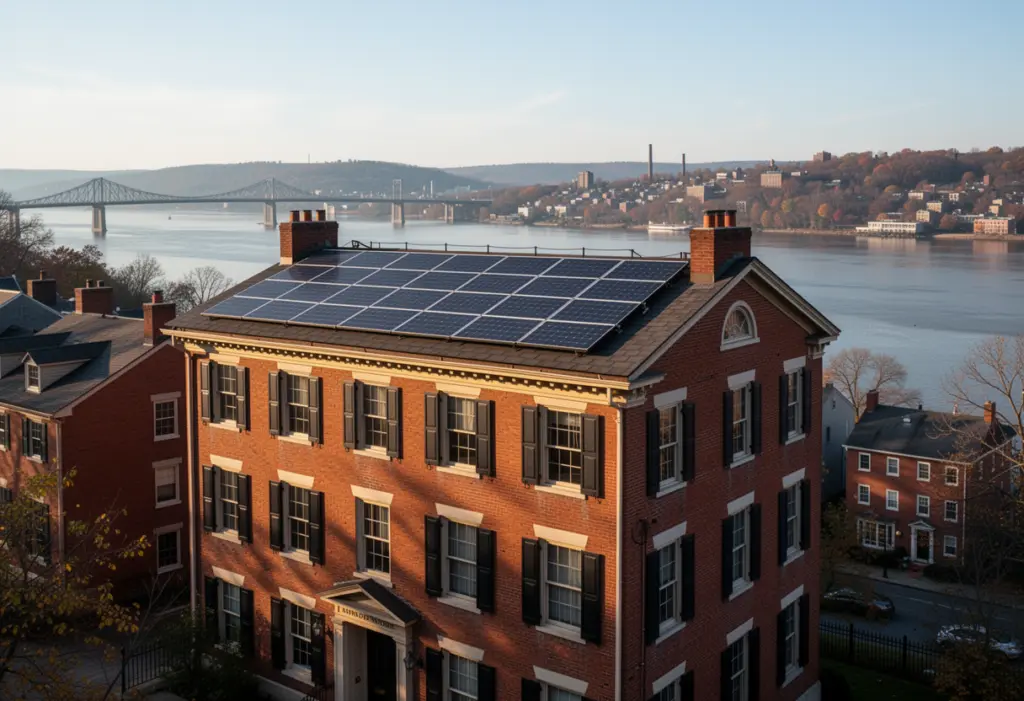
Newburgh sits on the west bank of the Hudson in Orange County. ZIP codes here begin 125. Three things need establishing before a solar project here goes anywhere: which municipality you are in, whether your property is in a historic district, and which utility serves you.
City or Town
The City of Newburgh and the Town of Newburgh are separate municipalities with separate building departments and separate turnarounds. The city is dense, historic and hilly; the town is largely suburban and commercial. Establish which covers your address first.
Historic review in the city
Newburgh’s East End Historic District is one of the largest in the state, and architectural review applies within it. That review comes before the building permit and can restrict street-visible placement.
Design for it: all-black modules with black frames, flush mounting, concealed conduit, and placement on rear or secondary planes. An installer with East End experience will propose that without being asked.
Which utility — and why it matters here
Orange County is split between Central Hudson and Orange & Rockland, and the boundary does not follow municipal lines cleanly. Read the name printed on your own bill. The difference is not trivial:
- Central Hudson: 2026 residential Customer Benefit Contribution of $1.67 per kW-month. An 8 kW system pays about $160 a year.
- Orange & Rockland: $1.00 per kW-month. The same system pays about $96 a year.
Roughly two thirds more on identical hardware, decided by a service boundary. Both are billed on DC system size regardless of production and recalculated annually.
Older housing
The city’s housing stock is old and includes a great deal of brick and masonry with slate and metal roofing — both of which need mounting approaches not every installer handles. Roof age is frequently the gate: under roughly ten years of shingle life left means re-roof first. Older structures also draw a structural engineer’s letter more often.
The sequence
- Twelve months of usage from your utility, an on-site shading assessment, roof condition and structure.
- Historic review, where it applies.
- Interconnection application, before installation.
- Building permit from the city or the town.
- Installation, then electrical inspection.
- Certificate to the utility, meter exchange, permission to operate.
2026 incentives
The 30% federal credit is gone: section 25D was terminated for expenditures made after 31 December 2025, with an expenditure treated as made when the original installation is completed.
Still available: New York’s 25% credit capped at $5,000 on Form IT-255, non-refundable but carried forward five years; the state sales tax exemption; and RPTL 487 where the city or town, Orange County and your school district have not opted out. The RPTL 487 exemption is not automatic: file form RP-487 with your assessor by the taxable status date (March 1 in most towns; January 2 in Nassau towns; May 1 or June 1 in Westchester towns; set by charter in cities; usually January 1 in villages), and the system must be built before January 1, 2030 (RP-487 instructions). NY-Sun is not on that list: as of September 2026 NYSERDA has no open NY-Sun block for homes in any utility territory, and its Affordable Solar incentive for lower-income households closed upstate on 9 March 2026. Check NYSERDA’s NY-Sun dashboard for a new one.
Five questions worth asking here
- Which utility is on my bill — Central Hudson or Orange & Rockland?
- City or Town of Newburgh, and what is that authority currently running at?
- Is my property inside the East End Historic District?
- What roof material am I on, and what has this installer mounted on it before?
- Does the net-cost figure contain any federal credit? It should not.
The first question is worth about $64 a year on an 8 kW system, every year the system runs, and it takes ten seconds to answer from a bill you already have.
Frequently Asked Questions
Which utility serves Newburgh for solar?
Orange County is split between Central Hudson and Orange & Rockland and the boundary does not follow municipal lines. Read the name on your own bill — the difference in the monthly solar charge is roughly two thirds on identical hardware.
Does the Newburgh East End Historic District affect solar?
Yes. Architectural review applies within the district and comes before the building permit, and it can restrict street-visible placement. All-black modules, flush mounting, concealed conduit and rear-plane placement help considerably.
Is the City of Newburgh the same as the Town for permits?
No. They are separate municipalities with separate building departments and turnarounds. Establish which covers your address before anything else.
What extra incentives exist for lower-income Newburgh households?
None from NY-Sun at the moment: NYSERDA's last upstate Affordable Solar block for lower-income households ($0.80 per watt) ran from 18 December 2025 to 9 March 2026 and is closed, and as of September 2026 NYSERDA has no open NY-Sun block for homes in any utility territory. What NYSERDA does offer now is Statewide Solar for All: households enrolled in their utility's Energy Assistance Program (EAP) get a monthly community-solar credit on their electric bill, with no upfront cost or fees, and enrolment in EAP enrolls you automatically. Check NYSERDA's NY-Sun dashboard for a new block before signing.
This article is general information, not tax, legal or financial advice. Incentive amounts, eligibility rules and deadlines change and depend on your utility, your tax situation and your property. Confirm current terms with NYSERDA, your utility and a qualified tax professional before making a decision.
NY Solar Incentives
Independent New York solar research. We summarise NYSERDA, NY-Sun and federal programme rules from published sources and state plainly when a figure is an estimate. We are not a government agency and do not sell equipment.
Run the arithmetic on your own system
Check the dated program table and your arrangement before counting an incentive. Standard residential NY-Sun blocks are closed; Long Island Affordable Solar has a conditional income-verification route. The NY credit depends on qualified costs and tax liability, while the NYC abatement reduces future property-tax bills. The estimator keeps those timings separate.