Solar Panel Installation in Rhinebeck, NY
Rhinebeck has one of the most carefully protected village centres in the Hudson Valley. Review decides the design here before anything else does.
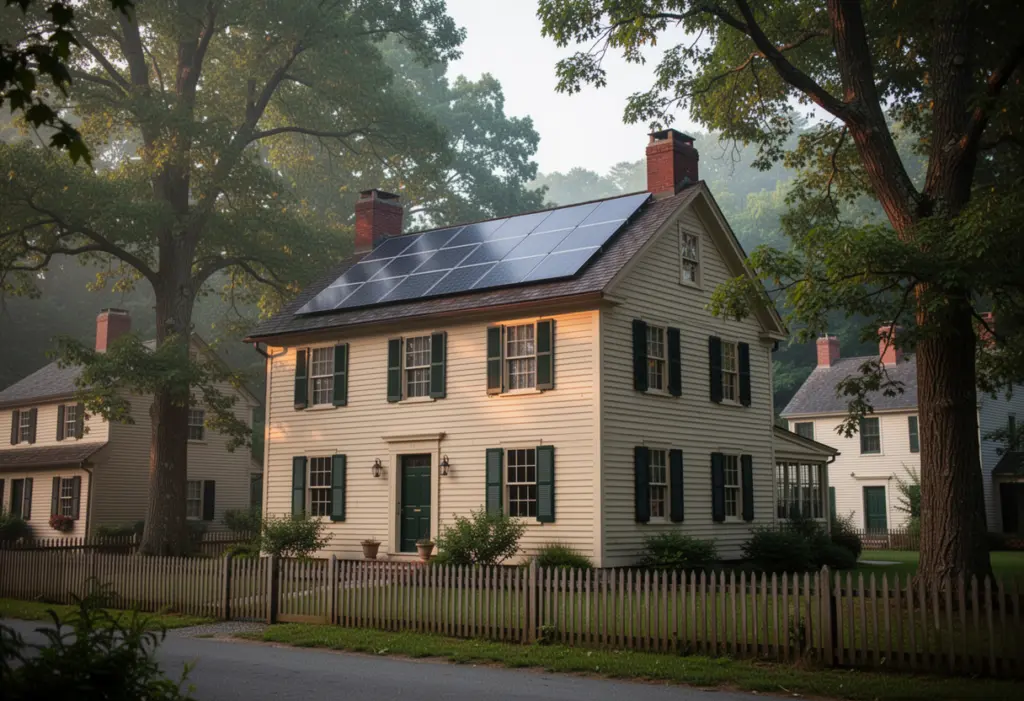
Rhinebeck sits on the east bank of the Hudson in Dutchess County. ZIP code 12572. Its village centre is one of the most carefully protected in the Hudson Valley, and that governs solar here more than any technical consideration.
Review decides the design
Architectural and historic review applies in the village and in parts of the town, and it sits ahead of the building permit — months ahead, in some cases, because boards frequently meet monthly and a missed submission deadline costs four weeks.
What gets approved is fairly predictable:
- A rear or secondary roof plane not visible from the public way. This single choice resolves most applications.
- All-black modules with black frames. Silver frames and light backsheets read as industrial equipment.
- Flush mounting following the roof plane. Tilted racking on a pitched historic roof is the most likely thing to be refused.
- Concealed conduit, run internally or painted where exposed.
- An explicit note that the mounting is reversible and the historic fabric unchanged beneath.
Establish whether your property is in a designated area, and when the board meets, before you sign anything. The Village of Rhinebeck and the Town of Rhinebeck are also separate authorities.
Roof materials that need specialists
Older Rhinebeck houses carry slate, standing-seam metal and other materials that need mounting approaches not every installer is equipped for. Ask what they have installed on your roof type before, and for photographs of it.
Where the roof is standing seam metal, that is good news: racking clamps to the seams with no penetrations at all, and metal roofs commonly outlast the panels.
Roof age is the usual gate on asphalt: under roughly ten years of shingle life left means re-roof first.
Land
Outside the village, Rhinebeck properties frequently have space, and a ground mount screened from the road is often the option a review board is most comfortable with — it does not touch the building at all. It also lets orientation and tilt be chosen and removes the roof-age question. Ask for it to be quoted alongside the roof option.
Central Hudson
The Customer Benefit Contribution is $1.67 per kW-month of DC system size for 2026, the highest residential rate in New York — about $13.36 a month on an 8 kW system, roughly $160 a year, or $240 on 12 kW. Billed on capacity regardless of production and recalculated annually. Confirm your utility from your own bill.
Shading
The area is well treed. Insist on an on-site shading assessment and ask what the model assumes about December and January. If tree removal is proposed, treat it as a decision rather than an assumption — and note that in a village setting it may need its own permission.
2026 incentives
The 30% federal residential credit has ended — section 25D was terminated for expenditures made after 31 December 2025, with an expenditure treated as made when the original installation is completed. A project held in review past that boundary lost it, which is the clearest illustration available of why review timing matters financially.
Still available: New York’s 25% credit capped at $5,000 on Form IT-255; the state sales tax exemption; and RPTL 487’s 15-year property tax exemption where the village or town, Dutchess County and your school district have not opted out, once you file form RP-487 with each assessor for your address by its taxable status date. NY-Sun is not on that list: as of September 2026 NYSERDA has no open NY-Sun block for homes in any utility territory; check NYSERDA’s NY-Sun dashboard for a new one.
Frequently Asked Questions
Can you put solar on a historic house in Rhinebeck?
Usually yes, on a rear or secondary plane with all-black flush-mounted modules and concealed conduit. Review sits ahead of the building permit, and boards frequently meet monthly, so a missed submission deadline costs four weeks.
What roof materials cause problems in Rhinebeck?
Slate and other older materials need mounting approaches not every installer handles — ask what they have installed on your roof type and for photographs. Standing seam metal is the opposite: racking clamps to the seams with no penetrations at all.
Is a ground mount easier to get approved?
Often, outside the village. A ground mount screened from the road does not touch the building at all, which review boards are frequently more comfortable with — and it lets orientation and tilt be chosen while removing the roof-age question.
What does Central Hudson charge a Rhinebeck solar customer?
The Customer Benefit Contribution at $1.67 per kW-month of DC system size for 2026, the highest residential rate in New York — about $160 a year on an 8 kW system and $240 on 12 kW.
This article is general information, not tax, legal or financial advice. Incentive amounts, eligibility rules and deadlines change and depend on your utility, your tax situation and your property. Confirm current terms with NYSERDA, your utility and a qualified tax professional before making a decision.
NY Solar Incentives
Independent New York solar research. We summarise NYSERDA, NY-Sun and federal programme rules from published sources and state plainly when a figure is an estimate. We are not a government agency and do not sell equipment.
Run the arithmetic on your own system
Check the dated program table and your arrangement before counting an incentive. Standard residential NY-Sun blocks are closed; Long Island Affordable Solar has a conditional income-verification route. The NY credit depends on qualified costs and tax liability, while the NYC abatement reduces future property-tax bills. The estimator keeps those timings separate.