Solar Panel Installation in Fayetteville, NY
Fayetteville is a village with its own building department at the foot of a rising escarpment. Both facts arrive before any equipment is chosen.
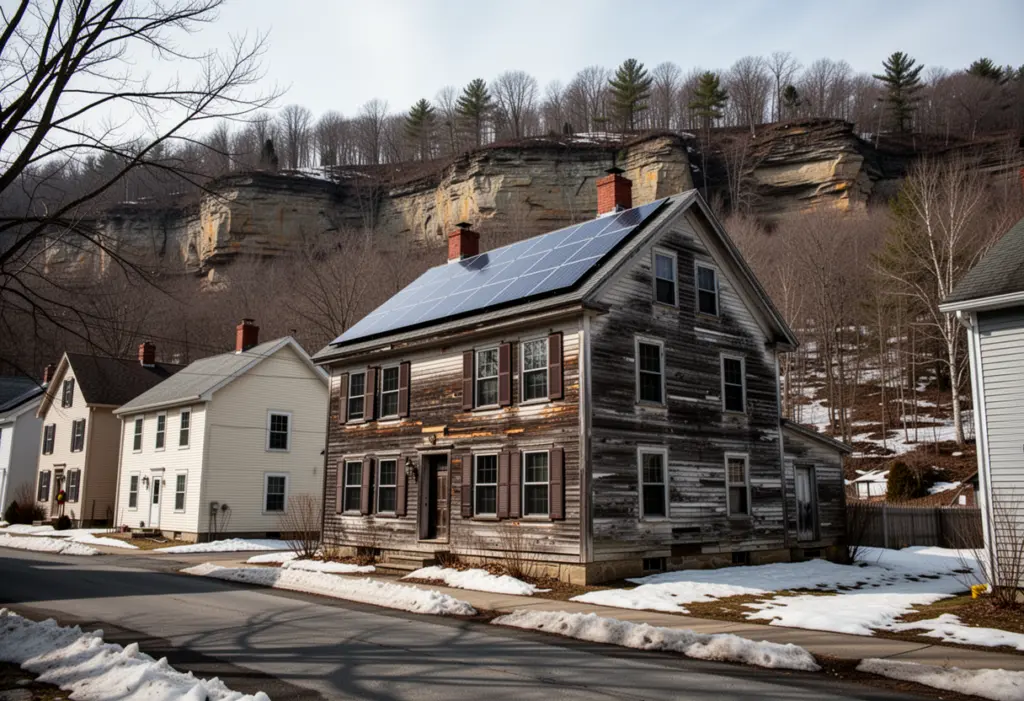
Fayetteville is a village in the Town of Manlius, Onondaga County, east of Syracuse. ZIP code 13066. Two facts decide the shape of a project here before any equipment is chosen: the village issues its own permits, and the ground climbs steeply just to the south.
The village permits its own
The Village of Fayetteville has its own building department, and it sits inside the Town of Manlius, which also contains the Villages of Manlius and Minoa. Four authorities operate in a small area, and which one holds your project is a matter of the parcel rather than the postal address. Get it identified in writing before a file is submitted. The same list of names returns at the end of the job, when the property tax exemption has to be checked at the village, the town, the county and the school district separately.
The escarpment to the south
Immediately south of the village the land rises onto the limestone escarpment that marks the northern edge of the Allegheny Plateau. For a house at the foot of it the southern horizon can be closed by terrain rather than vegetation, and terrain is not something a tree crew can fix. Three things to require of an estimate here:
- an on-site shading and horizon assessment rather than a satellite model, because when two installers disagree sharply on production for the same roof, one of them has usually not stood on the property;
- December and January figures given separately from the annual total, since those are the months when the sun sits lowest, the ridge reaches furthest and the credit bank is being spent down;
- a written statement of what the model assumes about tree removal, because felling mature trees is your decision, your cost and a permanent change to a property where those trees are often part of the value.
Older village housing, three questions
Roof covering. Slate and standing-seam metal both appear on these streets. Standing seam is the best case, since the racking clamps to the seams and puts no penetrations through the roof at all, and the covering commonly outlives the panels. Slate is workable by a crew that has done slate, so ask for photographs of theirs.
Structure and roof age. On asphalt, fewer than roughly ten years of shingle life left means re-roof first, because removing and reinstating an array costs considerably more than mounting on a bare deck. Older wood-frame roofs also draw a structural engineer’s letter more often than new construction, particularly given the snow load here.
Service capacity. 100 amp service is common in housing of this age, and a solar breaker may require a panel upgrade or a line-side tap. Ask what your service is and whether the busbar has room, and have it priced before contract. Design review may also apply on the older streets ahead of the building permit, in which case a rear plane, all-black flush-mounted modules and concealed conduit is the specification that gets approved.
Limestone Creek and the snow
Limestone Creek runs through the village, and low parcels beside it can sit in mapped flood plain, which pushes the inverter, the disconnects, the meter and any battery above a specified elevation and generally rules out the basement for storage. Ask whether yours is affected before a design exists. On snow the questions are what ground snow load the racking, attachments and structure are rated to, whether guards are needed where the array sheds over a door, walkway or driveway, and what snow-cover assumption the production estimate uses, since a downstate profile overstates a Fayetteville winter.
National Grid
Read your own bill to confirm the utility; most of this area is National Grid. The Customer Benefit Contribution is a monthly charge on DC system size for anyone interconnecting on or after 1 January 2022, set at $0.97 per kW-month for 2026, the lowest residential rate on the statewide table.
- 10 kW: $9.70 a month, about $116 a year.
- 14 kW: $13.58 a month, about $163 a year.
The bill follows nameplate capacity rather than kilowatt-hours, and the rate is set afresh each year. Alongside it, Phase One net metering values an exported unit at the full retail rate and locks that structure in for two decades from the day you interconnect.
2026 incentives, and the ten-year rule that catches leases
There is no federal residential credit to claim in 2026. Congress terminated section 25D for expenditures made after 31 December 2025, and the statute fixes the moment of the expenditure at completion of the original installation. A quote that still carries the 30% line was written against last year’s law and needs redoing.
Because the federal credit was the piece a third-party owner used to pass through, lease and power purchase offers deserve a closer reading here than they used to, and New York’s credit contains the rule that decides whether they qualify at all. The state’s 25% credit capped at $5,000 on Form IT-255 reaches a purchase, a lease of ten years or more, or a power purchase agreement of ten years or more. The ten-year minimum applies to the lease as well as the agreement, so a five- or seven-year lease brings no state credit whatsoever. On an arrangement running past fifteen years, no credit is allowed after the fifteenth year even if the $5,000 has not been used up, and for a lease or PPA the $5,000 is a lifetime ceiling for that agreement rather than an annual figure. The credit also requires a principal residence in New York and is limited by your actual state tax liability.
Beyond it: the state sales tax exemption (Onondaga County’s 4% local sales tax still applies, per the Tax Department’s Publication 718-S); and RPTL 487, a 15-year exemption on added value where the village, the town, Onondaga County and your school district have each not opted out, for construction before 1 January 2030, provided you file form RP-487 with each assessor by the taxable status date. NY-Sun and its Affordable Solar blocks, which your contractor used to apply to the price, are no longer open for homes. As of September 2026 NYSERDA has no open NY-Sun block for homes in any utility territory; check NYSERDA’s NY-Sun dashboard for a new one. Confirm current terms with NYSERDA and the state tax department before signing.
Frequently Asked Questions
Does the Village of Fayetteville issue its own solar permit?
Yes. It has its own building department and sits inside the Town of Manlius, which also contains the Villages of Manlius and Minoa. Establish which of the four authorities holds your parcel before anything is filed.
Why do production estimates vary so much in Fayetteville?
The escarpment south of the village can close the southern horizon with terrain rather than trees, and terrain cannot be trimmed. Insist on an on-site horizon assessment and ask for December and January separately from the annual total.
Does a solar lease qualify for the New York State credit here?
Only a lease of ten years or more, and the same ten-year minimum applies to a power purchase agreement. On an arrangement running past fifteen years no credit is allowed after the fifteenth year, and the $5,000 is a lifetime ceiling for that agreement.
What does National Grid charge a Fayetteville solar customer?
The Customer Benefit Contribution at $0.97 per kW-month of DC system size for 2026: $9.70 a month on 10 kW, about $116 a year, and $13.58 on 14 kW, about $163.
This article is general information, not tax, legal or financial advice. Incentive amounts, eligibility rules and deadlines change and depend on your utility, your tax situation and your property. Confirm current terms with NYSERDA, your utility and a qualified tax professional before making a decision.
NY Solar Incentives
Independent New York solar research. We summarise NYSERDA, NY-Sun and federal programme rules from published sources and state plainly when a figure is an estimate. We are not a government agency and do not sell equipment.
Run the arithmetic on your own system
Check the dated program table and your arrangement before counting an incentive. Standard residential NY-Sun blocks are closed; Long Island Affordable Solar has a conditional income-verification route. The NY credit depends on qualified costs and tax liability, while the NYC abatement reduces future property-tax bills. The estimator keeps those timings separate.