Solar Panel Installation in Camillus, NY
Camillus has two building departments, a creek running its whole length, and Lake Ontario snow. All three decide things a standard quote never mentions.
On this page 7 sections
- 01Two building departments, one mailing address
- 02Nine Mile Creek and the elevation the equipment has to reach
- 03Snow is a specification, not a season
- 04What National Grid charges on the size of the system
- 05Roof, service panel and the open half of the town
- 06What is left in 2026, and the one number that moves
- 07Frequently Asked Questions
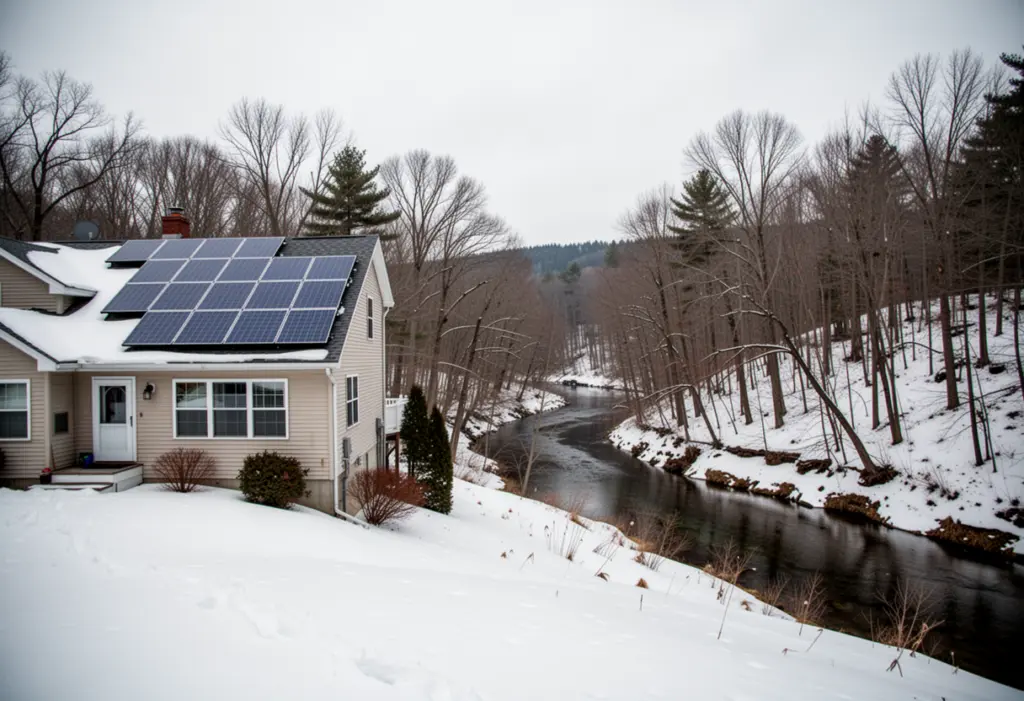
Camillus is a town and a village in Onondaga County, immediately west of Syracuse. ZIP code 13031. Three things about this address change a solar project, and a general New York guide raises none of them: two separate building departments, the low ground along Nine Mile Creek, and the snow that comes off Lake Ontario every winter.
Two building departments, one mailing address
The Town of Camillus and the Village of Camillus are separate authorities, each with its own building department, and the village sits inside the town. Nothing in a Camillus postal address tells you which of them holds your parcel.
Settle it before an installer files anything, and have the authority written into the proposal by name rather than agreed on the phone. A file lodged in the wrong queue costs weeks, not a phone call, and the fee schedules are not the same either.
Nine Mile Creek and the elevation the equipment has to reach
Is your parcel in a mapped flood zone? Along the low ground that follows Nine Mile Creek through the town the answer is often yes, and it decides something a quote rarely mentions: the height at which the inverter, the AC and DC disconnects, the production meter and any battery are permitted to sit. The convenient default position beside the meter may not be available at all, and a basement battery, which is the least costly and tidiest option almost everywhere else, is frequently ruled out here. Ask the town or the village what elevation applies to your address before a designer draws anything, because moving mounted equipment after an inspection costs several times what putting it in the right place would have.
Snow is a specification, not a season
Onondaga County sits downwind of Lake Ontario and collects lake-effect snow all winter. Three questions put that into the contract rather than into a later argument:
- What ground snow load are the racking, the attachments and the roof structure rated to carry? A structural engineer’s letter is needed here more often than downstate, and it belongs in the budget rather than in a change order.
- Where does the array shed? Glass releases snow as a slab, so guards above a door, a walkway or a driveway are a safety item rather than an upsell.
- What snow-cover assumption sits inside the production estimate? A model built on a downstate winter profile overstates what a Camillus roof returns.
Steepening a roof array so it clears itself faster is the wrong instinct. It raises wind load, complicates the mounting, and generally loses more annual production than the snow it sheds.
What National Grid charges on the size of the system
Most of Onondaga County is National Grid territory, though the name printed on your own bill is the only proof of that. Its Customer Benefit Contribution is a monthly charge on DC system size that applies to anyone interconnecting on or after 1 January 2022, and for 2026 it stands at $0.97 per kW-month, the lowest residential rate of the seven utilities on the statewide table.
- 8 kW: $7.76 a month, roughly $93 across a year.
- 12 kW: $11.64 a month, roughly $140 across a year.
The charge follows capacity rather than output, and it is reset each year rather than fixed at interconnection. Phase One net metering, which credits exported kilowatt-hours at the full retail rate and holds that structure for 20 years, is the arrangement most rooftop customers here are on.
Roof, service panel and the open half of the town
The roof gate is the usual one: under roughly ten years of shingle life left means re-roof first, since taking an array off and putting it back costs far more than mounting it on a bare deck. Older housing in the village and along the creek often runs 100 amp service, and fitting a solar breaker to it can mean a panel upgrade or a line-side tap, so ask what your service is and whether the busbar has room and get the answer priced before you sign. West of the village the parcels get large enough that a ground mount is a first choice rather than a consolation: tilt and orientation are chosen instead of inherited, roof age stops mattering, and clearing snow happens standing on the ground. Ask about setbacks, site plan review, frost-line foundation depth and the clearance under the lowest row.
What is left in 2026, and the one number that moves
The 30% federal residential credit is gone. Section 25D was terminated for expenditures made after 31 December 2025, and the statute treats an expenditure as made when the original installation is completed. A 2026 proposal carrying a 30% federal line is wrong at the bottom, and everything derived from it, payback and monthly comparison and finance schedule alike, is wrong with it.
The number that moved is NY-Sun. NYSERDA paid it through your contractor as a reduction in the quoted price, and the per-watt amount was structured in megawatt blocks that stepped down as each regional block filled, until the last standard upstate residential block (Block 14, $0.15/W, NYSEG, RG&E and National Grid territories) closed on 17 December 2025 and the upstate Affordable Solar block for lower-income households closed on 9 March 2026. As of September 2026 NYSERDA has no open NY-Sun block for homes in any utility territory; check NYSERDA’s NY-Sun dashboard for a new one. Treat a NY-Sun line or a per-watt number copied from an older proposal as out of date. What is left is the state’s 25% credit capped at $5,000 on Form IT-255 for a principal residence, the state sales tax exemption (Onondaga County’s 4% local sales tax still applies, per the Tax Department’s Publication 718-S), and RPTL 487, which exempts the added value for 15 years where the town or village, Onondaga County and your school district have each declined to opt out and where construction happens before 1 January 2030, provided you file form RP-487 with each assessor by the taxable status date.
Confirm all of it with NYSERDA and with the New York State Department of Taxation and Finance before signing. Programme terms move, and this page is a starting point rather than an authority.
Frequently Asked Questions
Who issues my solar permit in Camillus?
Either the Town of Camillus or the Village of Camillus. They are separate authorities with their own building departments and their own fee schedules, and the village sits inside the town. A postal address does not settle it, so have the correct authority named in writing on the proposal before anything is filed.
Does Nine Mile Creek affect where solar equipment goes?
On low parcels along it, yes. Mapped flood plain sets a minimum elevation for the inverter, the disconnects, the production meter and any battery, which usually takes the basement off the table for storage. Ask what elevation applies to your address before a design is drawn.
How should an array be specified for Onondaga County snow?
Ask for the ground snow load the racking, attachments and roof structure are rated to carry, and for snow guards wherever the array sheds over a door, walkway or driveway. Steepening the array to shed faster raises wind load and usually loses more annual production than it saves.
What does National Grid charge a Camillus solar customer in 2026?
The Customer Benefit Contribution, $0.97 per kW-month of DC system size, which is the lowest residential rate in New York. That is $7.76 a month on 8 kW, about $93 a year, and $11.64 on 12 kW, about $140. Confirm your utility from your own bill.
This article is general information, not tax, legal or financial advice. Incentive amounts, eligibility rules and deadlines change and depend on your utility, your tax situation and your property. Confirm current terms with NYSERDA, your utility and a qualified tax professional before making a decision.
NY Solar Incentives
Independent New York solar research. We summarise NYSERDA, NY-Sun and federal programme rules from published sources and state plainly when a figure is an estimate. We are not a government agency and do not sell equipment.
Run the arithmetic on your own system
Check the dated program table and your arrangement before counting an incentive. Standard residential NY-Sun blocks are closed; Long Island Affordable Solar has a conditional income-verification route. The NY credit depends on qualified costs and tax liability, while the NYC abatement reduces future property-tax bills. The estimator keeps those timings separate.