Solar Panel Installation in Gloversville, NY
Gloversville has dense older housing, a lot of two-family properties, and an income-based incentive that most quotes never mention. Raising it yourself is the single highest-value question here.
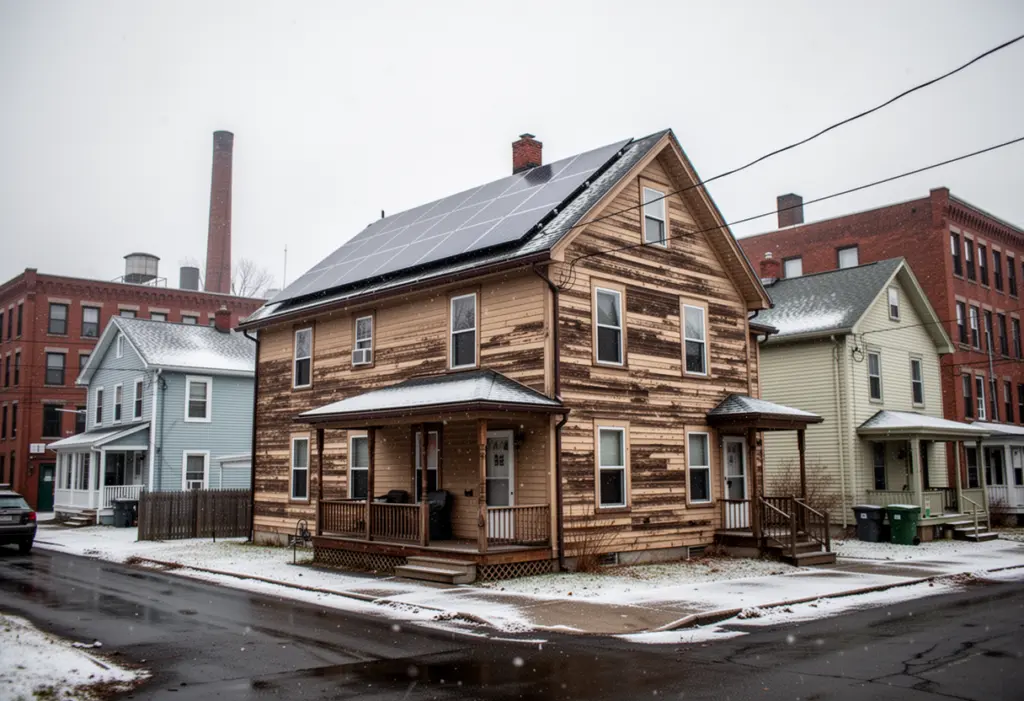
Gloversville is a city in Fulton County, in the foothills below the southern Adirondacks. ZIP code 12078. Its housing is older and more closely built than the county average, a substantial share of it is two-family or rented, and both facts change what a sensible approach to solar looks like here.
The question to ask on the first phone call
There was an income test attached to NY-Sun, and in this city it used to be the first thing worth asking about. NYSERDA’s Affordable Solar block paid a higher per-watt incentive to lower-income households, and it was delivered as a reduction on the contractor’s price rather than on a tax form. It has closed, and so has the rest of NY-Sun for homes.
- It no longer comes off the price. The upstate Affordable Solar block paid $0.80 per watt from 18 December 2025 to 9 March 2026; the regular upstate residential block had closed on 17 December 2025. As of September 2026 NYSERDA has no open NY-Sun block for homes in any utility territory; check NYSERDA’s NY-Sun dashboard for a new one.
- A quote that still shows it needs a question. A 2026 proposal with an Affordable Solar or NY-Sun reduction should name the open block it relies on — and where the person paying the bill does not own the roof, community solar (below) is the arrangement that reaches them.
Now that nothing federal remains and no NY-Sun block is open, ask for the dollar value of each incentive that is left on your own system, and ask to see those figures written on the paperwork rather than described to you across a table.
On a two-family, the meter comes before the roof
A system reduces the consumption recorded by the meter it is wired behind, and nothing else. An array on the owner’s meter offsets hallways, a shared boiler and common areas; a tenant’s apartment directly beneath the panels bills unchanged. Where the tenants hold the meters, the roof array does nothing for their electricity costs. Splitting production between two meters is not a small change of wiring, so ask what it would involve on your particular building before you plan around it — and where the person paying the bill is not the person who owns the roof, community solar is the arrangement that actually reaches them, with no roof, no up-front cost and no Customer Benefit Contribution for subscribers.
Older, closely built housing
Roof covering. Slate and standing-seam metal both appear on housing of this age. Slate wants an installer equipped for it, so ask for photographs of their work on it. Standing seam is the best case available anywhere: the racking clamps to the seams, nothing penetrates the covering, and the roof usually outlasts the panels.
Roof life on asphalt. Anything with less than about a decade of shingle left should be renewed before the array goes up. Detaching a finished system and setting it back afterwards buys you nothing and costs a great deal.
Structure. Older wood frame in a place that takes real snow draws a structural engineer’s letter more often than newer construction. Budget it rather than discovering it after contract.
Service panel. A great deal of the housing here is still on a 100 amp supply, and a solar breaker may not fit the busbar without an upgrade or a line-side tap. It is the single most frequent cost surprise on older housing in this region, and it is entirely predictable at survey stage. Have the supply size and the spare busbar capacity written into the quote.
Roof area. On close-set streets a neighbour’s roofline can shade yours at the low December sun angle, and on a modest roof the required fire-access pathways and setbacks take a proportionally larger bite out of the usable plane. Ask what is limiting your system size — if the answer is roof area rather than your consumption, that changes how the price should be read.
The Adirondack Park boundary
The Adirondack Park boundary crosses Fulton County north of the city. If your property lies inside it, ask whether Adirondack Park Agency jurisdiction attaches to your project alongside the municipal permit, and ask at the first conversation. A review discovered after signature is a schedule problem rather than a design one.
National Grid, after you have checked
None of the numbers below apply until you have checked that National Grid really is your supplier. New York holds a scattering of village-owned electric systems and this end of the state has more than its share of them: two in Oneida County, three in Herkimer. A customer of one of those falls outside Public Service Commission jurisdiction altogether, which means the village writes its own export credit, its own interconnection rules and its own charges, and the only way to learn them is to ask it.
On a National Grid account the Customer Benefit Contribution reaches systems interconnected on or after 1 January 2022 and is charged on DC capacity at the 2026 residential rate of $0.97 per kW-month, the lowest in the state. A 4.5 kW system, which is the sort of size a shaded city roof supports, works out at $4.37 a month, about $52 a year; 6.5 kW comes to $6.31 a month, about $76. It follows capacity rather than production and is recalculated annually, and Phase One net metering credits exports at the full retail rate for 20 years from interconnection. Where roof area caps the system, the charge stays small in absolute terms.
What 2026 leaves, in the order that matters here
The income-tested help used to come first, because it was the part that did not depend on a tax bill. Affordable Solar and NY-Sun were both applied by your contractor as a price reduction, but as of September 2026 NYSERDA has no open NY-Sun block for homes in any utility territory; check NYSERDA’s NY-Sun dashboard for a new one.
That leaves New York’s 25% credit capped at $5,000 on Form IT-255, for a principal residence in the state, reaching purchases as well as leases and power purchase agreements of at least ten years. It is limited by your actual state tax liability, which is a real constraint on a lower income — the credit is not refundable, although unused amounts carry forward for up to five years. Then the state sales tax exemption on residential solar equipment, and RPTL 487, a 15-year exemption on added property value where the city, Fulton County and your school district have each declined to opt out, for systems constructed before 1 January 2030, claimed by filing form RP-487 with the assessor by the taxable status date.
For a household buying a system in 2026 the federal credit is worth nothing at all. Section 25D was terminated for expenditures made after 31 December 2025, and the date that counts is the day the original installation was finished, not the day the meter was changed. On a small system that loss is proportionally large, which is exactly why the state credit and RPTL 487 deserve the attention here. Incentives change on their own schedule, so ask NYSERDA what is open now and read the Department of Taxation and Finance page on the state credit before you agree to anything.
Frequently Asked Questions
What help exists for a lower-income household here?
NY-Sun's income-tested Affordable Solar block closed on 9 March 2026. As of September 2026 NYSERDA has no open NY-Sun block for homes in any utility territory; check NYSERDA’s NY-Sun dashboard for a new one. Community solar needs no roof and no money up front, and the state credit, the state sales tax exemption and, where no local body has opted out, RPTL 487 still apply to a home you own and live in.
Does solar on a two-family house help the tenant?
Only where the array is wired behind the tenant's meter. Otherwise it offsets the owner's hallways, boiler and common areas. Community solar credits whoever holds the account, needs no roof and no money up front, and carries no Customer Benefit Contribution.
Will an older Gloversville house need electrical work?
Frequently, yes. Much of the housing here still runs on a 100 amp panel, and there may be no room on the busbar for a solar breaker without an upgrade or a line-side tap. Have that established and priced during quoting rather than discovered on installation day.
Does the Adirondack Park affect a project in Gloversville?
Only where the parcel lies inside the boundary, which crosses Fulton County north of the city. If yours does, ask at the first conversation whether Adirondack Park Agency jurisdiction attaches alongside the municipal permit, because it is a scheduling question.
This article is general information, not tax, legal or financial advice. Incentive amounts, eligibility rules and deadlines change and depend on your utility, your tax situation and your property. Confirm current terms with NYSERDA, your utility and a qualified tax professional before making a decision.
NY Solar Incentives
Independent New York solar research. We summarise NYSERDA, NY-Sun and federal programme rules from published sources and state plainly when a figure is an estimate. We are not a government agency and do not sell equipment.
Run the arithmetic on your own system
Check the dated program table and your arrangement before counting an incentive. Standard residential NY-Sun blocks are closed; Long Island Affordable Solar has a conditional income-verification route. The NY credit depends on qualified costs and tax liability, while the NYC abatement reduces future property-tax bills. The estimator keeps those timings separate.