Solar Panel Installation in Ilion, NY
Ilion runs its own municipal electric utility, and so do the villages either side of it. A proposal written from a New York State template will be wrong in three specific places.
On this page 7 sections
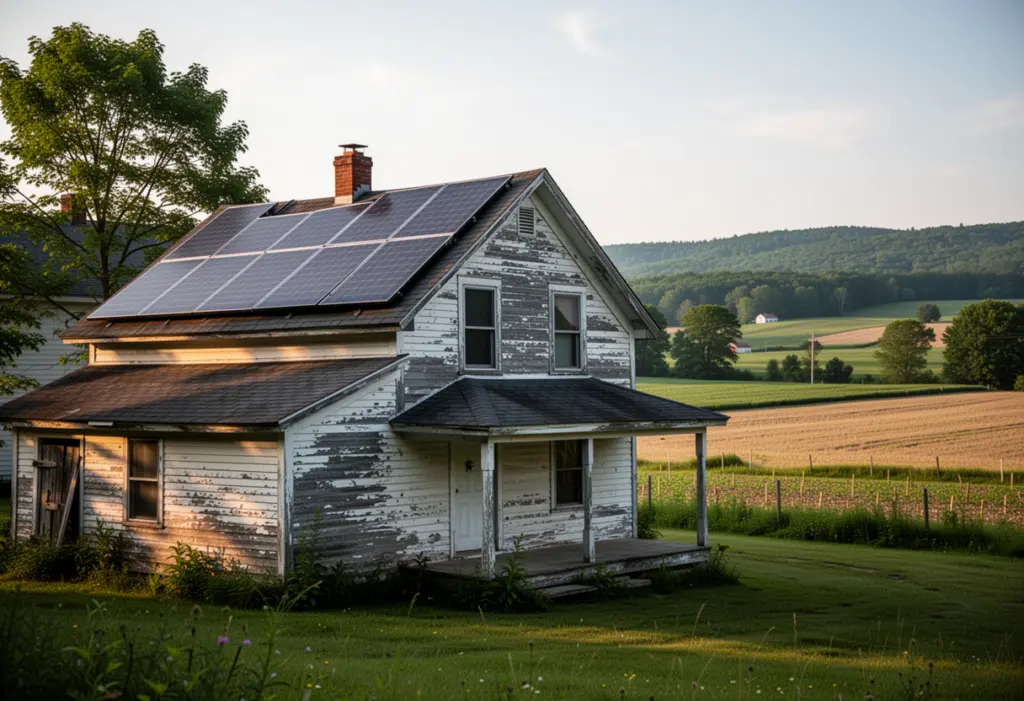
Ilion is a village in Herkimer County, on the south bank of the Mohawk River inside the Town of German Flatts. ZIP code 13357. Like the villages either side of it, Ilion runs its own municipal electric utility, and that fact changes how a solar proposal should be read here more than anything about your roof does.
Three municipal villages in a row
Ilion, Mohawk and Frankfort are all municipal — three adjoining villages, one after another. Herkimer, directly across the river, is not: it is National Grid territory, and that is precisely the trap. Sherrill and Boonville are municipal further west in Oneida County. Municipal electric systems are uncommon across New York as a whole, and an unusual share of the state’s total sits within a few miles of this village.
Which is why the standing instruction on this site — take the supplier name from your own bill — is doing real work in Ilion rather than repeating a caution. Service territory and municipal boundaries are different lines, and a neighbour two streets away may be on an entirely different arrangement.
How to read a proposal written for a state utility
Municipal electric utilities are outside Public Service Commission jurisdiction. A quote produced from a New York State template therefore contains three claims nobody checked against the utility that actually serves you. Go through the document looking for each.
- A net metering line. Phase One net metering — full retail rate for exports, held for 20 years from interconnection — is a PSC rule. On a village account, whether exports are credited at all, at what value and for how long is the village’s decision. If the savings model in your quote assumes retail-rate export credit, ask what that assumption is based on.
- A Customer Benefit Contribution line. That monthly charge on DC capacity applies to the investor-owned utilities. On a municipal account it is not a cost, and its presence tells you the document describes a different customer.
- An interconnection timeline. The standardised state process does not apply. The application, the fee, the timeline, any size cap, the metering and any insurance requirement are the village’s own — and they are the items most likely to move your schedule.
Put all three to the village electric department in writing before you sign, and ask the installer how many village-account systems they have interconnected here. That number is more informative than a general count of installations.
If the bill turns out to say National Grid
Then the Customer Benefit Contribution does apply, to systems interconnected on or after 1 January 2022, on DC capacity, at the 2026 residential rate of $0.97 per kW-month — the lowest residential rate in New York. A 5.5 kW system is $5.34 a month, about $64 a year; an 8.5 kW system is $8.25 a month, about $99. Capacity is billed rather than production, and the rate is recalculated annually rather than fixed at interconnection.
Permits, the creek and the low ground
The Village of Ilion and the Town of German Flatts run separate building departments, and that is a different question from who supplies your electricity. Establish which one covers your address before anything is filed.
Ilion occupies low ground where Steele Creek comes down to the Mohawk, and mapped flood plain applies to parts of it. Where it does, the constraint is on the electrical equipment rather than the array: the inverter, both disconnects, the production meter and any battery normally have to clear a specified elevation, which frequently removes the basement as a battery location even though it is the most convenient spot. Ask the building department what applies to your parcel before a design is drawn, since moving equipment after inspection is expensive.
Old roofs, and the land beyond the village
Three things about a nineteenth century village house decide whether an array is straightforward or awkward, and none of them is the roof pitch. The first is how much shingle is left: below about a decade, renew the covering before anything is fixed to it. The second is what an engineer will say about the frame carrying a loaded array through a Mohawk Valley February, since a letter is needed here more often than in newer construction. The third is the panel in the basement — 100 amps is normal on these streets, and a solar breaker often has nowhere to go without an upgrade or a line-side tap.
Slate and standing-seam metal both appear on older housing here. Slate needs an installer equipped for it; standing seam is the best case, since the racking clamps to the seams without penetrating the roof covering.
Out in German Flatts the lots open up and a ground array stops being a consolation prize. Nothing on the ground depends on the age or the pitch of your roof, the modules can face where the sun actually is, and a February clearing job is done from the lawn instead of from a ladder. What you buy in exchange is site work: a trench back to the service, footings taken below the frost line, a site plan review with setbacks attached, and enough height under the bottom row that a drift does not swallow it until March.
2026: NY-Sun has no open block for homes
NY-Sun used to be the incentive whose value you could not look up and then assume. It was paid through the contractor as a reduction on the price rather than claimed by you, the amount depended on system size and on region, and it was structured in megawatt blocks whose per-watt value stepped down as each one filled, because the programme was designed to phase out as the market matured. For homes it has now phased out. As of September 2026 NYSERDA has no open NY-Sun block for homes in any utility territory; check NYSERDA’s NY-Sun dashboard for a new one. The last standard upstate residential block (Block 14, $0.15/W, NYSEG, RG&E and National Grid territories) closed on 17 December 2025, and the upstate Affordable Solar block for income-qualified households closed on 9 March 2026. So if a proposal for your house still carries a NY-Sun or Affordable Solar line, ask the contractor which open block it comes from; and if a block does reopen, ask NYSERDA directly whether it reaches a village account.
The tax and property measures do not care who bills you for electricity:
- Form IT-255. A quarter of qualified expenditure, ceiling $5,000, at the home you actually live in — a seasonal, second or rental property does not qualify. Purchases count, and so do leases and power purchase agreements of at least ten years. It is usable only against New York tax you genuinely owe, with five years of carry-forward behind it.
- Sales tax. Residential solar energy systems equipment is exempt from the state levy, and a locality may elect separately on its own share.
- RPTL 487. Fifteen years of exemption on the value the system adds, provided the village, the Town of German Flatts, Herkimer County and your school district have each declined to opt out, and provided the system is constructed before 1 January 2030.
And the 30% federal residential credit is gone everywhere, on every utility. Section 25D closed to expenditures made after 31 December 2025, measured by when the original installation was completed rather than when the village switched you on. The state programmes change and so can a village tariff, so check both — NYSERDA and the Department of Taxation and Finance for the first, your electric department for the second — before you sign.
Frequently Asked Questions
Does the Customer Benefit Contribution apply in Ilion?
Not on a village municipal account, since the charge falls on customers of the investor-owned utilities. If your bill names National Grid instead, it applies at $0.97 per kW-month for 2026, about $64 a year on a 5.5 kW system.
What should I look for in a quote written for a state utility?
Three lines: any retail-rate net metering assumption, any Customer Benefit Contribution charge, and the interconnection timeline. All three come from Public Service Commission rules that do not reach a municipal utility, so each needs confirming with the village.
How do I find out what NY-Sun is worth on my system?
Nothing on a home at present. As of September 2026 NYSERDA has no open NY-Sun block for homes in any utility territory; check NYSERDA's NY-Sun dashboard for a new one. While residential blocks were open, the incentive was paid through the contractor as a price reduction, depended on system size and region, and stepped down per watt as each megawatt block filled.
Is a ground mount practical around Ilion?
Rarely inside the village. Out in German Flatts there is open land, and a ground array lets tilt and orientation be chosen, removes the roof-age question and puts snow clearing at standing height. Ask about setbacks, frost-line foundations and clearance under the lowest row.
This article is general information, not tax, legal or financial advice. Incentive amounts, eligibility rules and deadlines change and depend on your utility, your tax situation and your property. Confirm current terms with NYSERDA, your utility and a qualified tax professional before making a decision.
NY Solar Incentives
Independent New York solar research. We summarise NYSERDA, NY-Sun and federal programme rules from published sources and state plainly when a figure is an estimate. We are not a government agency and do not sell equipment.
Run the arithmetic on your own system
Check the dated program table and your arrangement before counting an incentive. Standard residential NY-Sun blocks are closed; Long Island Affordable Solar has a conditional income-verification route. The NY credit depends on qualified costs and tax liability, while the NYC abatement reduces future property-tax bills. The estimator keeps those timings separate.