What Solar Panels Cost in Yonkers, New York
Yonkers is a city and it is not New York City, and both facts change a solar quote here: who permits it, which property tax checks apply, and which abatement does not.
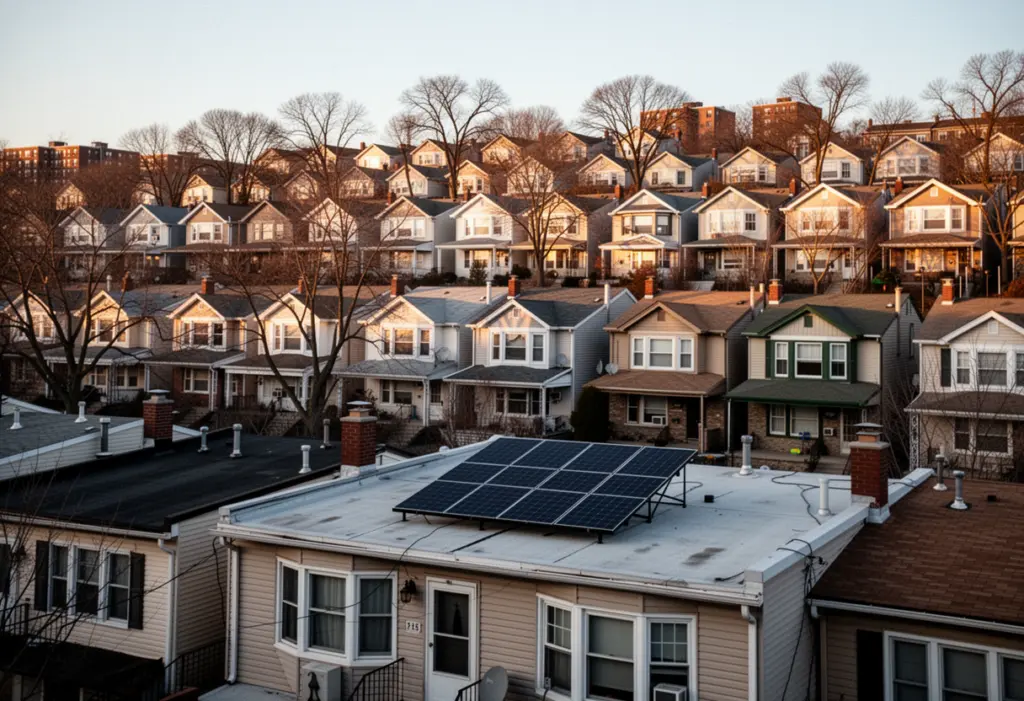
Yonkers is a city rather than a town or a village, and it is not New York City. Both facts change a solar quote. The permit comes from the city, the New York City solar property tax abatement does not reach here, and the school district check that complicates the property tax exemption almost everywhere else in the state does not apply in Yonkers at all.
Two opt-out checks instead of three
RPTL 487 exempts the added assessed value of a solar system for fifteen years, and municipalities, counties and school districts each hold a separate right to opt out of it. Yonkers is one of the five city school districts that are fiscally dependent — along with New York City, Buffalo, Rochester and Syracuse — and it levies no separate school property tax. There is therefore no school resolution to check here. The questions are whether the City of Yonkers and Westchester County have opted out, which is two answers from the assessor rather than three, and the system has to be constructed before 1 January 2030.
The separate abatement filed on form PTA4 with the Department of Buildings is a New York City programme taken over a four-year compliance period. It is not available in Yonkers, and a proposal that mentions it for a Yonkers address is describing the wrong jurisdiction.
Which meter, and which roof
A great deal of the housing here is two-family, three-family or rented, and an array only offsets the meter it is connected to. On a multi-family building the owner has to decide which account the system serves before the interconnection application goes in, because the output cannot be divided across meters afterwards. A tenant cannot install at all. For renters and apartment residents the arrangement that works is community solar — no roof, no permit, no capital, and no Customer Benefit Contribution either, since that charge falls on systems behind your own meter rather than on community projects.
Con Edison numbers for a Yonkers roof
Con Edison serves the city. Its residential Customer Benefit Contribution for 2026 is $1.29 per kW-month of DC size, so a 5 kW array — realistic on a city lot with limited southern roof — is charged 5 × $1.29 = $6.45 a month, about $77 a year, on capacity rather than on production. It applies to systems interconnected on or after 1 January 2022, and the rates are recalculated each year rather than locked in at the point of connection. Confirm the supplier from your own bill rather than assuming it from the address.
City conditions that show up in the price
- Small roofs, fixed costs. Permit, interconnection, inspection and crew mobilisation cost much the same on a 4 kW job as on a 10 kW one, so the price per watt rises as the array shrinks. It is arithmetic rather than a markup, and it is worth understanding before setting a city quote beside a suburban one.
- Hills and neighbours. The city is steep and densely built, and winter shadows from the building next door run far longer than summer ones. Ask for shading by month.
- Older service equipment. A 100 amp service is common across the 10701, 10703 and 10705 areas, and an upgrade may be required before anything else can proceed.
- Flat roofs. Ballasted mounting on a low-slope roof is a different design and a different price from a pitched asphalt roof, and roof condition matters more because the array is harder to work around later.
The incentive position in 2026
There is no federal residential credit for a buyer. Section 25D was terminated for expenditures made after 31 December 2025, with the expenditure treated as made when the original installation is completed, so a purchase this year earns nothing on a federal return regardless of when permission to operate arrives.
The state credit on Form IT-255 remains at 25% of qualifying cost with a five thousand dollar ceiling, limited by your New York State tax liability and carried forward up to five years. It requires a principal residence, so a two-family where the owner lives in one unit is a different question from a building held purely as an investment, and it is a question for a tax preparer rather than for a salesperson. NY-Sun, including its income-qualified Affordable Solar blocks, used to be applied by the contractor as a visible line on the price, but as of September 2026 NYSERDA has no open NY-Sun block for homes in any utility territory; check NYSERDA’s NY-Sun dashboard for a new one. The sales tax exemption covers residential equipment and its installation for the 4% state tax and the MCTD tax, but the City of Yonkers does not provide the local exemption: Publication 718-S lists it at a 3% local rate on residential solar equipment.
Ask the city whether it uses the New York State Unified Solar Permit for systems of 25 kW DC and under, which covers systems of that size outside the five boroughs. Then confirm everything above before signing, because each of these programmes moves and the version a neighbour describes may already be out of date.
Frequently Asked Questions
Does the New York City solar tax abatement apply in Yonkers?
No. The abatement filed on form PTA4 with the Department of Buildings is a New York City programme. A Yonkers system uses the RPTL 487 exemption on added assessed value instead, subject to the city and county opt-out checks.
Do I need to check my school district for the property tax exemption?
Not in Yonkers. Its school district is one of the five fiscally dependent city districts and levies no separate school property tax, so the checks are the City of Yonkers and Westchester County only.
What does Con Edison charge monthly for solar in Yonkers?
The 2026 residential Customer Benefit Contribution is $1.29 per kW-month of DC size. A 5 kW array pays $6.45 a month, about $77 a year, and the charge applies to systems interconnected on or after 1 January 2022.
Why is the price per watt higher on a small city roof?
Because permit, interconnection, inspection and crew mobilisation cost roughly the same whatever the size, so those fixed costs are spread across fewer watts. That is arithmetic rather than a markup on a small job.
This article is general information, not tax, legal or financial advice. Incentive amounts, eligibility rules and deadlines change and depend on your utility, your tax situation and your property. Confirm current terms with NYSERDA, your utility and a qualified tax professional before making a decision.
NY Solar Incentives
Independent New York solar research. We summarise NYSERDA, NY-Sun and federal programme rules from published sources and state plainly when a figure is an estimate. We are not a government agency and do not sell equipment.
Run the arithmetic on your own system
Check the dated program table and your arrangement before counting an incentive. Standard residential NY-Sun blocks are closed; Long Island Affordable Solar has a conditional income-verification route. The NY credit depends on qualified costs and tax liability, while the NYC abatement reduces future property-tax bills. The estimator keeps those timings separate.