Solar Panel Installation in Catskill, NY
Catskill sits where its creek meets the Hudson, with the mountain escarpment behind it. Low ground and a short afternoon are the two things a standard quote will not mention.
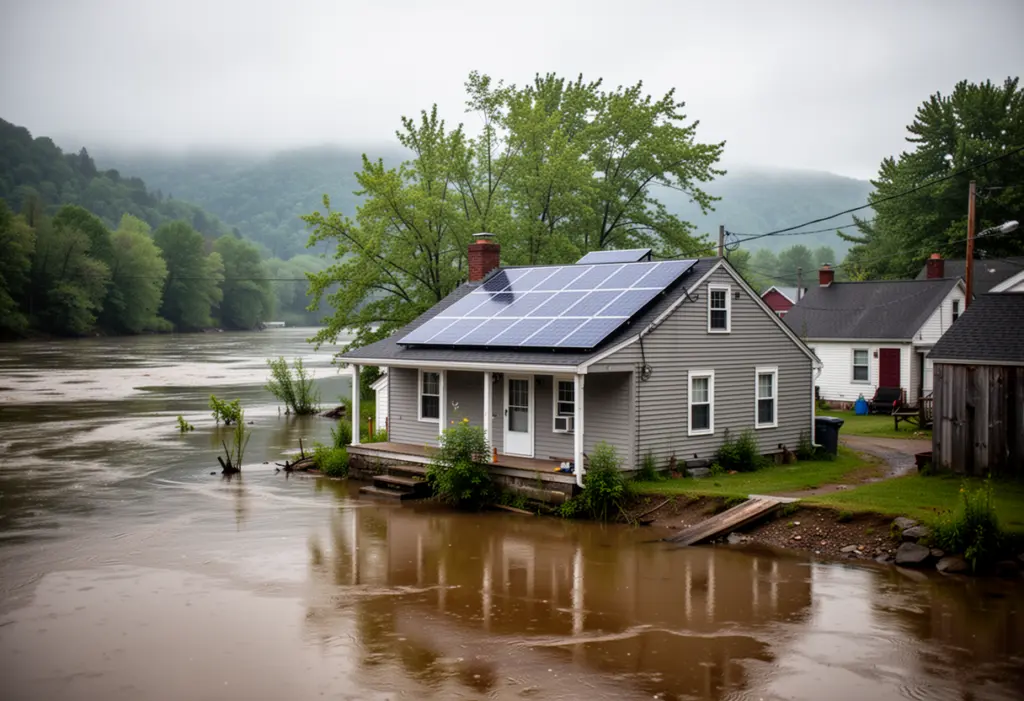
Catskill is a village inside the Town of Catskill and the seat of Greene County, on the west bank of the Hudson River where Catskill Creek runs into it. ZIP code 12414. Two local conditions here decide a solar design, and neither appears in general New York guidance.
Low ground decides where the equipment goes
The village sits on the river and the creek, and the low-lying parcels along both are in mapped flood plain. Where that applies it does not usually stop a project, but it moves things:
- The inverter, the AC and DC disconnects, the production meter and any battery normally have to sit above a specified elevation. That can mean a different wall, a greater height, or an interior location rather than the default position beside the meter.
- A basement battery is frequently the wrong answer on these parcels even where it is much the cheapest place to put one.
- The design has to be right the first time. Moving equipment after an inspection is expensive and slow.
Ask directly whether your parcel is in a mapped zone and what the town requires, before a design is drawn rather than after. An installer who has not worked along the creek may not raise it at all.
The escarpment takes the end of the afternoon
The Catskill escarpment rises steeply a few miles to the west, and high ground on the western side removes the end of the solar day rather than casting a moving shadow across it. It costs least in June and most in December, which is exactly the month the net metering credit bank is being drawn down.
So ask what the production model says about December and January rather than accepting an annual total, and insist on an on-site horizon assessment rather than a satellite estimate. Where two quotes for one roof disagree sharply on output, the usual reason is that one installer never came to the property.
Village or town, and the older streets
Two authorities share this name and they are not interchangeable. The Village of Catskill sits inside the Town of Catskill, each runs its own building department, and only one of them is yours. Find out which before a permit application is drafted.
The older village streets carry real nineteenth century character, and where architectural review applies it comes ahead of the building permit and can restrict street-visible placement. Design for approval rather than arguing after refusal: a rear or secondary roof plane, all-black modules with black frames, flush mounting following the pitch, and concealed conduit.
Older roofs and older panels
Village roofs run to slate and to standing-seam metal. Seamed metal is the best surface in Greene County by a distance: racking clamps onto the seams, nothing penetrates the covering, and such roofs regularly outlive the array bolted to them. Slate is skilled work, and photographs of finished penetrations are the only useful evidence that an installer has done it.
Asphalt sets its own deadline: with under about a decade of shingle remaining, re-roofing comes first, since a later removal and refit costs far more than a single mounting onto a fresh surface. On the electrical side, 100 amp service runs right through the older housing here, and where the busbar will not take a solar breaker the upgrade or the line-side tap belongs in the contract price rather than in a later conversation.
Central Hudson has the highest solar charge in the state
A worked example is easier than a rate table. Take an 8 kW array interconnected today, which is a common size on this housing. The Customer Benefit Contribution falls on any system connected on or after 1 January 2022 and is calculated from DC capacity rather than from production, so at Central Hudson’s 2026 residential rate of $1.67 per kW-month — the highest residential rate of any utility in New York — that array costs $13.36 a month, about $160 a year, in a wet summer as much as a dry one. On the neighbouring National Grid territory at $0.97 the identical array would cost $7.76 a month, about $93 a year, and on NYSEG at $1.19, $9.52 a month or about $114. The rate is reset annually rather than locked at interconnection.
Read the utility name printed on your own bill instead of assuming from the county, and note the exception that swallows this whole page: a household on a municipal electric system sits outside Public Service Commission jurisdiction altogether, so state net metering, this charge and the standardised interconnection process are replaced by whatever that utility sets for itself. Interconnect under Central Hudson and you take Phase One net metering with it, exports valued at the full retail rate and that structure held for two decades.
2026 incentives
A 2026 buyer earns no federal credit at all. Section 25D was terminated for expenditures made after 31 December 2025, an expenditure being fixed at the point the original installation is completed rather than at energisation. Read any proposal for that line before you read anything else on it.
The incentive most often assumed rather than checked in a place shaped like this one is RPTL 487, the 15-year exemption on the value the system adds to your assessment. It is not a state-wide guarantee. Four bodies can each decide independently to opt out, and on a village parcel here every one of them taxes you:
- The Village of Catskill, by local law.
- The Town of Catskill, by local law.
- Greene County, by local law.
- Your school district, by resolution.
A yes from the town tells you nothing about the district. Collect each answer from the assessing authority in writing before treating the exemption as yours, and remember that section 487 reaches only systems constructed before 1 January 2030. What else is on the table: 25% of qualified expenditure on Form IT-255 to a ceiling of $5,000, at a principal residence, on a purchase or a ten-year-plus lease or power purchase agreement, bounded by the state tax you owe; and the state sales tax exemption. Check the current terms of each before signing. What is not: NY-Sun, the per-watt incentive that used to come off the price through the contractor, and its Affordable Solar incentive at or below 80% of area median income. As of September 2026 NYSERDA has no open NY-Sun block for homes in any utility territory; check NYSERDA’s NY-Sun dashboard for a new one.
Frequently Asked Questions
Does the flood plain affect a solar install in Catskill?
On low parcels along Catskill Creek and the Hudson, yes. The inverter, disconnects, meter and any battery usually have to sit above a specified elevation, so a basement battery is frequently the wrong answer even where it is the cheapest place to put one.
Do the mountains west of the village cut production?
They shorten the afternoon rather than shading the roof, and the cost is concentrated in December when credits are being drawn down. Ask for an on-site horizon assessment and for December and January figures rather than only the annual total.
How many authorities can opt out of the property tax exemption here?
Four, each deciding independently: the Village of Catskill and the Town of Catskill by local law, Greene County by local law, and your school district by resolution. A yes from one proves nothing about the others, so get each answer in writing.
What does Central Hudson charge a Catskill solar customer?
The Customer Benefit Contribution at $1.67 per kW-month of DC system size for 2026, the highest residential rate in New York, so about $160 a year on an 8 kW array. The same array would cost about $93 on National Grid or $114 on NYSEG, so confirm from your bill.
This article is general information, not tax, legal or financial advice. Incentive amounts, eligibility rules and deadlines change and depend on your utility, your tax situation and your property. Confirm current terms with NYSERDA, your utility and a qualified tax professional before making a decision.
NY Solar Incentives
Independent New York solar research. We summarise NYSERDA, NY-Sun and federal programme rules from published sources and state plainly when a figure is an estimate. We are not a government agency and do not sell equipment.
Run the arithmetic on your own system
Check the dated program table and your arrangement before counting an incentive. Standard residential NY-Sun blocks are closed; Long Island Affordable Solar has a conditional income-verification route. The NY credit depends on qualified costs and tax liability, while the NYC abatement reduces future property-tax bills. The estimator keeps those timings separate.