Solar Panel Cost in Wappingers Falls, NY
Wappingers Falls is a compact mill village on the creek. Roof area and service capacity, not sunlight, are usually what set the price of a system here.
On this page 9 sections
- 01Roof area usually sets the size, not your consumption
- 02The service panel is the common cost surprise
- 03Which authority issues the permit
- 04The creek
- 05The charge that keeps running after the install is paid for
- 06What the state credit is actually worth
- 07When community solar is the cheaper answer
- 082026 incentives: what is left for a home
- 09Frequently Asked Questions
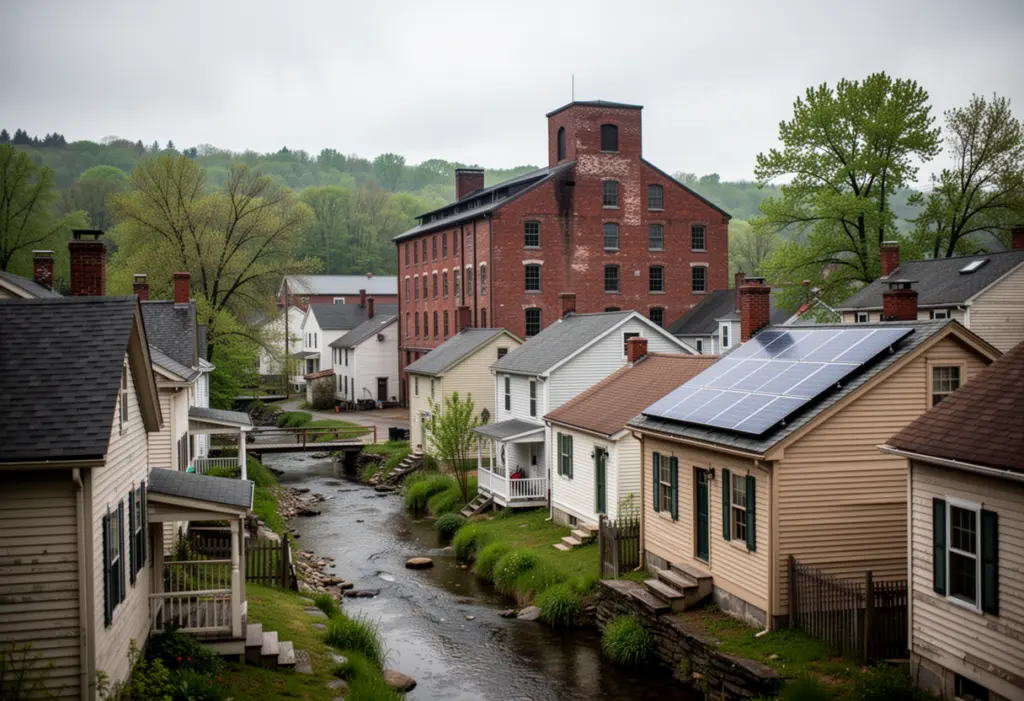
Wappingers Falls is a village on Wappinger Creek in southern Dutchess County, built around the falls that powered its mills. ZIP code 12590. It is compact, densely built and older than most of the county around it, and every one of those facts shows up in a quote.
Roof area usually sets the size, not your consumption
Village lots here are small and the houses sit close together. Three cost consequences follow:
- Fire-access clearances take proportionally more of a small roof. Code requires pathways and setbacks around an array, and on a modest roof plane those consume a larger share of what is available.
- Dormers, vents and chimneys cost more here. On a large roof an obstruction is worked around; on a small one it removes a meaningful fraction of the capacity.
- A neighbour’s roofline can shade yours at the low December sun angle, simply because the buildings are close.
Ask directly what is limiting the proposed system size and how much capacity went to clearances. If the answer is roof area rather than your consumption, that changes how you should read the price per watt.
The service panel is the common cost surprise
Ask what your service is rated at before you compare anything else. A 100 amp panel is normal in housing of this age, and where the busbar has no room left, adding a solar breaker means an upgrade or a line-side tap. That is a legitimate cost rather than padding, but it belongs on the quote you sign and not in a variation afterwards.
Roof age decides the sequence. Under about ten years of shingle life remaining, the covering goes first — an array removed and refitted later is paid for twice. Where a house carries slate or standing-seam metal, ask what the installer has done on that roof type; standing seam is the best case, since racking clamps to the seams with no penetrations at all.
Which authority issues the permit
The Village of Wappingers Falls is its own authority, and the village sits at the boundary between the Town of Wappinger and the Town of Poughkeepsie. An address a few streets outside the village line is a town matter, not a village one. Establish which department covers your parcel before an installer files anything, and confirm it against your tax bill.
The older streets carry historic character, and where architectural review applies it comes before the building permit. What clears review is consistent: keep the array off any plane the street can see, choose black frames over silver, follow the pitch instead of tilting, and hide the conduit.
The creek
Properties on low ground near Wappinger Creek can sit in mapped flood plain, which decides where the inverter, the disconnects, the meter and any battery may be mounted — usually above a specified elevation. That is worth settling before a design is drawn rather than after an inspection.
The charge that keeps running after the install is paid for
There is a second, much smaller bill that keeps arriving for the life of the system. Every array interconnected since 1 January 2022 pays a Customer Benefit Contribution worked out from its DC capacity, and Central Hudson’s 2026 residential figure — $1.67 a kilowatt, every month — is the steepest of the seven NYSERDA publishes. On the sizes a village roof supports:
- A 4 kW system: $6.68 a month, about $80 a year.
- An 8 kW system: $13.36 a month, about $160 a year.
Note what the arithmetic implies. Because the bill follows capacity rather than production, every kilowatt you fit and do not use costs you every month for the life of the system — which is a direct argument for sizing to consumption on a constrained roof. The rate is also reset annually rather than fixed at interconnection, so a 20-year projection built on today’s figure is a guess. And territory in this part of the valley does not follow municipal lines, so take the utility name from your own bill rather than from the map.
What the state credit is actually worth
New York’s credit is 25% of qualified expenditure, capped at $5,000, claimed on Form IT-255 for a principal residence in New York. On a modest system sized by a small village roof, the 25% often lands below the cap, so the cap is not what binds — your New York State tax liability is, because the credit is limited by it. It is not refundable, but unused credit carries forward up to five years, so a liability shortfall in year one is not necessarily the credit lost. Check your own position with an accountant before a proposal is built around the full figure.
Buying outright is not the only route to it. A lease or a power purchase agreement also qualifies, provided the term runs to ten years or more — a floor that governs the lease exactly as it governs the PPA, so a five or seven year deal sits outside the credit however it is marketed.
When community solar is the cheaper answer
Where the roof is small, shaded or rented, community solar needs no roof and no up-front cost, and subscribers pay no Customer Benefit Contribution at all. On Central Hudson, the state’s highest rate, avoiding that charge is worth more than it is anywhere else in New York.
2026 incentives: what is left for a home
The 30% federal residential credit is gone. Section 25D closed to expenditures made after 31 December 2025, and the date that governs is the one on which the original installation was finished. On a modest system that loss is proportionally large, which is precisely why the remaining programmes deserve more attention here than on an expensive array.
The one people still ask about is Affordable Solar, the NYSERDA adder on top of NY-Sun for lower-income households, which the contractor applied as a reduction in the price rather than something you claimed on a form. It is closed: the Upstate Affordable Solar block ran from 18 December 2025 to 9 March 2026, after NYSERDA’s last standard Upstate residential block for Central Hudson and Orange & Rockland customers (Block 13, $0.15/W) closed on 4 August 2025; the last for NYSEG, RG&E and National Grid customers (Block 14, $0.15/W) closed on 17 December 2025. As of September 2026 NYSERDA has no open NY-Sun block for homes in any utility territory; check NYSERDA’s NY-Sun dashboard for a new one. If a quote still shows an NY-Sun or Affordable Solar reduction, ask which open block it comes from.
The rest of the 2026 package: the state credit described above; the state sales tax exemption on residential solar equipment; and RPTL 487, a 15-year exemption on the added assessed value where the village or town, Dutchess County and your school district have each separately declined to opt out, for systems constructed before 1 January 2030. Programmes are revised, so verify the current position with NYSERDA before committing.
Frequently Asked Questions
Why is the system I was quoted smaller than my usage?
Usually roof area rather than consumption. Village lots here are small, fire-access clearances take proportionally more of a modest roof, and dormers or chimneys remove a larger fraction than they would on a big plane. Ask how much capacity went to clearances.
Will an older Wappingers Falls house need an electrical upgrade?
Often. 100 amp service is common in housing of this age, and fitting a solar breaker can require a panel upgrade or a line-side tap. Ask what your service is and whether the busbar has room, and get it in the quote rather than a later change order.
How much is the monthly utility charge on a system here?
Central Hudson's Customer Benefit Contribution for 2026 is $1.67 per kW-month of DC size, the highest in New York — about $80 a year on a 4 kW system and $160 on 8 kW, billed on capacity regardless of what the system produces.
Is the New York credit really 25% of what I pay?
It is 25% of qualified expenditure capped at $5,000, and it is limited by your actual New York State tax liability. On a small system the cap often does not bind, but the liability limit can. Unused credit carries forward up to five years. Check your position with an accountant first.
This article is general information, not tax, legal or financial advice. Incentive amounts, eligibility rules and deadlines change and depend on your utility, your tax situation and your property. Confirm current terms with NYSERDA, your utility and a qualified tax professional before making a decision.
NY Solar Incentives
Independent New York solar research. We summarise NYSERDA, NY-Sun and federal programme rules from published sources and state plainly when a figure is an estimate. We are not a government agency and do not sell equipment.
Run the arithmetic on your own system
Check the dated program table and your arrangement before counting an incentive. Standard residential NY-Sun blocks are closed; Long Island Affordable Solar has a conditional income-verification route. The NY credit depends on qualified costs and tax liability, while the NYC abatement reduces future property-tax bills. The estimator keeps those timings separate.