Solar Panel Installation in Carmel, NY
Carmel is the Putnam County seat, and much of the town sits in reservoir country. Ground disturbance and the utility on your bill are the two things to settle first.
On this page 8 sections
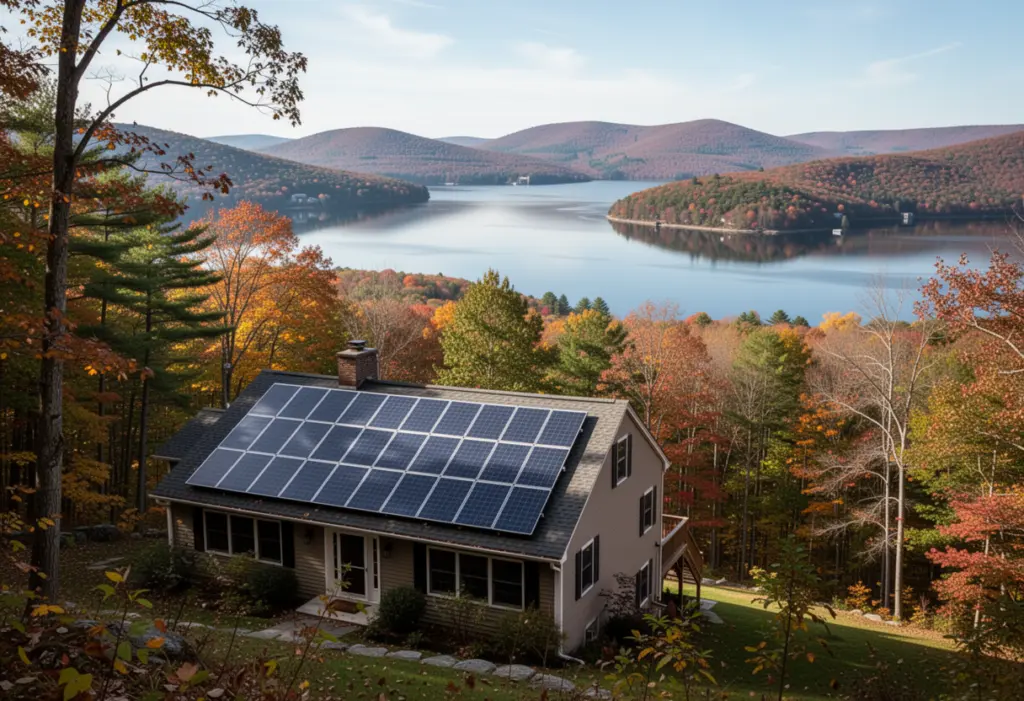
Carmel is a town in Putnam County and the county seat, taking in the hamlets of Carmel, Mahopac and Mahopac Falls. ZIP codes 10512 and 10541. It is reservoir and ridge country, and two questions here have to be answered before a design is worth drawing: what review applies to ground disturbance, and which utility your meter belongs to.
New York City watershed land
Putnam County contains land within the New York City water supply watershed, and where that applies additional review can apply to work that disturbs the ground. This is not a reason to abandon a project — it is a reason to establish early which agencies have a say over your parcel, rather than assuming none do.
It matters most for anything that breaks ground:
- A ground mount and its foundations.
- Trenching for the conductor run between an array and the house.
- Access work, regrading or a new track cut for machinery.
A roof array on an existing house is a much simpler proposition than any of those. Ask your installer directly whether they have permitted ground-disturbing work in this town before, and ask the Town of Carmel building department what applies to your address rather than relying on a sales answer.
Who issues the permit
The Town of Carmel issues permits across the town. There are no incorporated villages inside it, so unlike much of the Hudson Valley there is no second authority layered on top — Mahopac and Mahopac Falls are hamlets, not villages, and they are handled by the town. Putnam County does have villages elsewhere, at Brewster, Cold Spring and Nelsonville, so a friend’s experience in one of those may not describe yours.
The utility question is worth real money here
The Customer Benefit Contribution is a monthly charge on the DC size of a system, applied to anyone interconnecting on or after 1 January 2022. Putnam County is split between utilities, and the difference is not small:
- Central Hudson at $1.67 per kW-month for 2026, the highest residential rate in New York. On a 10 kW system that is $16.70 a month, about $200 a year; on 14 kW, $23.38, about $281.
- NYSEG at $1.19 per kW-month. The same systems pay $11.90 and $16.66 a month — roughly $143 and $200 a year.
That is a difference of about $58 a year on the smaller system and $81 on the larger one, decided by nothing except which company sends the bill. Read the utility name off your own bill and check that any proposal is using that rate rather than a statewide average. The charge follows capacity rather than output, and it is reset annually, so it is not locked in at interconnection.
Exports are a separate mechanism: under Phase One net metering they are credited at the full retail rate, and a system interconnected today keeps that structure for 20 years. That is what most residential rooftop customers here are on.
Trees, ridges and the December sun
Much of the town is wooded and hilly, with lakes and reservoirs cutting between the ridges. Both features work the same way: they raise the horizon and shorten the winter day for properties tight against high ground.
The test is whether somebody stood on the roof. A satellite estimate will not see a ridge line properly, and the number that matters is not the annual total but what the model predicts for December and January — the stretch where the net metering credit bank is drawn down. If tree removal is proposed, treat it as your decision rather than an assumption folded into a production estimate. It costs real money and it permanently changes a property where the trees are frequently part of the value.
Wells, septic and where a ground mount can go
Many properties here are on a well and a septic system, and both constrain siting. An array and its trench cannot sit over a leach field, and the run from a ground mount back to the house is priced by the foot. Ask what the trench length is, whether it changes the wire size, and where the equipment is going before you compare two ground-mount quotes — a cheaper array with a longer run is not necessarily cheaper.
Roofs and service panels
The usual gates apply. If the shingles have under about ten years in them, replace them first; an array that has to come off and go back on is charged twice. Older houses here frequently carry 100 amp service, and a full busbar turns a solar breaker into a panel upgrade or a line-side tap — a real number that belongs in the quote you compare, not in a later variation.
2026 incentives, and the option that needs no roof
The 30% federal residential credit is gone. For anything spent after 31 December 2025 the section is dead, and 25D fixes the moment of expenditure at the point the original installation is completed. A proposal that still shows the credit is materially wrong.
Before working through what remains, consider whether an on-site system is the right answer at all. In a town this wooded, with watershed review sitting over anything that breaks ground and a great many properties tight against a ridge, the honest conclusion for some addresses is that the roof will not carry an economic array and the ground cannot be disturbed cheaply. Community solar answers exactly that case: no roof, no trench, no foundations, no structural letter, no watershed question — and its subscribers pay no Customer Benefit Contribution at all, which on Central Hudson’s rate is the largest single saving available to a household here. It also reaches tenants, who cannot install on a roof they do not own.
If the roof does work, the 2026 package for a principal residence is New York’s 25% credit capped at $5,000 on Form IT-255 — limited by your actual state tax liability, carrying forward up to five years, and reaching leases and power purchase agreements of ten years or more as well as purchases; the state sales tax exemption; and RPTL 487, a 15-year exemption on the added assessed value where the town, Putnam County and your school district have each separately not opted out, for systems constructed before 1 January 2030. NY-Sun and its Affordable Solar incentive are not part of it: NYSERDA’s last standard Upstate residential block for Central Hudson and Orange & Rockland customers (Block 13, $0.15/W) closed on 4 August 2025; the last for NYSEG, RG&E and National Grid customers (Block 14, $0.15/W) closed on 17 December 2025 and the Upstate Affordable Solar block on 9 March 2026, and as of September 2026 NYSERDA has no open NY-Sun block for homes in any utility territory; check NYSERDA’s NY-Sun dashboard for a new one. Programmes are revised, so verify the current position with NYSERDA before committing.
Frequently Asked Questions
Does the New York City watershed affect solar in Carmel?
It can affect work that disturbs ground — foundations for a ground mount, trenching, or access work. Establish early which agencies have a say over your parcel by asking the town building department, rather than assuming none do. A roof array is a simpler case.
Is Carmel served by Central Hudson or NYSEG?
Putnam County is split, and the difference matters: the 2026 charge is $1.67 per kW-month on Central Hudson against $1.19 on NYSEG. On a 10 kW system that is about $200 a year against $143. Confirm the utility name printed on your own bill.
Do I need a village permit in Mahopac or Carmel hamlet?
No. There are no incorporated villages in the Town of Carmel, so the town issues permits across it. Putnam's villages are Brewster, Cold Spring and Nelsonville, so a friend's experience in one of those will not describe yours.
Where can a ground mount go on a well and septic property?
Not over a leach field, and the trench run back to the house is priced by the foot. Ask what the run length is and whether it changes the wire size before comparing two ground-mount quotes.
This article is general information, not tax, legal or financial advice. Incentive amounts, eligibility rules and deadlines change and depend on your utility, your tax situation and your property. Confirm current terms with NYSERDA, your utility and a qualified tax professional before making a decision.
NY Solar Incentives
Independent New York solar research. We summarise NYSERDA, NY-Sun and federal programme rules from published sources and state plainly when a figure is an estimate. We are not a government agency and do not sell equipment.
Run the arithmetic on your own system
Check the dated program table and your arrangement before counting an incentive. Standard residential NY-Sun blocks are closed; Long Island Affordable Solar has a conditional income-verification route. The NY credit depends on qualified costs and tax liability, while the NYC abatement reduces future property-tax bills. The estimator keeps those timings separate.