Solar Panel Cost in Great Neck, NY: Village by Village
The Great Neck peninsula is divided among many incorporated villages, and which one you live in changes the review, the layout and sometimes the price.
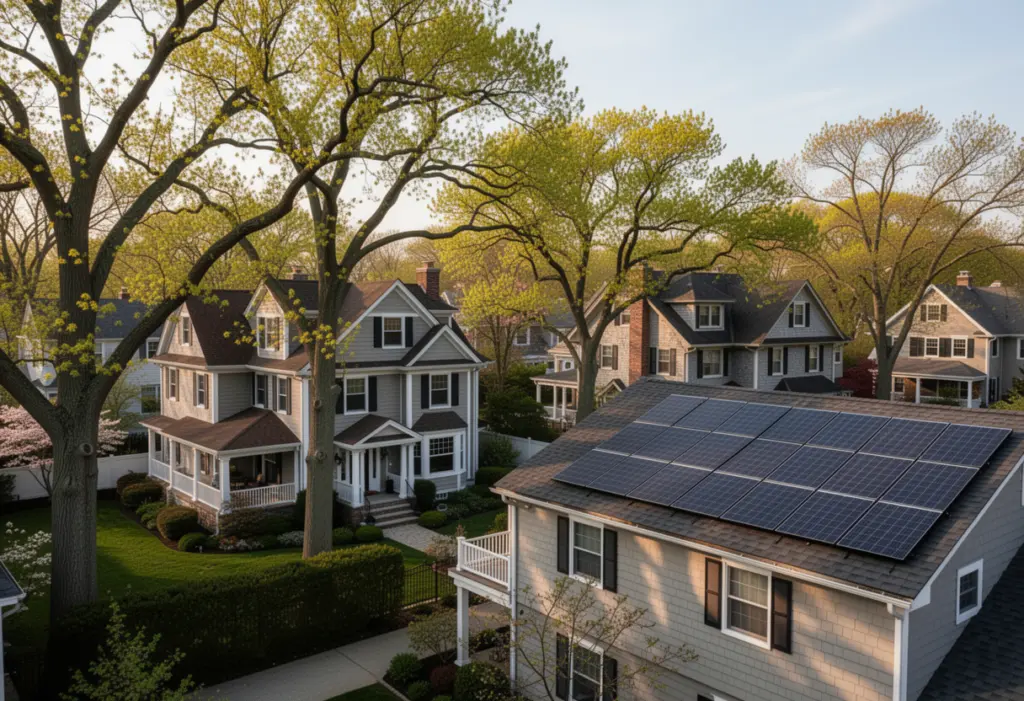
Great Neck is not one municipality. The peninsula in the Town of North Hempstead is divided among a set of incorporated villages, including Great Neck, Great Neck Estates, Great Neck Plaza, Kensington, Kings Point, Lake Success, Russell Gardens, Saddle Rock and Thomaston, alongside unincorporated pockets. The postal areas 11020, 11021, 11023 and 11024 cut across those lines rather than following them. So the first question about cost here is not about equipment at all, it is which building department reviews your application.
Why the jurisdiction changes the number
Several of the peninsula villages run architectural or design review in addition to a building permit. That does not stop a solar installation, but it can affect where panels are allowed to sit and how long approval takes. If a street-facing plane is discouraged and the array moves to a rear or north-of-east roof, you lose production for the same hardware cost, which is a price change even though no line item moved.
Ask your installer three specific things: which authority they are filing with for your exact address, whether that authority requires any design or architectural review for rooftop equipment, and what the last completed project at that office took from submission to permit. New York’s Unified Solar Permit covers systems of 25 kW DC and under and has been adopted by more than 300 authorities having jurisdiction statewide, but adoption is per authority, so ask rather than assume.
Older, larger houses change the installation
- Roof material. Slate, clay tile and standing seam metal are all common on the older housing here, and each needs a different attachment method. Slate in particular is a specialist job and the labour is not comparable to asphalt.
- Roof geometry. Steep pitches, multiple dormers and hipped planes cut the usable area, so a large house does not automatically fit a large array.
- Mature trees. The tree cover here is old and tall. A shading study run from satellite imagery understates it. Ask for an on-site assessment and for the assumed December production specifically.
- Service and subpanels. Older homes with several additions often have a patchwork of subpanels. The interconnection point has to be found and rated before anyone can price it honestly.
The battery question, answered plainly
Great Neck homeowners ask about storage constantly, and the honest answer is that a battery in New York is a resilience purchase rather than an economic one. Under Phase One net metering, exports are credited at the full retail rate, so the grid is already acting as a near-perfect store of value for your surplus. A battery buys you power during an outage. It does not buy you a better rate on your exports. Decide it on that basis and the conversation gets much simpler.
What the capacity charge costs a larger array
PSEG Long Island operates the LIPA system here, which the utility name printed on your own bill will confirm. The Customer Benefit Contribution is billed monthly on the DC size of the system rather than on generation, at a 2026 residential rate of $1.13 per kW-month. On the larger arrays these houses can take, that is real: an 11 kW system pays 11 x $1.13 = $12.43 a month, about $149 a year, every year, whatever the weather does. It applies to systems interconnected on or after 1 January 2022 and is recalculated annually.
Where the state credit stops helping
New York’s solar credit is 25 percent of qualified expenditure capped at $5,000, claimed on Form IT-255 for equipment at your principal residence. The arithmetic that matters on a big house is that 25 percent of $20,000 is already $5,000, so every dollar of qualified expenditure above roughly $20,000 attracts no further state credit. It is also non-refundable and limited by your actual New York tax liability, though unused credit carries forward for up to five years. A seasonal or second home does not qualify.
Federally there is nothing for a 2026 buyer. Section 25D was terminated for expenditures made after 31 December 2025, and the test is when the original installation was completed rather than when the system was energised. Treat any proposal still showing 30 percent as evidence about the salesperson. Check the live position yourself at tax.ny.gov and nyserda.ny.gov before signing.
Frequently Asked Questions
Which village permits solar on the Great Neck peninsula?
It depends on your exact address. The peninsula is divided among incorporated villages including Great Neck, Great Neck Estates, Great Neck Plaza, Kensington, Kings Point, Lake Success, Russell Gardens, Saddle Rock and Thomaston, plus unincorporated areas.
Does a slate or tile roof cost more for solar?
Yes. Slate, clay tile and standing seam metal each need a different attachment method, and slate in particular is specialist labour that is not comparable to a straightforward asphalt installation.
Is a home battery worth it in Great Neck?
As resilience, possibly. As economics, rarely. Phase One net metering credits exports at the full retail rate for 20 years, so a battery buys outage coverage rather than a better price for your surplus.
When does the New York State credit stop growing?
At $5,000, which is 25% of $20,000 of qualified expenditure. Spending above that earns no further state credit, and the credit is also limited by your actual New York tax liability with a five year carryforward.
This article is general information, not tax, legal or financial advice. Incentive amounts, eligibility rules and deadlines change and depend on your utility, your tax situation and your property. Confirm current terms with NYSERDA, your utility and a qualified tax professional before making a decision.
NY Solar Incentives
Independent New York solar research. We summarise NYSERDA, NY-Sun and federal programme rules from published sources and state plainly when a figure is an estimate. We are not a government agency and do not sell equipment.
Run the arithmetic on your own system
Check the dated program table and your arrangement before counting an incentive. Standard residential NY-Sun blocks are closed; Long Island Affordable Solar has a conditional income-verification route. The NY credit depends on qualified costs and tax liability, while the NYC abatement reduces future property-tax bills. The estimator keeps those timings separate.