Does Solar Add Value to a Home in New York?
An owned array can carry value into a sale. A leased one transfers an obligation instead. What decides the difference is documentation, and it is assembled long before the listing.
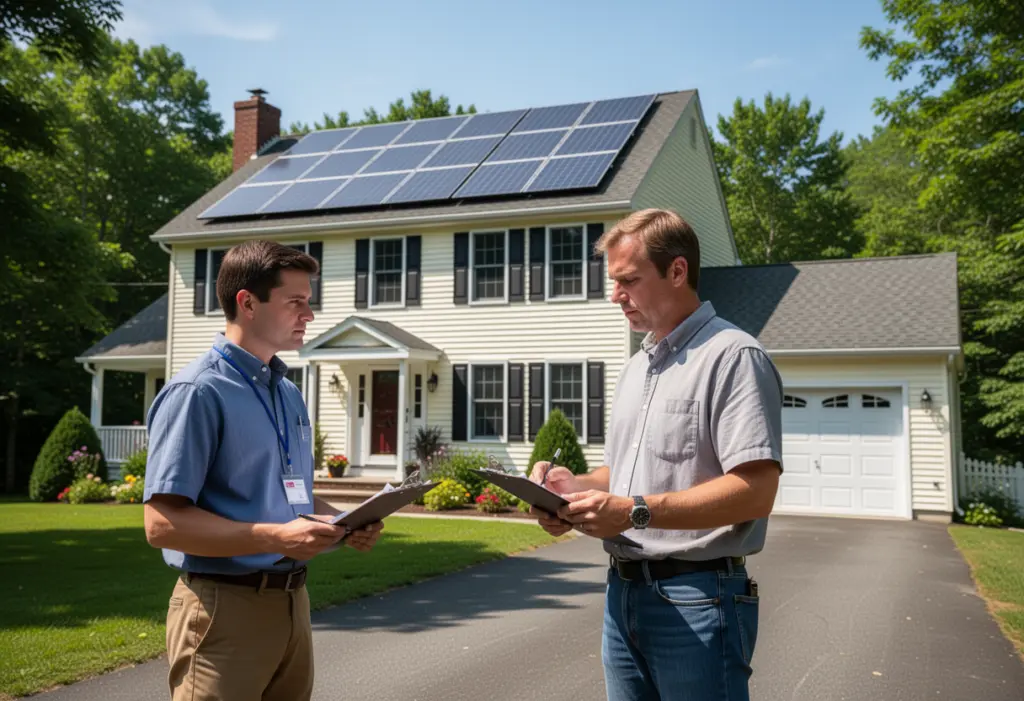
The short answer is that it depends on who owns the system and what you can prove about it. An owned, documented, transferable array is an improvement a buyer and an appraiser can price. A leased array or one supplying power under a third party agreement transfers an obligation, and an obligation is negotiated at closing rather than valued.
Value is recognised by an appraiser, not by a proposal
If a sales proposal tells you the system adds a specific sum to your home value, ask what source that figure comes from and whether it describes New York. Value is established when a buyer offers and an appraiser supports the number, and an appraiser works from what is documented and what comparable sales show in your own market. Nothing that happens at the point of sale of the panels determines it.
The practical consequence is that your job is evidence. An appraiser asked to attribute value to a system needs to know what it is, that it is owned, that it works, and that it will keep working for the next owner.
The file that makes value defensible
- Proof of outright ownership, or a payoff figure and a written release path for any lien or financing statement against the equipment.
- The interconnection agreement with its date. Phase One net metering credits exports at the full retail rate and holds for 20 years from interconnection, so the remaining term is part of what a buyer receives.
- Production history from the monitoring platform across several years, alongside the utility bills that reflect it. Measured output is stronger than a modelled estimate.
- Permits and the final inspection sign-off. An unclosed permit is a defect discovered at the worst possible moment.
- Warranty documents with their transfer conditions, and confirmation that the installing company still trades.
- The assessor’s record of any RPTL 487 exemption on the parcel and how many of its 15 years are left.
What a buyer is actually buying
Two things carry across the closing table and both are quantifiable, which is why they belong in a listing rather than in a footnote. The first is the remaining net metering term. The second is whatever the system does to the monthly bill, net of its own recurring charge.
That charge is worth naming, because a buyer will find it. The Customer Benefit Contribution is billed monthly on DC capacity regardless of production, on systems interconnected on or after 1 January 2022, and it follows the property. On Central Hudson the 2026 residential rate is $1.67 per kW-month, so a 12 kW array costs 12 x $1.67, about $20.04 a month or roughly $240 a year. A large array on a house with modest consumption therefore reads to a buyer as a fixed cost attached to capacity they will not use. Sizing decisions made years earlier show up here.
What subtracts
Being honest about the negative side is what makes the positive side credible.
- An unpaid balance. A loan secured against the equipment has to be resolved, and your lender and the buyer’s lender will both have a view about it.
- A lease or PPA with a long remaining term and an annual escalator. The buyer must qualify to assume it, and buyers who do not want it will price that in.
- A roof approaching the end of its life under the array. The buyer is inheriting a removal and reinstatement job, so get a written price for that work rather than leaving it to be guessed at during negotiation.
- Missing paperwork. An array that cannot be documented is hard for an appraiser to credit and easy for a buyer to discount.
The property tax angle points the same way
New York’s RPTL 487 exemption removes the added value of a solar installation from taxable assessment for 15 years, where the municipality, the county and the school district have each not opted out. That mechanism only exists because added value is what the assessment system expects a solar installation to create. It also means a buyer inherits the remaining years of the exemption rather than a fresh 15, so the age of the system matters to them in a way it may not have occurred to you to mention. The exemption requires construction before 1 January 2030.
Where 2026 incentives fit into the conversation
They belong to the person who buys and installs, not to the person who inherits. The state credit of 25% capped at $5,000 on Form IT-255 requires the taxpayer’s own principal residence in New York. The federal residential credit is gone — section 25D ended for expenditures made after 31 December 2025, with the test being when the original installation is completed — so a buyer comparing your solar house with an unsolared one is no longer comparing against a 30% federal discount on doing it themselves. That change moved in your favour as a seller, and it is a fair point to make, in writing, with the citation rather than as a sales line.
Assemble the file before the listing goes live rather than after an offer, and confirm the exemption status with your assessor at the same time, since local positions change.
Frequently Asked Questions
Do solar panels increase the sale price of a New York home?
An owned, documented and transferable system can be credited by an appraiser and a buyer. A leased system or one on a power purchase agreement transfers an obligation instead, and that gets negotiated rather than valued.
What documents does an appraiser need for solar?
Proof of ownership or a payoff and release path, the interconnection agreement with its date, several years of monitored production, closed permits with final inspection sign-off, transferable warranties, and the assessor's exemption record.
Does a large array help or hurt at resale?
Capacity a buyer will not use still carries the Customer Benefit Contribution every month. On Central Hudson at $1.67 per kW-month for 2026 a 12 kW array is about $20.04 a month, roughly $240 a year, and it follows the property.
Does the buyer get a fresh property tax exemption?
No. RPTL 487 runs 15 years from when it is granted, so a buyer inherits whatever remains. It applies only where the municipality, the county and the school district have each not opted out, and requires construction before 1 January 2030.
This article is general information, not tax, legal or financial advice. Incentive amounts, eligibility rules and deadlines change and depend on your utility, your tax situation and your property. Confirm current terms with NYSERDA, your utility and a qualified tax professional before making a decision.
NY Solar Incentives
Independent New York solar research. We summarise NYSERDA, NY-Sun and federal programme rules from published sources and state plainly when a figure is an estimate. We are not a government agency and do not sell equipment.
Run the arithmetic on your own system
Check the dated program table and your arrangement before counting an incentive. Standard residential NY-Sun blocks are closed; Long Island Affordable Solar has a conditional income-verification route. The NY credit depends on qualified costs and tax liability, while the NYC abatement reduces future property-tax bills. The estimator keeps those timings separate.