Solar Panel Cost in East Hampton, NY
Two things decide what solar costs in East Hampton: how visible the array is from the street, and whether the house is where you actually live.
On this page 8 sections
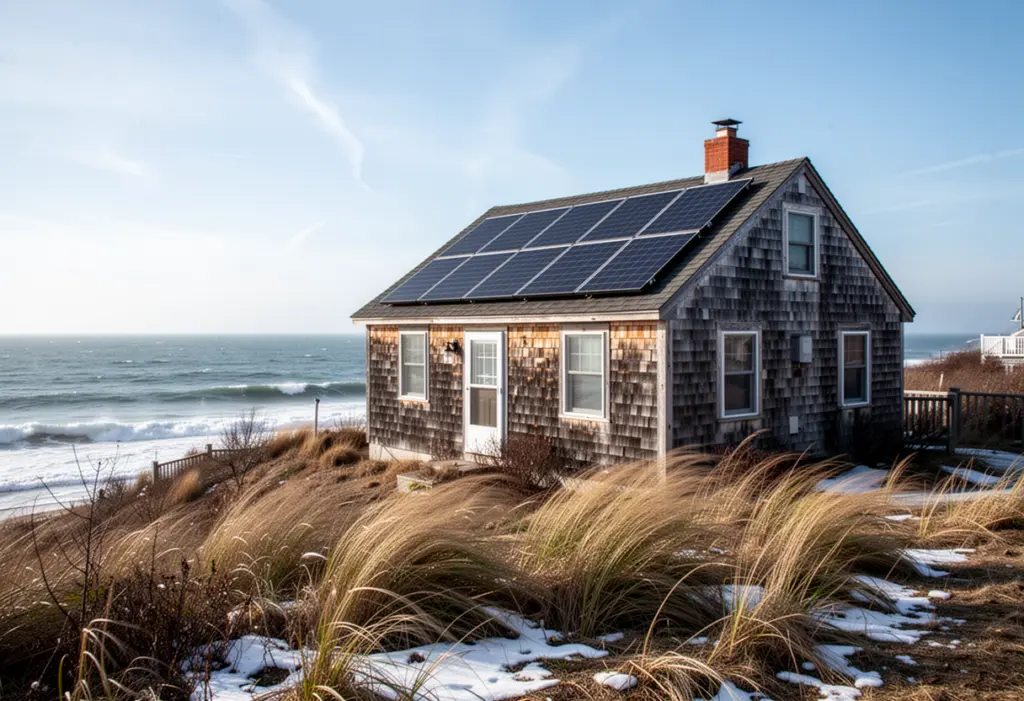
East Hampton is a town in Suffolk County at the eastern end of the South Fork, taking in Amagansett, Wainscott, Springs and Montauk. ZIP codes include 11937, 11930, 11954 and 11975, with part of 11963 at Sag Harbor. Costs here are driven by design review, by exposure, and by a tax rule that removes the largest remaining incentive from a great many of the houses.
Design review comes before any hardware
Suffolk towns are large and each issues its own permits. In East Hampton the Town of East Hampton covers most addresses, while the Village of East Hampton and the Village of Sag Harbor run their own building departments. The East End villages add architectural review ahead of the building permit, and that review can restrict street-visible placement.
That has two cost consequences people underestimate. The first is design: an approved array is frequently not the cheapest array. The second is time, and time is money on a project financed or scheduled around a season. Design for approval from the outset:
- A rear or secondary roof plane not visible from the public way. This resolves most applications on its own, at the price of some production if the plane faces less well.
- All-black modules with black frames. They cost slightly more than silver-framed modules and they are what gets approved.
- Flush mounting following the roof plane. Tilted racking on a visible pitched roof is the most likely thing to be refused.
- Concealed conduit, run internally or painted. Internal runs cost more labour and are worth quoting explicitly.
Ask when the board meets and what the submission deadline is. A monthly cycle means one missed deadline is four weeks.
Big houses, big arrays, and a cap that binds
New York’s credit is 25% of qualified expenditure, capped at $5,000 on Form IT-255. East Hampton houses are large and their arrays are correspondingly large, so the cap binds routinely here. On a 14 or 20 kW system the credit is a much smaller proportion of the total than the headline rate implies, and a proposal that shows 25% of the whole project as a state benefit is overstating it.
The 30% federal residential credit is gone. The termination applies to expenditures made after 31 December 2025, and section 25D dates the expenditure to the day the original installation was completed. On a large system that removes a large absolute number from the arithmetic, so any 2026 quote still showing a federal line needs to be rebuilt without it before you compare it with anything.
A second home gets no state credit at all
This is the decisive point in East Hampton. The IT-255 credit attaches to the house you actually live in — a principal residence in New York. Used seasonally, kept as a second home or let to a tenant, the property is outside it entirely, and the East End has a very high share of exactly those.
If the house is not where you actually live, the credit line is zero, the federal line is zero, and the case rests on the sales tax exemption, the property tax exemption and the electricity itself, since NY-Sun has no open block for homes. That is a legitimate case, but it is a different one, and it should be built honestly from the start rather than corrected at tax time. The credit is also limited by your actual New York State tax liability, and it reaches leases and power purchase agreements of ten years or more as well as purchases, with the ten-year minimum applying to the lease as well as to the PPA.
What PSEG Long Island charges
Then there is the charge that keeps arriving afterwards. The Customer Benefit Contribution has applied to systems interconnected since 1 January 2022, and it is worked out from DC capacity rather than from output — $1.13 a kilowatt each month on PSEG Long Island in 2026. At the sizes this town builds, that is not trivial:
- A 16 kW system: $18.08 a month, about $217 a year.
- A 20 kW system: $22.60 a month, about $271 a year.
It is charged on capacity regardless of production and recalculated annually, so an oversized array costs money every month of the year including the months a seasonal house is empty. Exports are credited at the full retail rate under Phase One net metering, and that structure holds for 20 years from interconnection. The utility here is PSEG Long Island; the Village of Greenport and Fishers Island, both in the Town of Southold across the bay, run their own municipal electric utilities, and their customers sit outside Public Service Commission jurisdiction entirely — so take the answer from the name printed on your bill.
Montauk exposure
The eastern end of the town is as exposed as anywhere in New York. Three specification questions follow, and each is a real line item:
- Wind load. Ask what wind speed the racking, attachments and roof structure are specified for. The Atlantic-facing bluffs are not an inland site.
- Salt-rated hardware. Ask what the fasteners, clamps and flashing are made of. Ordinary hardware fails faster here.
- Enclosure ratings. Ask what rating the inverter and outdoor disconnects carry.
Near Lake Montauk, the harbour and the low ground behind the dunes, mapped flood zones also decide where equipment may be mounted — usually above a specified elevation, which can rule out the cheapest position and make a basement battery the wrong answer.
Trees and the low December sun
Northwest Woods and Springs carry heavy canopy on large lots. An obstruction irrelevant in July removes hours of production in December, the month the net metering credit bank is being drawn down. Insist on an on-site shading assessment, and ask what the model says about December and January rather than only the annual total.
2026: when the roof is the wrong place to spend the money
Put the East Hampton conditions together and a pattern appears. Architectural review pushes the array onto a plane that produces less. Heavy canopy in Northwest Woods and Springs shades what is left. Salt, wind and flood elevation each add specification cost. And on a second home the state credit is zero. There are addresses here where a rooftop system is simply the most expensive way to buy a kilowatt-hour, and it is worth saying so plainly rather than shrinking the array until the spreadsheet works.
Community solar is the alternative that answers all four of those at once. It needs no roof, so review, canopy and exposure stop mattering; it needs no up-front cost; and its subscribers pay no Customer Benefit Contribution at all, since the charge does not reach front-of-the-meter projects. It also reaches a tenant, who cannot install on a roof they do not own.
The other route worth understanding on a second home is third-party ownership. The credit that survived the end of 2025 is the business-side one, claimed by the company that owns a leased or PPA system rather than by you — which is why those offers still price in a federal incentive that never appears on your own return, and why the tax arithmetic in 2026 leans away from buying outright. If you take that route, the New York credit still requires a term of ten years or more, on a lease as much as on a PPA.
And whichever route you take, the rest of the package stands: the state sales tax exemption on residential solar equipment, and RPTL 487’s 15-year property tax exemption on the added value where the town or your village, Suffolk County and your school district have each not opted out. NY-Sun is no longer part of it: on Long Island the last residential block closed on 17 April 2016, NYSERDA’s income-qualified Affordable Solar incentive has no open block for homes either, and as of September 2026 NYSERDA has no open NY-Sun block for homes in any utility territory; check NYSERDA’s NY-Sun dashboard for a new one. East Hampton contains several small school districts, including East Hampton, Amagansett, Springs, Montauk and Wainscott, so ask your assessor about your specific parcel. Section 487 requires construction before 1 January 2030, and the whole position should be confirmed with NYSERDA and the New York State Department of Taxation and Finance before you sign anything.
Frequently Asked Questions
Does architectural review add cost in East Hampton?
Yes, in two ways. An approved array is often not the cheapest one — a rear plane, all-black modules, flush mounting and concealed conduit all have a price — and a monthly board cycle means a missed deadline costs four weeks of schedule.
What does a second home owner in East Hampton actually get?
Not the New York credit. Form IT-255 requires your principal residence in New York, so a seasonal or second home is excluded, and the federal credit ended for expenditures made after 31 December 2025. The sales tax exemption and RPTL 487 are what remain to discuss; NY-Sun has no open block for homes as of September 2026.
What does PSEG Long Island charge on a large East Hampton array?
The Customer Benefit Contribution at $1.13 per kW-month of DC system size for 2026 — about $217 a year on a 16 kW system and $271 on 20 kW, charged on capacity every month regardless of production.
What should I ask about wind and salt in Montauk?
What wind speed the racking, attachments and roof structure are specified for, what the fasteners, clamps and flashing are made of, and what enclosure rating the inverter and outdoor disconnects carry. Near the harbour, ask about flood zone mounting heights too.
This article is general information, not tax, legal or financial advice. Incentive amounts, eligibility rules and deadlines change and depend on your utility, your tax situation and your property. Confirm current terms with NYSERDA, your utility and a qualified tax professional before making a decision.
NY Solar Incentives
Independent New York solar research. We summarise NYSERDA, NY-Sun and federal programme rules from published sources and state plainly when a figure is an estimate. We are not a government agency and do not sell equipment.
Run the arithmetic on your own system
Check the dated program table and your arrangement before counting an incentive. Standard residential NY-Sun blocks are closed; Long Island Affordable Solar has a conditional income-verification route. The NY credit depends on qualified costs and tax liability, while the NYC abatement reduces future property-tax bills. The estimator keeps those timings separate.