Solar Panel Installation in Fishkill, NY
Fishkill is a village inside a town, next to a second town with almost the same name. Getting that right is the first practical step of a solar project here.
On this page 7 sections
- 01Establish which authority covers your address
- 02The Highlands are to the west, and December is when it shows
- 03Fishkill Creek and low ground
- 04Two very different housing stocks
- 05Central Hudson: the highest solar charge in New York
- 062026 incentives, and the check most people skip
- 07Frequently Asked Questions
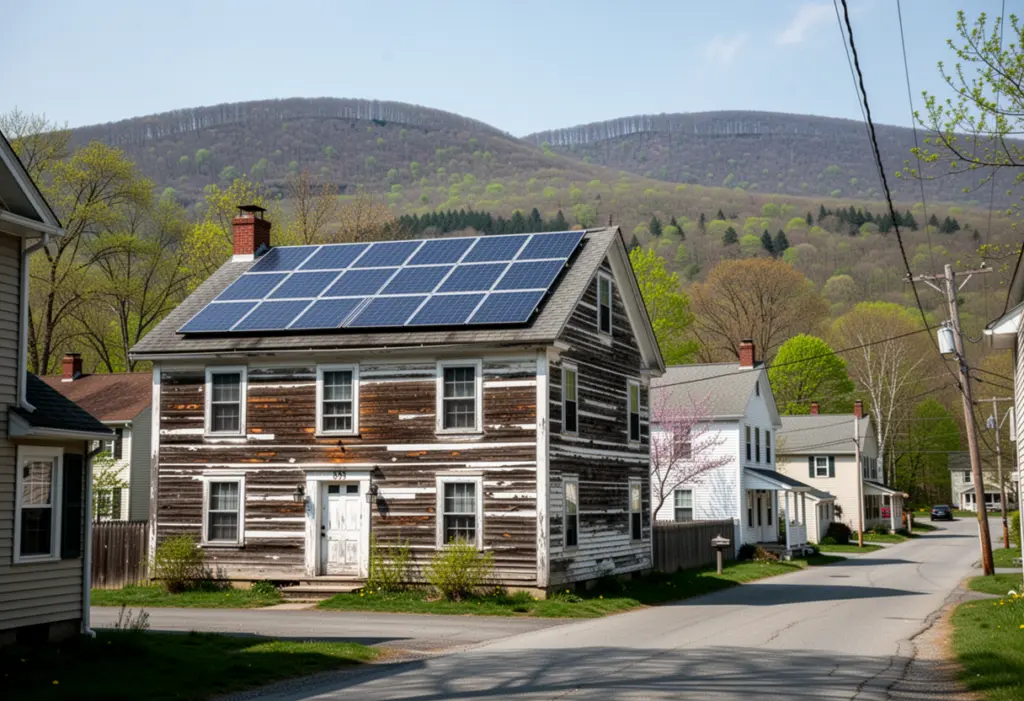
Fishkill is a village inside the Town of Fishkill, in southern Dutchess County. ZIP code 12524. Immediately east is the separate Town of East Fishkill, whose main hamlet is Hopewell Junction at 12533, and immediately west is the City of Beacon. Four authorities with confusable names sit within a few miles of each other, and each runs its own building department.
Establish which authority covers your address
This is not a formality. Have your installer name the authority in writing before anything is lodged, and verify it yourself against your tax bill. A file that goes to the wrong department does not get redirected — it goes to the back of a different queue, and the fees, the inspection slots and the turnaround are all set separately.
The older core of the village carries genuine historic character, and where architectural or historic review applies it is a step ahead of the building permit. Find out whether your property is affected before signing. Where it does apply, what gets approved is fairly predictable: modules on a rear or secondary plane out of sight from the street, black-framed rather than silver, laid flat to the pitch rather than tilted, and the conduit kept out of view.
The Highlands are to the west, and December is when it shows
The Hudson Highlands rise close to the west and south of the village, and properties tucked against the higher ground lose the low winter sun earlier in the afternoon than an annual production model suggests.
Two questions settle it:
- Was the shading assessment done on site, or from satellite imagery? A ridge line and mature trees both show up properly only on the ground.
- What does the model say about December and January specifically? That is the period the net metering credit bank is being drawn down, so a shortfall there costs more than the same shortfall in June.
Fishkill Creek and low ground
The creek runs through the village, and properties on low ground near it can sit in mapped flood plain. Where that applies it decides where the electrical equipment may be mounted — the inverter, the AC and DC disconnects, the production meter and any battery usually have to sit above a specified elevation.
The practical consequence is that a basement is frequently the wrong place for a battery even where it is the cheapest place to put it, and that a design has to be right the first time, because moving equipment after inspection is expensive. Ask whether your parcel is in a mapped zone and what the authority requires, before a design is drawn.
Two very different housing stocks
The village core and the older roads carry housing old enough that a 100 amp panel is the norm, and once the busbar is full a solar breaker means either an upgrade or a line-side tap. Price it in the contract rather than meeting it later as a variation. The covering is the other gate: a shingle roof with under roughly ten years left in it should be replaced before the array goes up, since a removal and refit afterwards is paid for twice.
The newer subdivisions off the Route 9 corridor are the opposite case. Engineered trusses carry an array without difficulty, 200 amp service usually has busbar room, and large simple roof planes fit more modules. What applies there instead is a covenant or an association rule, which is a private agreement entirely separate from the town permit — read yours and apply early if approval is needed.
Central Hudson: the highest solar charge in New York
Every system interconnected on or after 1 January 2022 carries the Customer Benefit Contribution, billed monthly against DC capacity rather than against output. Central Hudson’s 2026 residential rate, $1.67 per kW-month, is the highest of the seven NYSERDA publishes:
- A 7 kW system: $11.69 a month, about $140 a year.
- An 11 kW system: $18.37 a month, about $220 a year.
The rate is reset each year rather than locked at interconnection, so nobody can honestly hand you a 20-year total for it. Most of Dutchess County is Central Hudson territory, but the boundaries here do not follow municipal lines, so the utility name on your own bill is the only answer worth using. Exports are handled under Phase One net metering, credited at the full retail rate, and that arrangement runs for 20 years from interconnection.
Because this rate is the highest in the state, the fact that community solar subscribers pay no Customer Benefit Contribution at all is worth more here than in any other utility territory in New York. It also needs no roof, which matters on a shaded lot or a rented apartment.
2026 incentives, and the check most people skip
Start with what has been removed. The 30% federal residential credit has been terminated. Section 25D no longer reaches expenditures made after 31 December 2025, and the statute dates an expenditure to the completion of the original installation. A 2026 quote still carrying a federal line is wrong, and every payback figure underneath it is wrong by roughly that amount.
Of what survives, the piece that most often goes unchecked is the school district. RPTL 487’s 15-year exemption on the added assessed value applies only where the taxing bodies have not opted out, and a district makes that decision by its own resolution, independently of the village, the town and Dutchess County. Outside the five fiscally dependent Big Five city districts, the school levy is a separate line and a separate answer — and because four confusably named authorities sit within a few miles here, be certain which municipality is yours before you even ask.
Then work through the rest:
- New York’s 25% credit, capped at $5,000, on Form IT-255 — a principal residence only, limited by your actual state tax liability, unused amounts carrying forward five years, and reaching leases and power purchase agreements of ten years or more as well as outright purchases.
- NY-Sun, which used to arrive as a reduction on the contractor’s price rather than as a form you file, is closed to homes: NYSERDA’s last standard Upstate residential block for Central Hudson and Orange & Rockland customers (Block 13, $0.15/W) closed on 4 August 2025; the last for NYSEG, RG&E and National Grid customers (Block 14, $0.15/W) closed on 17 December 2025, and as of September 2026 NYSERDA has no open NY-Sun block for homes in any utility territory; check NYSERDA’s NY-Sun dashboard for a new one.
- Affordable Solar, the NYSERDA incentive for lower-income households, is closed too: the Upstate block ran from 18 December 2025 to 9 March 2026. A quote that still shows it, or any NY-Sun reduction, should name the open block it comes from.
- The state sales tax exemption on residential solar equipment.
Section 487 also requires the system to be constructed before 1 January 2030. Every one of these is subject to revision, so confirm the position with NYSERDA and the New York State Department of Taxation and Finance before signing.
Frequently Asked Questions
Is Fishkill the same as East Fishkill?
No. The Village of Fishkill sits inside the Town of Fishkill, and East Fishkill is a separate town whose main hamlet is Hopewell Junction. They run separate building departments, so establish which covers your address before anything is filed.
Does the flood plain along Fishkill Creek affect a solar design?
On low-lying parcels it can. The inverter, disconnects, meter and any battery usually have to sit above a specified elevation, which means a basement is often the wrong place for a battery even where it is cheapest. Settle it before a design is drawn.
What does Central Hudson charge a Fishkill solar customer?
The Customer Benefit Contribution at $1.67 per kW-month of DC system size for 2026, the highest residential rate in New York — about $140 a year on a 7 kW system and $220 on 11 kW.
Why does my quote assume less production than my neighbour's?
Usually shading. The Highlands rise west and south of the village, and properties against the higher ground lose the low winter sun earlier. Ask whether the assessment was done on site and what the model says about December and January, not only the annual total.
This article is general information, not tax, legal or financial advice. Incentive amounts, eligibility rules and deadlines change and depend on your utility, your tax situation and your property. Confirm current terms with NYSERDA, your utility and a qualified tax professional before making a decision.
NY Solar Incentives
Independent New York solar research. We summarise NYSERDA, NY-Sun and federal programme rules from published sources and state plainly when a figure is an estimate. We are not a government agency and do not sell equipment.
Run the arithmetic on your own system
Check the dated program table and your arrangement before counting an incentive. Standard residential NY-Sun blocks are closed; Long Island Affordable Solar has a conditional income-verification route. The NY credit depends on qualified costs and tax liability, while the NYC abatement reduces future property-tax bills. The estimator keeps those timings separate.