Solar Panel Cost in Cortland, NY: Who Is on the Deed
In a city with as much rented housing as Cortland, the biggest variable in what solar costs is not the roof. It is who owns the house and who pays the bill.
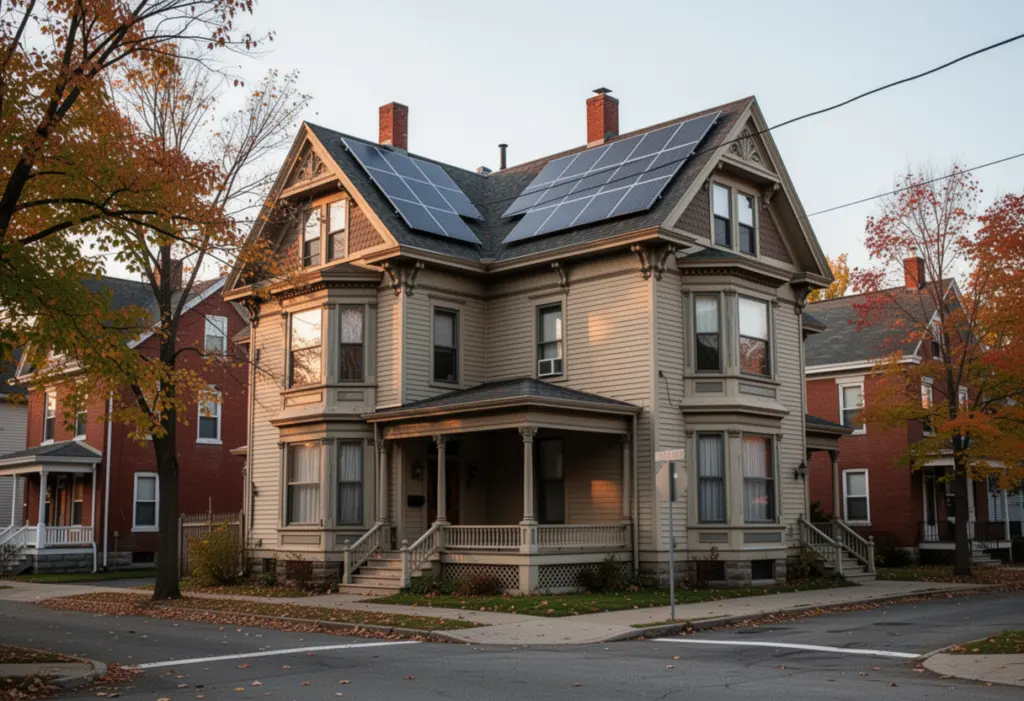
In most New York towns the biggest variable in what solar costs is the roof. In Cortland it is the deed. A city with a large student and rental population has a great many houses where the person paying the electric bill is not the person who owns the building, and that single fact changes which incentives apply, who benefits from the production, and whether the project is worth doing at all.
The state credit follows the principal residence
New York’s 25 percent credit, capped at $5,000 on Form IT-255, requires the equipment to be installed and used at the taxpayer’s principal residence in New York State. A rental property you own but do not live in does not qualify. Neither does a second home or a camp. For an owner-occupied two-family — common in this city — the credit follows the part of the house you actually live in, and the apportionment is a question for your accountant rather than for an installer’s spreadsheet.
That is the largest single incentive still available to a New York homeowner, so establishing whether you can claim it is the first step, not the last. It is also non-refundable, limited by your actual state tax liability, and carried forward for up to five years where it exceeds that liability.
Then the meter question
Solar production offsets consumption on the meter it is connected to. In a two-family or a converted house with separate meters, an array wired to the owner’s meter does nothing for the tenant’s bill, and an array wired to a tenant’s meter reduces a bill the owner does not pay. Before a design is drawn, settle three things in writing: how many meters serve the building, which one the array will be tied to, and who receives the net metering credits. A landlord who installs solar and then finds the benefit accruing to a tenant account has paid for something they cannot recover.
Read the bill before you accept any savings figure
Cortland County sits close to a boundary between service territories, and utility boundaries in central New York do not follow county lines cleanly. Do not assume from the map: read the utility name printed on your own bill, because the monthly cost of owning the array depends on it.
The Customer Benefit Contribution is billed on DC system size rather than production. For 2026 it is $0.97 per kW-month on National Grid and $1.19 on NYSEG. On a 9.6 kW array that is $9.31 a month, about $112 a year in the first case and $11.42 a month, about $137 a year in the second — roughly $25 a year apart on the same equipment, decided by nothing except which company sends the bill. The charge applies to systems interconnected on or after 1 January 2022, and the rates are recalculated annually rather than locked in.
There is a third possibility in this county. The Village of Marathon runs its own municipal electric department. A municipal electric customer is outside Public Service Commission jurisdiction: no state net metering entitlement, no Customer Benefit Contribution and no state interconnection process. Everything is set by the utility and has to be asked for directly, so a Marathon address needs a conversation with the village rather than a standard proposal.
Two authorities, two fee schedules
The City of Cortland and the Town of Cortlandville are separate authorities with separate code enforcement. A 13045 mailing address can be in either, and the permit fee and inspection queue differ. Ask which one receives the application and whether the permit figure in the proposal is that authority’s actual fee rather than a placeholder. For systems of 25 kW DC and under, most authorities across the state work from the New York State Unified Solar Permit, which standardises the form but not the cost.
What the older housing adds
- Service capacity. Pre-war housing near the centre frequently has 100 amp service, and a solar breaker may require a panel upgrade or a line-side tap. Get it priced as its own line.
- Roof covering and pitch. Steep older roofs cost more in labour and safety provision than a low suburban ranch. If the shingles have under roughly ten years left, re-roof first rather than paying twice to move the array.
- Structural letters. Older framing draws an engineer’s letter more often. It is a small fee, but it belongs in the quote rather than appearing later.
- Winter production. Ask for December and January estimates separately, and for an on-site shading assessment rather than a satellite figure. The hills around the city change the southern horizon more than a flat-map tool assumes.
The 2026 position, stated plainly
There is no federal residential credit for a 2026 purchase. Section 25D was terminated for expenditures made after 31 December 2025, and an expenditure is treated as made when the original installation is completed. A proposal still showing 30 percent federal is not describing this year. What remains for a Cortland owner-occupier is the state credit above, the state sales tax exemption on residential solar equipment, and RPTL 487, which exempts the added value of the system from property tax for 15 years where the city or town, the county and the school district have each not opted out, for systems constructed before 1 January 2030. NY-Sun is not on that list: as of September 2026 NYSERDA has no open NY-Sun block for homes in any utility territory; check NYSERDA’s NY-Sun dashboard for a new one.
For a landlord rather than an owner-occupier, the analysis is a business one and belongs with an accountant: the residential credit is not available, different federal provisions apply to business property, and the numbers turn on depreciation and on who consumes the power. Whichever side of that line you are on, incentive programmes are revised regularly — check the current position with NYSERDA and the Department of Taxation and Finance before you sign.
Frequently Asked Questions
Can I claim the New York solar credit on a rental property in Cortland?
No. Form IT-255 requires the equipment to be installed and used at your principal residence in New York State. A property you own but do not live in does not qualify, and for an owner-occupied two-family the apportionment is a question for your accountant.
Which utility serves Cortland, and why does it matter?
Central New York territory boundaries do not follow county lines, so read the name on your own bill. The 2026 Customer Benefit Contribution is $0.97 per kW-month on National Grid and $1.19 on NYSEG — about $112 versus $137 a year on a 9.6 kW array.
What happens if my address is in the Village of Marathon?
Marathon runs its own municipal electric department, which sits outside Public Service Commission jurisdiction. There is no state net metering entitlement, no Customer Benefit Contribution and no state interconnection process, so terms must be requested from the village directly.
Which meter should the solar array be connected to in a two-family house?
Settle it in writing before design: how many meters serve the building, which one the array ties to, and who receives the net metering credits. Production only offsets the account it is wired to, so the wrong choice benefits the wrong party.
This article is general information, not tax, legal or financial advice. Incentive amounts, eligibility rules and deadlines change and depend on your utility, your tax situation and your property. Confirm current terms with NYSERDA, your utility and a qualified tax professional before making a decision.
NY Solar Incentives
Independent New York solar research. We summarise NYSERDA, NY-Sun and federal programme rules from published sources and state plainly when a figure is an estimate. We are not a government agency and do not sell equipment.
Run the arithmetic on your own system
Check the dated program table and your arrangement before counting an incentive. Standard residential NY-Sun blocks are closed; Long Island Affordable Solar has a conditional income-verification route. The NY credit depends on qualified costs and tax liability, while the NYC abatement reduces future property-tax bills. The estimator keeps those timings separate.