Solar Panel Installation in Cortland, New York
Cortland sits in a valley in NYSEG territory. Shading and hosting capacity are the two questions to ask before anything else.
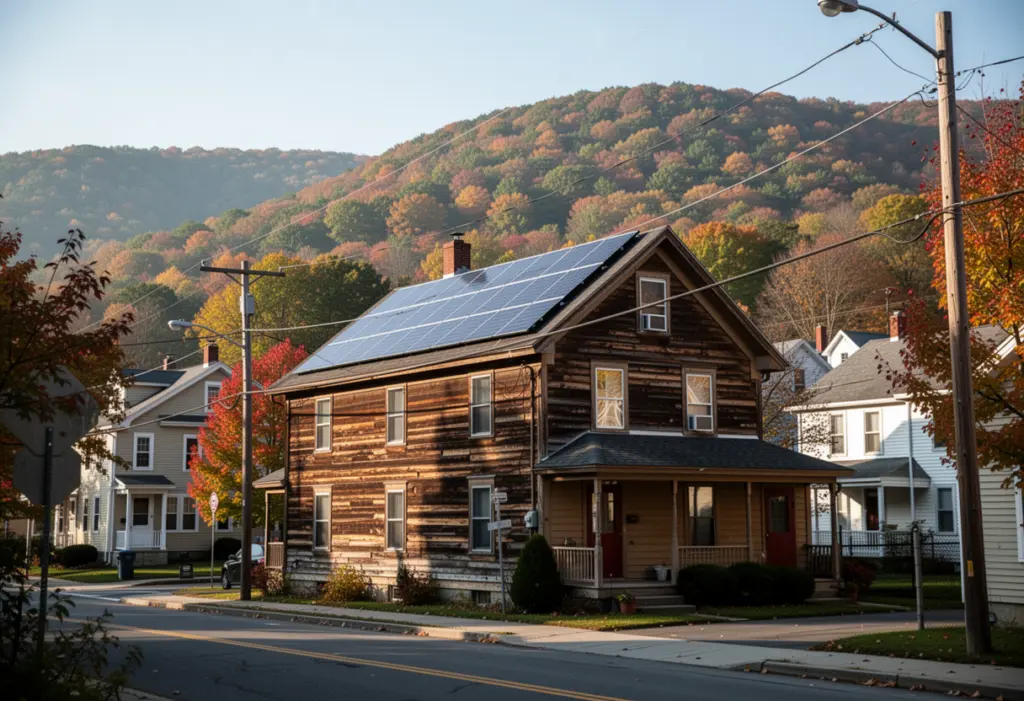
Cortland sits in a valley in central New York, between the Finger Lakes and the Southern Tier. ZIP codes here begin 130. Two local questions decide most projects here, and both should be asked before a design is produced.
Question one: the southern horizon
Valley towns share a specific problem — hills to the south block the low winter sun. An obstruction irrelevant in July removes hours of December production, and December is when the credit balance is being drawn down.
Insist on an on-site shading assessment, not a satellite estimate, and ask what the model assumes about December and January rather than only the annual total. In terrain like this two installers can differ substantially on the same roof.
Where the roof genuinely will not work, the honest answers are a smaller array, a different plane, a ground mount if there is land — realistic on many Cortland County properties — or community solar.
Question two: hosting capacity
Cortland is NYSEG territory, and NYSEG’s rural and semi-rural circuits are where interconnection applications hit limits. An application can come back requiring a study or a distribution upgrade before a system can be accepted.
Ask whether your installer checked the hosting capacity information for your circuit before designing the system. And settle two things in writing before signing: when the interconnection application will be filed — before installation, so a surprise arrives before your roof is drilled — and what happens to your deposit if a study or upgrade is required.
The sequence
- Twelve months of NYSEG usage, an on-site shading assessment, roof condition and structure.
- Interconnection application to NYSEG, before installation.
- Building permit from the City of Cortland or your town — Cortlandville, Homer, Virgil and others each run their own.
- Installation, then electrical inspection.
- Certificate to NYSEG, meter exchange, permission to operate. The system may not run before PTO.
Housing and roofs
Cortland’s housing stock is old, so roof age is frequently the gate: under roughly ten years of shingle life left means re-roof first, because removing and reinstalling an array later costs considerably more. Snow load here is real and racking must be specified for it; ask what snow assumption the production estimate used.
Household consumption is often higher than a template assumes, because electric hot water and supplementary electric heat are both common in older housing. Get twelve months of actual usage.
The NYSEG charge
The Customer Benefit Contribution is $1.19 per kW-month of DC system size for 2026 — about $9.52 a month on an 8 kW system, roughly $114 a year. Billed on capacity regardless of production and recalculated annually rather than fixed at interconnection.
2026 incentives
The 30% federal residential credit is gone. Section 25D was terminated for expenditures made after 31 December 2025, with an expenditure treated as made when the original installation is completed.
Still available: New York’s 25% credit capped at $5,000 on Form IT-255, non-refundable but carried forward five years; the state sales tax exemption; and RPTL 487’s 15-year property tax exemption where the city or town, Cortland County and your school district have not opted out, so check all three. The RPTL 487 exemption is not automatic: file form RP-487 with your assessor by the taxable status date (March 1 in most towns; January 2 in Nassau towns; May 1 or June 1 in Westchester towns; set by charter in cities; usually January 1 in villages), and the system must be built before January 1, 2030 (RP-487 instructions).
NY-Sun is not on that list. As of September 2026 NYSERDA has no open NY-Sun block for homes in any utility territory: the last standard Upstate residential block (Block 14, $0.15/W, NYSEG, RG&E and National Grid territories) closed on 17 December 2025, and the income-qualified Upstate Residential Affordable Solar block ran from 18 December 2025 to 9 March 2026. Check NYSERDA's NY-Sun dashboard for a new one, and ask any installer whose quote deducts a NY-Sun incentive which open block it comes from.
Frequently Asked Questions
Is Cortland's valley position a problem for solar?
It can be. Hills to the south block the low winter sun, and an obstruction irrelevant in July removes hours of December production. An on-site shading assessment is essential, and ask what the model assumes about December specifically.
Can NYSEG refuse a solar interconnection in Cortland County?
An application can come back requiring a study or a distribution upgrade where a rural circuit already carries substantial distributed generation. Ask whether hosting capacity was checked for your circuit before the system was designed.
What does NYSEG charge a Cortland solar customer?
The Customer Benefit Contribution at $1.19 per kW-month of DC system size for 2026 — about $9.52 a month, roughly $114 a year, on an 8 kW system.
Who issues a solar permit in Cortland County?
The City of Cortland or your town — Cortlandville, Homer, Virgil and others each run their own building department with their own turnaround. The NYSEG step is identical across all of them.
This article is general information, not tax, legal or financial advice. Incentive amounts, eligibility rules and deadlines change and depend on your utility, your tax situation and your property. Confirm current terms with NYSERDA, your utility and a qualified tax professional before making a decision.
NY Solar Incentives
Independent New York solar research. We summarise NYSERDA, NY-Sun and federal programme rules from published sources and state plainly when a figure is an estimate. We are not a government agency and do not sell equipment.
Run the arithmetic on your own system
Check the dated program table and your arrangement before counting an incentive. Standard residential NY-Sun blocks are closed; Long Island Affordable Solar has a conditional income-verification route. The NY credit depends on qualified costs and tax liability, while the NYC abatement reduces future property-tax bills. The estimator keeps those timings separate.