What Solar Panels Cost in Beacon, NY: The Local Variables
A solar quote in Beacon is decided by the roof, the ridge behind the city, the age of the electrical service and which incentives you can actually use. Central Hudson territory changes the arithmetic more than most local variables do.
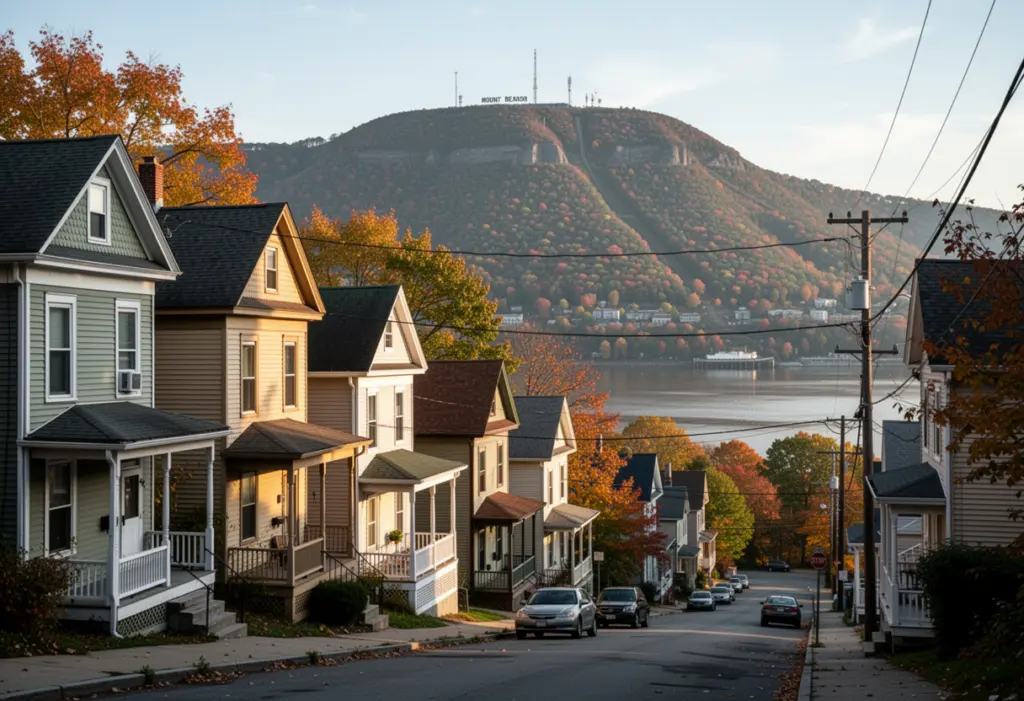
What solar costs in Beacon is decided by four things: how much array the roof can carry, what the ridge behind the city does to your morning sun, how old the electrical service is, and which incentives you can genuinely use. Beacon sits in Central Hudson territory, and that matters more than most local variables, because Central Hudson carries the highest 2026 residential capacity charge of the seven New York utilities that levy one.
The variables that move a Beacon quote
- The terrain, not just the trees. Mount Beacon and the Fishkill Ridge rise east and south-east of the city while the Hudson opens the western horizon. Shading models built from aerial imagery handle trees badly and terrain worse. Ask for a horizon profile and ask specifically what the estimate assumes about early-morning production, not only the annual total.
- Hillside roofs. Steep pitches and cut-up roof planes mean more racking, more penetrations and fewer usable faces. Two houses on the same street can differ by several kilowatts of practical capacity.
- The age of the house. Much of the housing in the 12508 area is pre-war frame and brick. A 100 amp service or a roof within a few years of replacement is the single largest surprise in a Beacon quote, and both are cheaper to establish before design than after.
- Water. The Hudson waterfront and the Fishkill Creek corridor bring mapped flood zones into part of the city. If the address is in one, ask where the inverter, disconnect and any battery will be mounted.
- Who issues the permit. Beacon is a city, so the application goes to the City of Beacon rather than to a town or a village. Ask whether the city works to the New York State Unified Solar Permit, which covers residential systems of 25 kW DC and under. If the property sits in a locally designated historic district, ask the building department what review applies before the array is laid out, not after.
The monthly charge nobody puts in the quote
The Customer Benefit Contribution is billed on the DC size of the array rather than on what it produces, for systems interconnected on or after 1 January 2022. On Central Hudson’s 2026 residential rate of $1.67 per kW-month, a 7 kW array is $11.69 a month, about $140 a year. The identical array under National Grid would be $6.79 a month. Nothing about the roof changes that; only the utility does.
The practical consequence is that in Beacon an oversized array is charged twice, once in the purchase price and again every month for as long as it is connected. Size to the load you actually have and ask what the estimate assumes about future consumption rather than rounding up.
What the incentives take off the Beacon number
New York’s solar energy system equipment credit is 25 percent of qualified expenditure capped at $5,000, claimed on Form IT-255 for a principal residence in the state. The cap starts to bite above $20,000 of qualified expenditure, which is worth knowing before you accept a larger system on the argument that the credit scales with it. The credit is not refundable and is limited by your New York liability, with a five-year carryforward.
The state sales tax exemption applies to residential solar equipment, and localities elect separately on their own share, so the total exemption is not the same in every county. As of September 2026 NYSERDA has no open NY-Sun block for homes in any utility territory; check NYSERDA’s NY-Sun dashboard for a new one. The income-qualified Affordable Solar incentive has closed as well: outside Con Edison and Long Island it ran from 18 December 2025 to 9 March 2026. If a block for homes reopens, NY-Sun is applied by the contractor as a reduction on the price rather than paid to you, so ask to see it on the contract.
For property tax, RPTL 487 exempts the added value of the system for fifteen years, and Beacon takes three separate checks: Dutchess County, the City of Beacon, and the Beacon City School District. Beacon is a city but it is not one of the five whose school districts are fiscally dependent, so the school levy is a genuine third question with its own answer. The system must also be constructed before 1 January 2030 to qualify at all.
What is no longer on the table
The 30 percent federal residential credit is gone. Section 25D was terminated for expenditures made after 31 December 2025, and an expenditure is treated as made when the original installation is completed rather than when the system is energised. A Beacon proposal dated 2026 that still shows a 30 percent federal line is materially wrong, and the rest of its arithmetic deserves the same scrutiny.
What remains genuinely valuable is Phase One net metering, which credits exports at the full retail rate and holds that structure for twenty years from interconnection. That is what makes an accurate load estimate matter more here than a large array. Incentive programmes move, so confirm the current position yourself at tax.ny.gov and nyserda.ny.gov, and confirm the utility from the name printed on your own bill before anyone quotes you a bill saving.
Frequently Asked Questions
Which utility serves Beacon?
Beacon is in Central Hudson's mid-Hudson territory. Confirm it from the utility name printed on your own bill, because service boundaries in the Hudson Valley do not follow county or city lines cleanly.
Who issues a solar permit in Beacon?
Beacon is a city, so the application goes to the City of Beacon rather than a town or village. Ask whether the city uses the New York State Unified Solar Permit, which covers residential systems of 25 kW DC and under.
What will the Customer Benefit Contribution cost in Beacon?
It is charged on DC system size. At Central Hudson's 2026 residential rate of $1.67 per kW-month, a 7 kW array is $11.69 a month, roughly $140 a year, whatever the array produces.
Does Beacon qualify for the RPTL 487 property tax exemption?
Only where none of the three taxing bodies has opted out. Check Dutchess County, the City of Beacon and the Beacon City School District separately, and note the system must be constructed before 1 January 2030.
This article is general information, not tax, legal or financial advice. Incentive amounts, eligibility rules and deadlines change and depend on your utility, your tax situation and your property. Confirm current terms with NYSERDA, your utility and a qualified tax professional before making a decision.
NY Solar Incentives
Independent New York solar research. We summarise NYSERDA, NY-Sun and federal programme rules from published sources and state plainly when a figure is an estimate. We are not a government agency and do not sell equipment.
Run the arithmetic on your own system
Check the dated program table and your arrangement before counting an incentive. Standard residential NY-Sun blocks are closed; Long Island Affordable Solar has a conditional income-verification route. The NY credit depends on qualified costs and tax liability, while the NYC abatement reduces future property-tax bills. The estimator keeps those timings separate.