Solar Generator vs Home Battery in New York: Which to Buy
These are not the same product at two prices. One is an appliance you plug things into; the other is part of the house wiring. Your outage history decides which one is proportionate.
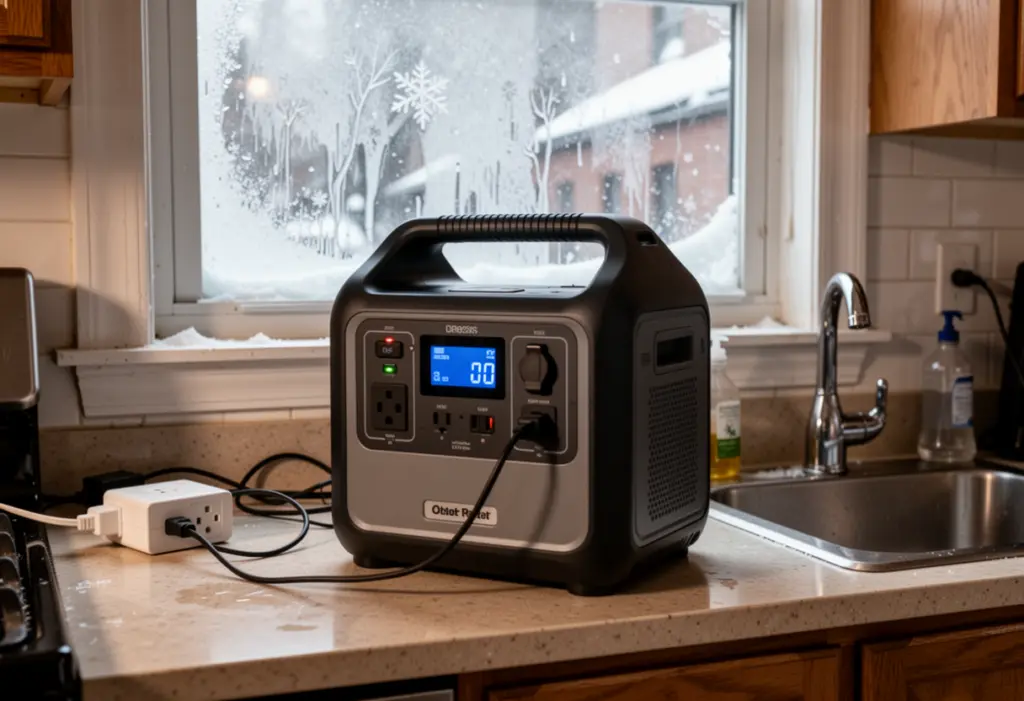
A portable unit sold as a solar generator and an installed home battery are not competing products at different prices. They solve different problems, and the useful question is not which is better but how long your outages actually last and what has to keep running through them.
The plain difference
A solar generator is an appliance. It is a battery, an inverter and some outlets in a case, it arrives by courier, and you plug things into it. No permit, no inspection, no electrician, no interconnection application. A home battery is part of the house electrical system. It is permitted, inspected, and wired into a subpanel or the main panel, and where it is paired with solar it forms part of an interconnection agreement with your utility.
What each one actually powers
- Portable unit. A refrigerator, phones, laptops, lamps, a modem, a CPAP machine. You run extension cords, and you go and plug things in yourself, in the dark, at whatever hour the power went out.
- Home battery. A defined set of circuits, or in larger installations the whole panel, switched over automatically in a fraction of a second. Boiler controls, a well pump and a septic pump can be on that list. On a portable unit they generally cannot, because they are hard wired rather than plugged in, and because motor starting surge is beyond most portable inverters.
The winter recharging problem nobody mentions
A portable unit recharges from folding panels, and in a New York winter that is slow. Short days, a low sun angle and snow are exactly the conditions that coincide with the outages you bought it for. Assume it charges more slowly than the marketing figure, and plan around roughly one useful charge per clear day rather than a continuous supply.
The related surprise: a rooftop solar array cannot charge a portable unit, and cannot run your house either, unless it has storage and an inverter configured to island. A grid tied array shuts down the moment the grid does. Owning solar and owning backup are two separate purchases, and a great many homeowners discover that during their first outage.
Counting your outages honestly
This is the arithmetic that decides it, and it is arithmetic about your address rather than about the products. If your power goes out for two or three hours a few times a year, a portable unit is proportionate and a home battery is not. If you are in an ice or snow belt where multi day outages happen, on a well and a septic pump, with a boiler whose controls need power, then intermittent hours on a few outlets is not backup, and the honest comparison is between a home battery and a fuel generator on a transfer switch.
A fuel generator belongs in that comparison. It runs for as long as you can feed it, which no battery does, and in exchange it wants maintenance, fuel storage and a properly installed transfer switch so that it can never backfeed a line a utility crew is working on. Feeding a generator into a wall outlet through a cord is dangerous and illegal, and it is how line workers get hurt.
Neither one earns money in New York
Under Phase One net metering your exports are credited at the full retail rate, and the arrangement holds for 20 years from interconnection. There is no gap between the price you sell at and the price you buy at, so there is no arbitrage for storage of any kind to capture. Both options here are resilience purchases and should be judged as such. The Customer Benefit Contribution is charged on the DC size of a solar array rather than on storage, so neither choice changes it: an 8 kW array pays 8 x $1.13 = $9.04 a month on LIPA and PSEG Long Island, roughly $108 a year, with or without a battery in the garage.
Two New York specifics before you buy
If your electricity comes from a municipal utility, the net metering and interconnection rules described here do not govern you, because municipal utilities sit outside Public Service Commission jurisdiction. That includes customers of the Village of Freeport and the Village of Rockville Centre in Nassau County and the Village of Greenport in Suffolk, all of which sit inside an area most people assume is entirely PSEG Long Island. Check the name printed on your bill.
On incentives, the 30% federal residential credit is gone, terminated for expenditures made after 31 December 2025 and measured by when the original installation is completed, so it reaches neither option in 2026. New York State keeps the 25% credit capped at $5,000 on Form IT-255, but it applies to solar energy system equipment installed and used at your principal residence, which is a different thing from an appliance bought at retail; ask your tax preparer before assuming a portable unit qualifies for anything. Programmes change, so confirm at the state tax site rather than from a product page.
Frequently Asked Questions
Is a solar generator the same as a home battery?
No. A portable solar generator is an appliance you plug things into, with no permit or interconnection. A home battery is wired into the house electrical system, permitted, inspected and switched over automatically.
Can a portable unit run my well pump?
Usually not. Hard wired pumps draw a large starting surge and are not on an outlet you can reach with a cord. Well and septic pumps generally need an installed battery or a fuel generator on a transfer switch.
Will my solar panels power the house in an outage?
Not on their own. A grid tied array shuts down when the grid goes down so it cannot energise lines crews are working on. Backup requires storage and an inverter configured to island.
How fast does a portable unit recharge from panels in winter?
More slowly than the headline figure. Short days, a low sun angle and snow cover coincide with the season you most want backup, so plan on roughly one useful charge per clear day.
This article is general information, not tax, legal or financial advice. Incentive amounts, eligibility rules and deadlines change and depend on your utility, your tax situation and your property. Confirm current terms with NYSERDA, your utility and a qualified tax professional before making a decision.
NY Solar Incentives
Independent New York solar research. We summarise NYSERDA, NY-Sun and federal programme rules from published sources and state plainly when a figure is an estimate. We are not a government agency and do not sell equipment.
Run the arithmetic on your own system
Check the dated program table and your arrangement before counting an incentive. Standard residential NY-Sun blocks are closed; Long Island Affordable Solar has a conditional income-verification route. The NY credit depends on qualified costs and tax liability, while the NYC abatement reduces future property-tax bills. The estimator keeps those timings separate.