Solar for Affordable Housing in New York
Two very different projects hide behind one phrase: solar on an affordable housing property, and solar for a household on a low income. They use different programmes.
On this page 8 sections
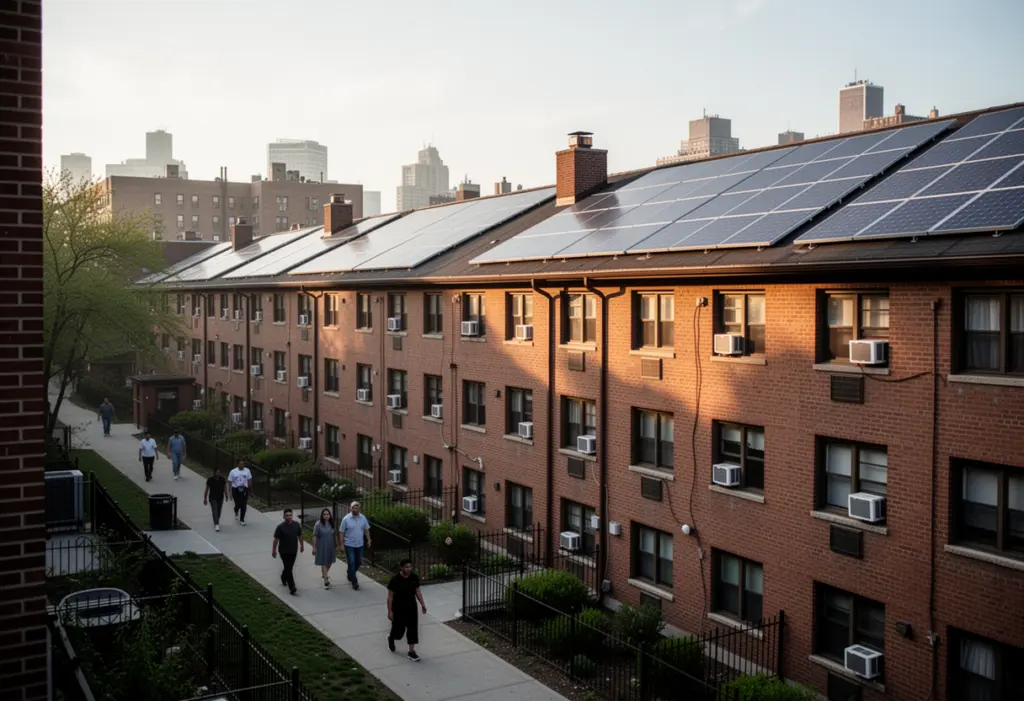
Two different projects hide behind this phrase, and the programmes that serve them barely overlap. One is solar installed on an affordable housing property, which is a decision made by whoever owns the building. The other is solar for a household living on a low income, which is a decision the household can usually make alone. Establishing which one you are asking about saves a great deal of wasted effort, because the wrong programme will not reach you no matter how carefully it is applied for.
If you are the household
Two things have been aimed at you directly, and only one of them is open today. The first is NYSERDA’s Affordable Solar incentive, a higher NY-Sun rate of $0.80 per watt for lower-income households, delivered through the contractor as a lower price rather than as a payment to you. It is closed: the Con Edison block ran from 30 May to 15 October 2025 and the Upstate block from 18 December 2025 to 9 March 2026. As of September 2026 NYSERDA has no open NY-Sun block for homes in any utility territory; check NYSERDA’s NY-Sun dashboard for a new one. If a quote still shows it, ask which open block it comes from.
The second is community solar, and for a tenant it is usually the only route that works. You subscribe to a share of an off-site project, credits arrive on your own utility account, and you own no equipment and touch no roof. Because the projects sit in front of the meter, neither they nor their subscribers pay the Customer Benefit Contribution. Income-eligible subscriptions exist; before signing, read the cancellation notice period, ask whether the discount applies to the credit or the whole bill, and ask what happens if you move.
Why the metering arrangement decides everything
In a master-metered building the owner buys the electricity and bills it through the rent, so an array on that roof reduces the owner’s bill and nothing lands on any tenant’s account. In an individually metered building each tenant has their own utility relationship, which is exactly what community solar attaches to. Look at whether an electricity bill arrives in your name. If it does not, no rooftop project on that building will change what you pay unless the lease is renegotiated, and that is a conversation about rent rather than about solar.
If you are the owner
The most common expensive error here is assuming the New York State residential credit applies. It does not: the 25 percent credit capped at $5,000 on Form IT-255 requires the taxpayer’s principal residence in New York, and a rental property is not that. Nor is a seasonal or second home. Business and multifamily projects sit under a different part of the tax code entirely, and the honest advice is to take that question to an accountant rather than to an installer or to a page like this one. Do not let a proposal quietly borrow the residential credit to make a rental project look better.
The 30 percent federal residential credit is in any case gone. Section 25D was terminated for expenditures made after 31 December 2025, with the expenditure treated as made when the original installation is completed. Any proposal still carrying it for a residential owner is wrong.
Property tax and the three separate opt-outs
RPTL 487 exempts the added value of the system for fifteen years, but only where the municipality, the county and the school district have each declined to opt out. Three separate decisions, three separate checks, and one no is enough. The system must also be constructed before 1 January 2030. On a multifamily property this is worth establishing before design rather than after, because it changes the operating arithmetic materially. In New York City there is no separate school district check, as the city school district is fiscally dependent and levies no separate property tax.
The charge that scales with the array
The Customer Benefit Contribution is billed on DC capacity rather than production, so a larger building array carries a larger fixed monthly cost. A 30 kW system in National Grid territory pays 30 × $0.97 at the 2026 residential rate, which is $29.10 a month and $349.20 a year, and under Central Hudson the same system pays $50.10 a month. Check which service class the building account sits on first, because a small commercial account takes a different rate, $1.38 on National Grid and $1.83 on Central Hudson, and an account already billed a demand charge is outside the contribution entirely. It applies to systems interconnected on or after 1 January 2022 and the rates are reset annually rather than locked at interconnection, which matters over a twenty-year hold.
Financing routes worth naming
NYSERDA offers financing through Energy Finance Solutions, including an On-Bill Recovery Loan repaid through the utility bill and the Smart Energy Loan. For a household these are worth comparing against a contractor-arranged loan, where a low advertised interest rate is frequently paid for by a dealer fee already built into the system price. If two quotes differ by thousands and one offers a strikingly low rate, that is usually the explanation, and asking for the cash price alongside the financed price will show it.
How to confirm the current position
NY-Sun incentives step down as each regional capacity block fills, income thresholds are updated, and the capacity charge changes annually. Check NY-Sun and Affordable Solar at NYSERDA, community solar terms in the subscription agreement itself, and the property tax position with the assessor for that specific parcel. Confirm the utility from a bill rather than from a service territory map, because a municipal electric customer is outside the Public Service Commission programmes altogether.
Frequently Asked Questions
What is the Affordable Solar incentive?
A higher NY-Sun rate, $0.80 per watt, for lower-income households, applied by the contractor as a price reduction rather than paid to you. It is closed: the Con Edison block ran from 30 May to 15 October 2025 and the Upstate block from 18 December 2025 to 9 March 2026. As of September 2026 NYSERDA has no open NY-Sun block for homes in any utility territory; check NYSERDA’s NY-Sun dashboard for a new one.
Can a tenant get solar?
Through community solar, yes. You subscribe to an off-site project and credits arrive on your own utility bill with no equipment and no roof. Subscribers pay no Customer Benefit Contribution. Check the cancellation notice period before signing.
Can a landlord claim the New York State solar credit?
Not on a rental. The 25 percent credit capped at $5,000 on Form IT-255 requires the taxpayer's principal residence in New York, so a rental, seasonal or second property does not qualify. Business projects fall under different provisions and belong with an accountant.
Does the property tax exemption apply to a multifamily building?
RPTL 487 exempts the added value for fifteen years where the municipality, county and school district have each not opted out. All three must be checked separately, and the system must be constructed before 1 January 2030.
This article is general information, not tax, legal or financial advice. Incentive amounts, eligibility rules and deadlines change and depend on your utility, your tax situation and your property. Confirm current terms with NYSERDA, your utility and a qualified tax professional before making a decision.
NY Solar Incentives
Independent New York solar research. We summarise NYSERDA, NY-Sun and federal programme rules from published sources and state plainly when a figure is an estimate. We are not a government agency and do not sell equipment.
Run the arithmetic on your own system
Check the dated program table and your arrangement before counting an incentive. Standard residential NY-Sun blocks are closed; Long Island Affordable Solar has a conditional income-verification route. The NY credit depends on qualified costs and tax liability, while the NYC abatement reduces future property-tax bills. The estimator keeps those timings separate.