Solar for a New York Restaurant: What Actually Changes
A restaurant runs its heaviest load after the sun has gone down. That single fact decides most of what solar can and cannot do for the bill.
On this page 8 sections
- 01Read your own bill before the first meeting
- 02Refrigeration is the part that helps
- 03The roof is a working surface
- 04If you rent, the roof is not yours to give
- 05The New York incentives, honestly
- 06The capacity charge, and the exemption that may cover your account
- 07Property tax and the deadline
- 08Frequently Asked Questions
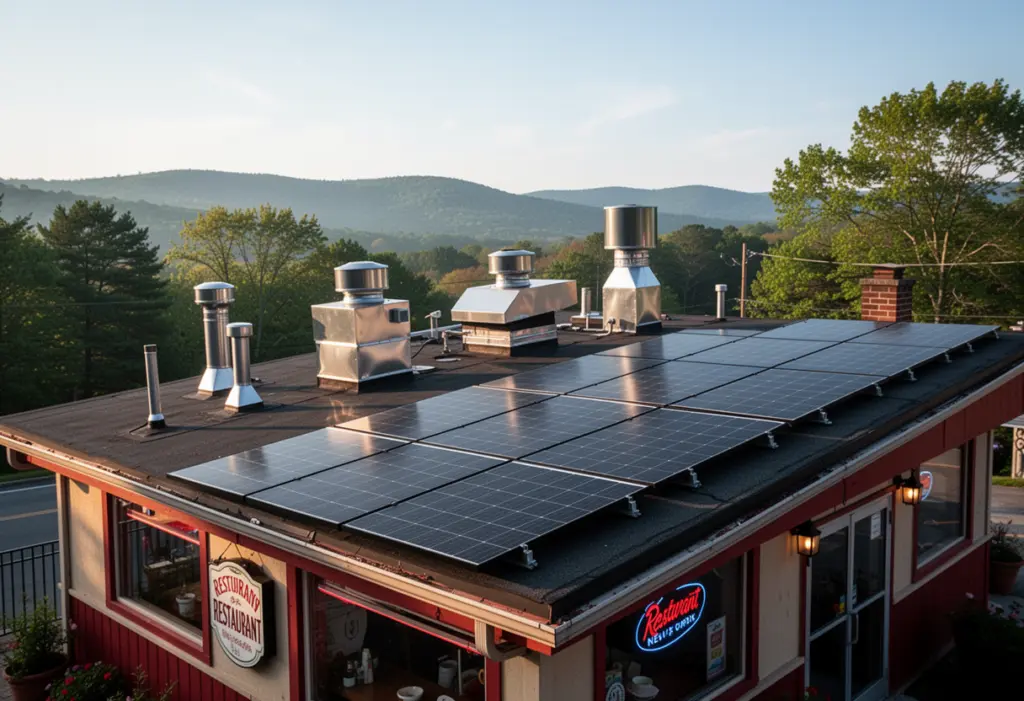
The honest answer for a restaurant turns on two things a homeowner never has to consider: when your load actually peaks, and whether your bill carries a demand charge. A restaurant peaks during evening service, hours after production has stopped, and a commercial tariff frequently bills the highest short interval of draw in the month as a separate line. Solar reduces the kilowatt-hours you consume. It does far less to that peak. Settle both before anyone shows you a payback figure.
Read your own bill before the first meeting
Collect twelve months of bills and find three things in them.
- The utility name printed on the bill, not inferred from your county. If you are served by a municipal electric utility you sit outside Public Service Commission jurisdiction entirely: no PSC net metering, no Customer Benefit Contribution, no state interconnection process, and terms set by that utility rather than by the state.
- The rate or service classification, which decides how everything else is billed.
- Whether there is a demand charge, billed in kilowatts, separate from the energy charge billed in kilowatt-hours.
A restaurant with a demand charge and an evening peak is the hardest case for solar to answer honestly. Whether yours is that case is a question your own twelve months of bills answer, not a rule of thumb.
Refrigeration is the part that helps
Not all of a restaurant’s load sits in the evening. Walk-in refrigeration and freezers run continuously, air conditioning works hardest through summer afternoons, and prep, dishwashing and make-up air all draw during daylight. That daytime base is what solar actually offsets, and it is the number worth quantifying: not your annual kilowatt-hours, but how many of them fall in daylight hours. Interval data from the utility will tell you. A proposal built on the annual total alone is not answering the question you have.
The roof is a working surface
A restaurant roof already carries kitchen exhaust fans, make-up air units, condensers and the service clearances around them, and none of that can be built over or blocked. Ask the installer to lay the array out against the equipment actually up there and against the paths a service engineer needs, rather than against a satellite outline of the building. Ask where the exhaust discharge sits relative to the modules and what that means for cleaning.
Then ask about the membrane: its age, the remaining term of its warranty, who is permitted to penetrate it without voiding that warranty, and what it would cost to remove and reinstall the array if the roof needs replacing in eight years. That last figure is the one most often left out of a proposal, and on a flat commercial roof it is not small. If the roof is near the end of its life anyway, price doing both together.
If you rent, the roof is not yours to give
Where the premises are leased rather than owned, the whole calculation changes. A solar system is a twenty-five year asset bolted to somebody else’s building under a lease that may have six years left to run. The landlord has to agree in writing, and the agreement has to say what happens at the end of your tenancy: who owns the system, who removes it, who repairs the roof, and who carries the cost. Do not let a proposal advance on a verbal assurance. If the lease term is short and the landlord will not commit, that is an answer, and it is far better to have it in month one than in month nine.
The New York incentives, honestly
The 30 percent federal residential credit is gone. Section 25D was terminated for expenditures made after 31 December 2025, and an expenditure counts as made when the original installation is completed. Business projects fall under a different provision entirely and this page does not guess at it. Take that question to your accountant with the actual ownership structure in front of them.
New York State’s 25 percent credit, capped at 5,000 dollars on Form IT-255, is for a principal residence and does not reach business premises. The state sales tax exemption is written for residential solar energy systems equipment, so a commercial project should confirm its own position rather than assuming the exemption applies. NY-Sun is applied by the contractor as a price reduction and steps down in blocks as capacity fills, so ask what the per-watt figure is on the day and whether it is already netted off the price you were shown.
The capacity charge, and the exemption that may cover your account
The Customer Benefit Contribution is a monthly charge on the DC size of the system, not on what it produces, for systems interconnected on or after 1 January 2022. For 2026 the net-metered small commercial rates are 1.83 dollars per kW-month on Central Hudson, 1.47 on Con Edison, 1.38 on National Grid, 1.19 on LIPA and PSEG Long Island, 1.14 on NYSEG, 0.96 on RG&E and 0.88 on Orange & Rockland; a project compensated under the Value Stack instead sits on a separate, lower schedule. On a 20 kW array that is 29.40 dollars a month on Con Edison against 17.60 on Orange & Rockland.
But accounts with a demand charge do not pay it at all, which is the one place where the demand charge that spoils your payback works in your favour. The rates are recalculated annually rather than fixed at interconnection, so a twenty-year model that holds this line constant is wrong on its face.
Property tax and the deadline
RPTL 487 exempts the added value of the system from real property tax for fifteen years, but only where the municipality, the county and the school district have each separately not opted out. Three separate checks, made with your assessor. The system must also be constructed before 1 January 2030. In New York City, Buffalo, Rochester, Syracuse and Yonkers the school district levies no separate property tax, so there are two checks rather than three.
Programmes move. Confirm the current NY-Sun block with NYSERDA, the credit position with the New York State Department of Taxation and Finance, the exemption with your assessor, and the tariff with your utility, before you sign rather than after.
Frequently Asked Questions
Does solar make sense for a restaurant if the load peaks in the evening?
It can, but not for the reason a sales pitch usually gives. What solar offsets is the daytime base load: refrigeration, air conditioning, prep, dishwashing and make-up air. Ask for interval data and have the model show how much of your consumption falls in daylight hours rather than working from the annual total.
Will solar reduce my demand charge?
Only if your billed peak happens while the array is producing. A demand charge is set by the highest short interval of draw in the month, so an evening peak is largely untouched. Ask for the demand line and the energy line to be modelled separately.
Does a restaurant pay the Customer Benefit Contribution?
Accounts with a demand charge do not pay it. On accounts that do, it is billed on DC system size: at 2026 small commercial rates a 20 kW array is $29.40 a month on Con Edison and $17.60 on Orange & Rockland, whatever the array produces.
Can I put solar on a building I lease?
Only with the landlord's written agreement, and the agreement has to cover the end of your tenancy: ownership, removal, roof repair and who pays. A twenty-five year system on a six-year lease is a question to settle before design, not after.
This article is general information, not tax, legal or financial advice. Incentive amounts, eligibility rules and deadlines change and depend on your utility, your tax situation and your property. Confirm current terms with NYSERDA, your utility and a qualified tax professional before making a decision.
NY Solar Incentives
Independent New York solar research. We summarise NYSERDA, NY-Sun and federal programme rules from published sources and state plainly when a figure is an estimate. We are not a government agency and do not sell equipment.
Run the arithmetic on your own system
Check the dated program table and your arrangement before counting an incentive. Standard residential NY-Sun blocks are closed; Long Island Affordable Solar has a conditional income-verification route. The NY credit depends on qualified costs and tax liability, while the NYC abatement reduces future property-tax bills. The estimator keeps those timings separate.