Solar Export Limits in New York: What Utilities Restrict
Under Phase One net metering there is no cap on the value of what you export. What limits a New York array is sizing, the local circuit, and the fine print.
On this page 8 sections
- 011. Sizing against your own consumption
- 022. What the local circuit can accept
- 033. Export control written into the agreement
- 04Two thresholds people mistake for export caps
- 05If your utility is municipal, none of this applies
- 06The questions that settle it
- 07The 2026 incentive position
- 08Frequently Asked Questions
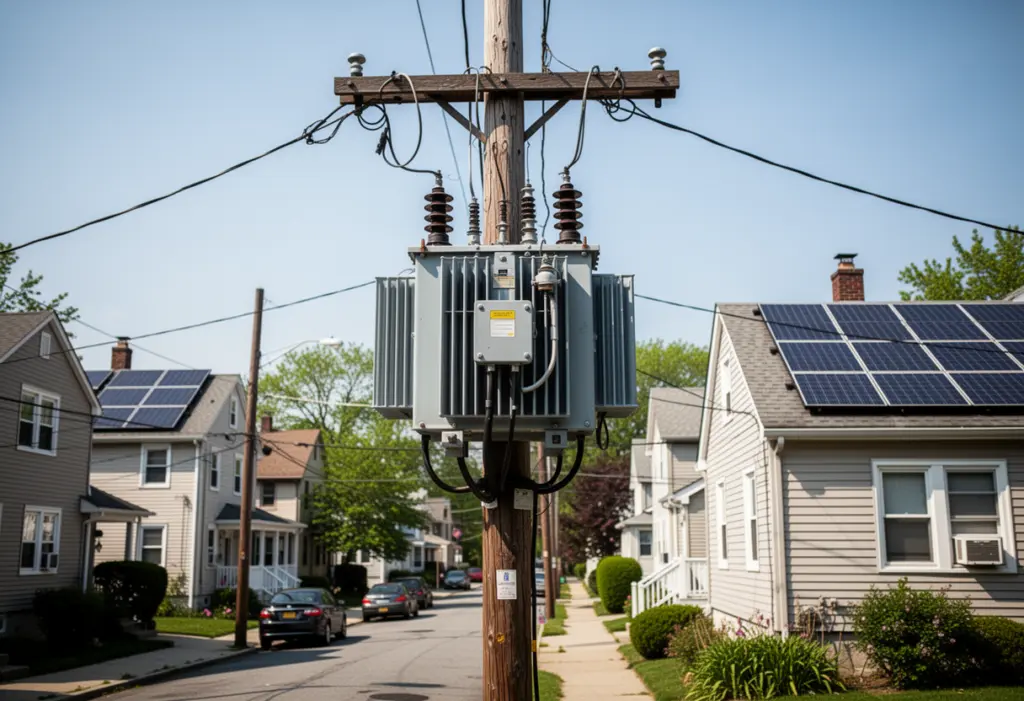
Homeowners usually arrive at this question expecting a number — a maximum number of kilowatt-hours a New York utility will accept from a rooftop array. That is not how the residential structure works. Under Phase One net metering your exports are credited at the full retail rate, and a system interconnected today holds that structure for 20 years. There is no per-kilowatt-hour export cap sitting inside it. What actually limits you is three other things, and each one is a question to put to the installer before signing.
1. Sizing against your own consumption
The first and most common limit is your own annual usage. Residential net metering is designed to offset the load at the premises, not to turn a roof into a generating business, and a system materially larger than the household consumes runs into that expectation at the application stage.
It also fails on its own arithmetic. Net metering reconciles over a year, so a credit balance you never draw down is not money — it is unpaid capital sitting on your roof. And the Customer Benefit Contribution is billed monthly on the DC size of the array regardless of production, so every surplus kilowatt costs you every month. On PSEG Long Island the 2026 residential rate is $1.13 per kW-month, so a 12 kW array carries $13.56 a month, about $163 a year — the same whether the credits are consumed or wasted. Ask what annual consumption figure the design was built from, and ask to see it.
2. What the local circuit can accept
The second limit is physical and entirely outside your control: the distribution circuit your house sits on. Where a feeder already carries a great deal of distributed generation, an application can require additional study, or system upgrades whose cost lands on the project, or a longer timeline than the sales conversation assumed. This is not a rejection and it is not rare — it is ordinary engineering, and the utilities publish hosting capacity information precisely so it can be anticipated.
The practical questions are: has the installer checked the circuit before quoting, what happens to the price and the schedule if a study is required, and who pays if an upgrade is triggered. A contract that is silent on all three puts that risk on you.
3. Export control written into the agreement
The third limit is the one worth reading for specifically. An interconnection agreement can require the inverter to be configured so that the system limits or does not export at all, which changes the economics completely: a non-exporting array only saves what the house is consuming at that moment, and everything the roof makes while nobody is home is thrown away.
Ask, in writing, whether any export limitation or non-export configuration is proposed for your system, and if so, what production estimate has been adjusted to reflect it. An estimate produced for a freely exporting array and then used to sell a limited one is not a small discrepancy.
Two thresholds people mistake for export caps
- 25 kW DC is the ceiling for the New York State Unified Solar Permit, which standardises residential and small commercial permitting and has been adopted by over 300 authorities having jurisdiction. It is a permitting threshold, not an export limit, and it says nothing about what the utility will accept.
- The Value Stack, or VDER, is a different compensation structure for community distributed generation and for larger and commercial projects — not mass-market residential. If a proposal moves you onto it, ask why, and ask what your exports would be worth under each. Do not accept the switch as a formality.
If your utility is municipal, none of this applies
New York has roughly fifty municipal electric utilities, and they sit outside Public Service Commission jurisdiction entirely. There is no PSC net metering, no Customer Benefit Contribution and no state interconnection process for their customers. Whether exports are credited at all, at what rate, and under what limits is set by that utility and has to be asked directly. Confirm the utility name from your own bill rather than from a coverage map, because service territories do not follow municipal lines cleanly and several villages inside investor-owned territory run their own systems.
The questions that settle it
- What annual kilowatt-hour consumption was this design sized to, and from which twelve months of bills?
- Has the circuit been checked for available hosting capacity, and what happens to price and schedule if a study or an upgrade is required?
- Does the proposed interconnection agreement contain any export limitation or non-export requirement?
- What is the monthly Customer Benefit Contribution for the exact DC size being proposed, and what is it over a year?
- Is anything in this quote priced on the Value Stack rather than on Phase One net metering?
The 2026 incentive position
None of the above is affected by the federal change, but the change affects every payback figure attached to it. Section 25D was terminated for expenditures made after 31 December 2025, with an expenditure treated as made when the original installation is completed, so a purchasing homeowner claims nothing federally in 2026 and any proposal still carrying a 30% line needs reissuing. What remains is New York’s own credit at 25% capped at $5,000 on Form IT-255 for a principal residence, the state sales tax exemption on residential solar equipment, and RPTL 487’s 15-year property tax exemption, which needs the county, the municipality and the school district each not to have opted out and the system constructed before 1 January 2030. NY-Sun no longer belongs on that list: as of September 2026 NYSERDA has no open NY-Sun block for homes in any utility territory, and that includes the income-qualified Affordable Solar blocks, which closed in Con Edison territory on 15 October 2025 and in NYSERDA’s Upstate region on 9 March 2026. Check NYSERDA’s NY-Sun dashboard for a new one. Rates and programme terms are revised annually — verify with NYSERDA and with your own utility before you rely on any number in a proposal.
Frequently Asked Questions
Is there a limit on how much solar power I can export in New York?
Not as a kilowatt-hour cap under Phase One net metering, which credits exports at the full retail rate for 20 years. The real limits are sizing to your own consumption, what the local distribution circuit can accept, and any export control written into the interconnection agreement.
What happens if my circuit has no hosting capacity left?
The application can require additional study, a longer timeline, or system upgrades whose cost may land on the project. Ask before signing whether the circuit was checked, and who carries the cost and the delay if a study or upgrade is triggered.
Can a utility require my inverter to limit exports?
An interconnection agreement can require a limited or non-export configuration, which changes the economics substantially because only what the house consumes at that moment is saved. Ask in writing whether one is proposed and whether the production estimate reflects it.
Does the 25 kW limit mean I cannot export more than that?
No. 25 kW DC is the ceiling for the New York State Unified Solar Permit, a permitting standard adopted by over 300 authorities having jurisdiction. It is unrelated to what the utility will accept as export.
This article is general information, not tax, legal or financial advice. Incentive amounts, eligibility rules and deadlines change and depend on your utility, your tax situation and your property. Confirm current terms with NYSERDA, your utility and a qualified tax professional before making a decision.
NY Solar Incentives
Independent New York solar research. We summarise NYSERDA, NY-Sun and federal programme rules from published sources and state plainly when a figure is an estimate. We are not a government agency and do not sell equipment.
Run the arithmetic on your own system
Check the dated program table and your arrangement before counting an incentive. Standard residential NY-Sun blocks are closed; Long Island Affordable Solar has a conditional income-verification route. The NY credit depends on qualified costs and tax liability, while the NYC abatement reduces future property-tax bills. The estimator keeps those timings separate.