Running a Heat Pump on a New York Time-of-Use Rate
A heat pump makes you a winter-peaking customer. Here is how New York time-of-use rates are structured, why heat pump demand fights them, and the settings that turn the trade around.
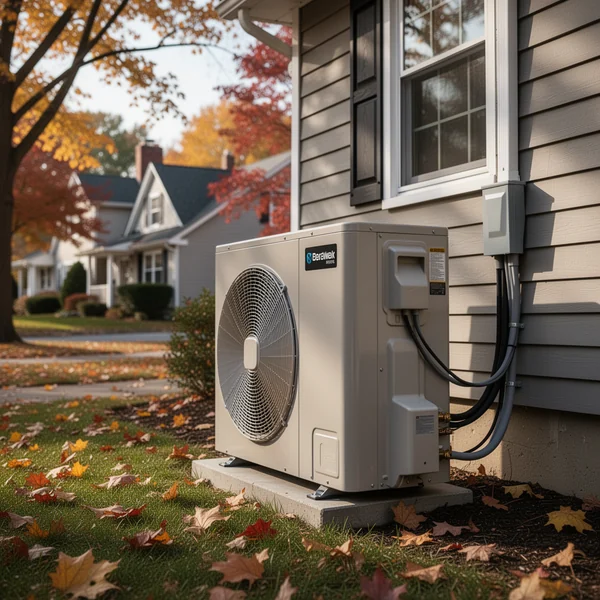
A time-of-use rate can make a heat pump in New York noticeably cheaper to run or noticeably more expensive, and which way it goes is decided almost entirely by load shape: the hours your house demands the most heat versus the hours your utility charges the most for a kilowatt-hour. In New York those two windows overlap badly, because the coldest stretch of a January morning is also when the grid is straining, so a heat pump moved onto a time-of-use rate without any change in how it is operated will often land on the wrong side of the trade.
The good news is that this is a controllable problem. Below is how the rates are structured here, why a heat pump’s demand curve fights them, and the specific operating changes that flip the outcome.
What a New York time-of-use rate actually changes
Under a standard residential rate, every kilowatt-hour costs the same regardless of when you use it. Under a time-of-use rate, the day is split into priced periods — a peak window that costs more and off-peak hours that cost less — with the definitions usually shifting between a summer season and a winter season. Residential time-of-use service in New York is generally voluntary: you opt in, and the tariff sets a minimum term before you can go back.
Three things about how this works here catch people out.
The peak windows are published in the tariff, not in a blog post. Con Edison, National Grid, NYSEG, RG&E, Central Hudson, Orange & Rockland and PSEG Long Island each define their own periods, and they are revised from time to time. Read your own utility’s rate-options page and the current service classification before you enrol. Anyone quoting you universal New York peak hours is guessing.
Supply and delivery are separate, and so are their time-of-use offers. Your utility sets the delivery rate; your supply may come from the utility or from an ESCO. An ESCO’s “time-of-use” supply product is a different animal from your utility’s time-of-use delivery rate, and switching one does not switch the other. Establish which half of the bill you are actually changing.
Winter peaks and summer peaks exist for different reasons. A summer peak is built around air conditioning in the late afternoon. A winter peak is built around the morning and evening, when heating and lighting stack. A heat pump makes you a winter-peaking customer in a state where much of the rate design was written around summer, and that is exactly the mismatch you are managing.
Why a heat pump’s demand curve is awkward
Three effects compound. First, heating demand rises as the outdoor temperature falls, and the coldest hour of the day is typically just before dawn — right at the leading edge of a morning peak period. Second, a heat pump’s coefficient of performance falls at the same time, so each unit of heat costs more kilowatt-hours precisely when kilowatt-hours are dearest. Third, and worst, is recovery: if the thermostat has been set back overnight and it calls for a large temperature rise at 6 a.m., many systems bring on electric resistance backup to catch up. Resistance heat has a coefficient of performance of 1.0 by definition. Burning it inside a peak window is the single most expensive way to heat a New York house, and it is entirely self-inflicted.
The operating changes that make time-of-use work
- Stop deep overnight setbacks. The old furnace advice does not transfer. A heat pump is happiest holding a steady temperature; the setback saves a little overnight and then buys it back at peak prices with backup heat. If your thermostat supports adaptive or early recovery, use it so the house reaches temperature before the peak window opens rather than during it.
- Lock out auxiliary heat by outdoor temperature. Most heat pump thermostats can be told not to energise resistance strips above a set outdoor temperature. Getting that lockout configured — and verified, not just typed in — is the highest-value hour a commissioning technician can spend on a time-of-use customer.
- Pre-heat and coast. Push the setpoint up slightly in the cheap hours before the peak, then let the house drift down through it. How long you can coast depends on the building, not the equipment: a tight, heavy house in Saratoga County holds temperature for far longer than an uninsulated 1920s frame house in Rochester with original windows. Try it on a mild week and watch the thermostat’s runtime data before you rely on it in February.
- Put the water heater on a schedule. A heat pump water heater already contains thermal storage — the tank is a battery you have paid for. Scheduling its heating for off-peak hours is free money and affects comfort very little.
- Do the envelope work first. Air sealing and attic insulation shrink the peak-hour load itself, which beats shifting it. This is also the work that makes coasting through a peak window possible at all.
Measure before you switch — the data is yours
Do not enrol on a hunch. New York utilities make interval usage data available to customers through their online accounts and Green Button downloads. Pull a full year of hourly data, apply the candidate time-of-use periods to it, and compare the total against what your standard rate produced. If you have not yet installed the heat pump, you can still do a version of this: model the added winter kilowatt-hours against the peak and off-peak periods and see how much of the load lands where.
Check one more thing before enrolling: if you also charge an electric vehicle, some utilities offer a separate EV-specific rate or a charging incentive, and whether that can be combined with a whole-house time-of-use rate varies. Ask the utility directly rather than assuming.
Solar, batteries and time-of-use together
If you already have panels, the interaction gets more interesting and more complicated. Under net metering your exports earn credits, but the value of an exported kilowatt-hour under a time-of-use structure depends on the hour it left the house — and in New York, winter is when solar production is weakest and heating demand is highest. Summer credits carrying a winter heating bill is a real strategy, but only if your net metering arrangement banks them the way you think it does; the mechanics differ by utility and are covered in Net Metering in New York: How Credits Work, with the Con Edison specifics in Con Edison Net Metering and the upstate version in NYSEG Net Metering.
A home battery changes the calculation again, because it lets you buy energy off-peak and spend it on-peak regardless of what the sun is doing. Whether that arbitrage justifies the hardware is a separate question with a genuinely mixed answer in New York, and we work through it in Do You Need a Battery With Solar in New York?. The short version: buy a battery for resilience during outages and treat rate arbitrage as a bonus, not the other way round.
The money side in 2026
There is no federal credit for a heat pump installed in 2026. Section 25C applied to qualifying property placed in service through 31 December 2025, per the IRS, and Section 25D terminated for expenditures after the same date. Build your payback model with a zero in that row.
The live incentive is NYS Clean Heat, run by NYSERDA with seven sponsoring utilities: Central Hudson, Con Edison, National Fuel Gas, National Grid, NYSEG, Orange & Rockland and RG&E. Rebate amounts are not published as a single statewide table — they vary by utility and equipment — so use the address-based finder at cleanheat.ny.gov. PSEG Long Island is not a Clean Heat sponsor and runs its own separate programmes, which Nassau and Suffolk readers should check directly. And note that New York’s Form IT-255 credit, 25% of cost capped at $5,000, is a solar equipment credit — it does not apply to a heat pump.
What to do next
- Download twelve months of interval usage data from your utility account and apply the published peak and off-peak periods to it yourself before enrolling.
- Read the current service classification on your utility’s own rate page for the peak window definitions and the minimum enrolment term.
- Confirm whether the time-of-use offer you are considering is a delivery rate from the utility or a supply product from an ESCO.
- Have your installer set and demonstrate the auxiliary-heat lockout temperature at commissioning, and get the setting written on the job sheet.
- Replace overnight setbacks with a steady setpoint or adaptive recovery, then compare a month of thermostat runtime against the previous winter.
- Check your address in the Clean Heat finder, and if you are on Long Island go to PSEG-LI’s programme pages instead.
NY Solar Incentives
Independent New York solar research. We summarise NYSERDA, NY-Sun and federal programme rules from published sources and state plainly when a figure is an estimate. We are not a government agency and do not sell equipment.
Run the arithmetic on your own system
Check the dated program table and your arrangement before counting an incentive. Standard residential NY-Sun blocks are closed; Long Island Affordable Solar has a conditional income-verification route. The NY credit depends on qualified costs and tax liability, while the NYC abatement reduces future property-tax bills. The estimator keeps those timings separate.