The PSEG Long Island CBC Charge on Solar
On PSEG Long Island the capacity charge is $1.13 per kW-month in 2026, billed on the size of the array rather than on anything it produces.
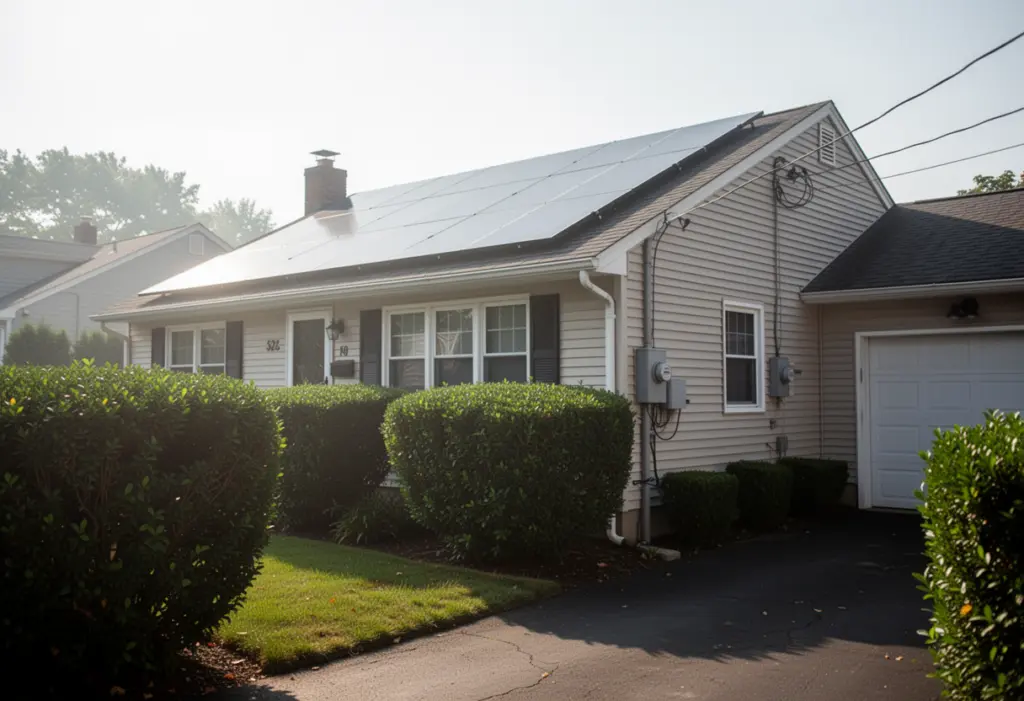
For PSEG Long Island customers the Customer Benefit Contribution is $1.13 per kW-month in 2026, and it is charged on the DC size of your array rather than on anything the array produces. An 8 kW system pays 8 × $1.13, which is $9.04 a month and $108.48 across the year. That figure is identical in a February of grey skies and a June of full sun, because production is not part of the calculation at any point.
How the number is arrived at
Take the DC nameplate capacity of the system, which is the module count multiplied by the module wattage, and multiply it by the rate for your utility and customer class. It appears as a monthly line, and it funds public benefit programmes covering low income support, energy efficiency and clean energy. The charge applies to systems interconnected on or after 1 January 2022, and that wording matters: a Long Island customer whose system was interconnected in 2019 does not owe it, and any page telling them that solar customers have paid it since 2022 is describing a charge they do not have.
The DC figure is also the number to check on a proposal. A system described as 7.6 kW in one place and 8.0 kW in another is a $0.45 a month difference, which is small, but the same imprecision usually indicates that the design has changed since the estimate was built and the savings figures underneath it have not been rebuilt.
Who pays nothing
- Systems interconnected before 1 January 2022. The charge does not reach back.
- Community solar. Front-of-the-meter projects are outside it, and so are their subscribers. Someone taking a bill credit from an off-site project pays no capacity charge at all, which is one of the quiet advantages of that route for a shaded roof or a rented house.
- Commercial accounts with a demand charge. Those customers are already billed on capacity through a different mechanism.
There is one boundary worth handling carefully. Whether adding capacity to a pre-2022 system brings the charge with it has been described differently in different editions of the NYSERDA fact sheet: the current version treats those systems as remaining outside it, while superseded text said the opposite and is still widely mirrored by industry blogs. If you are expanding an older array, put the question to the utility in writing and keep the answer, rather than relying on any published summary including this one.
It is not fixed at interconnection
This is the part most sales models get wrong by omission. The rates are recalculated annually and are not locked in on the day your system goes live. A twenty-year payback model that carries today’s charge unchanged through 2046 is making an assumption it has not declared. Ask what escalation, if any, the model applies to it, and ask to see the payback with the charge held flat and then increased, so you can see how sensitive the result is to a line nobody discusses on the doorstep.
How Long Island compares
Across the state the 2026 residential rates run from $0.97 per kW-month on National Grid to $1.67 on Central Hudson, with Con Edison at $1.29, RG&E at $1.31, NYSEG at $1.19 and Orange & Rockland at $1.00. LIPA at $1.13 sits in the middle. On that same 8 kW system the annual charge is about $93 under National Grid, $108 on Long Island and $160 under Central Hudson, for identical hardware on an identical roof. It is one of the few costs in a solar project determined entirely by which utility the house happens to sit under.
Two Long Island specifics are worth knowing beyond the headline rate. First, the small commercial rate here is $1.19, which is above the residential rate rather than below it, so a small business account should not assume it is treated more gently. Second, mass-market LIPA projects cannot opt into the Value Stack, so the net metering against Value Stack comparison that appears in upstate discussions does not arise for a Long Island home. Phase One net metering credits exports at the full retail rate and holds for 20 years from interconnection.
What it should change about the system you buy
Because the charge scales with capacity rather than output, an oversized array is penalised twice over. You pay for panels whose production becomes credits you never draw down, and you pay a monthly fee on their nameplate for as long as they are connected. Size against twelve months of your own metered consumption, plus any electrification you have genuinely decided on such as a heat pump or an electric vehicle, and stop there. If the proposed system is meaningfully larger than your usage, ask the installer to justify the extra kilowatts against both of those costs rather than against a percentage-offset target.
The charge is also the reason a battery does not rescue an oversized design. Under full retail-rate net metering the grid already banks surplus at full value, so storage on Long Island is a resilience purchase for outage weeks rather than an economic one, and adding it does not reduce the capacity charge by a cent.
Check the name on the bill first
PSEG Long Island operates the LIPA system across Nassau and Suffolk and the Rockaways, but not every address in that area. Some communities are served by their own electric systems, which sit outside Public Service Commission jurisdiction entirely: no state net metering, no Customer Benefit Contribution and no state interconnection process, with terms available only from that utility directly. The name printed on your own bill is the only reliable way to settle which regime you are in, and it takes ten seconds.
Where the incentives sit against it
Nothing offsets this charge, so it belongs on the cost side of the arithmetic permanently. What sits on the other side is the state sales tax exemption on residential solar equipment, with localities electing separately on their own share; New York’s 25 percent credit capped at $5,000 on Form IT-255 for a principal residence, limited by the state tax you actually owe; and RPTL 487’s fifteen-year exemption on the added value, where the town or village, the county and the school district have each not opted out and the system is constructed before 1 January 2030. NY-Sun is not on that side any more: the last Long Island residential block closed on 17 April 2016. As of September 2026 NYSERDA has no open NY-Sun block for homes in any utility territory; check NYSERDA’s NY-Sun dashboard for a new one. Nothing federal applies to a 2026 residential purchase, since section 25D was terminated for expenditures made after 31 December 2025, with an expenditure treated as made when the original installation is completed. Confirm the current rate at NYSERDA before signing, since it is reset every year.
Frequently Asked Questions
How much is the CBC on PSEG Long Island?
For 2026 it is $1.13 per kW-month for residential net metered solar, billed on DC system size. An 8 kW array pays $9.04 a month, about $108 a year, regardless of what it generates.
Does the charge depend on how much I produce?
No. It is calculated from the DC nameplate capacity of the array, so the monthly amount is the same in December as in June. Production affects your net metering credits, not this line.
Who is exempt from it?
Systems interconnected before 1 January 2022, community solar projects and their subscribers, and commercial accounts already billed a demand charge. For an expansion of a pre-2022 system, get the utility's answer in writing.
Will the rate stay at $1.13?
No. The rates are recalculated annually and are not locked in at interconnection. Ask what escalation your payback model applies to this line, and ask to see the result with it held flat.
This article is general information, not tax, legal or financial advice. Incentive amounts, eligibility rules and deadlines change and depend on your utility, your tax situation and your property. Confirm current terms with NYSERDA, your utility and a qualified tax professional before making a decision.
NY Solar Incentives
Independent New York solar research. We summarise NYSERDA, NY-Sun and federal programme rules from published sources and state plainly when a figure is an estimate. We are not a government agency and do not sell equipment.
Run the arithmetic on your own system
Check the dated program table and your arrangement before counting an incentive. Standard residential NY-Sun blocks are closed; Long Island Affordable Solar has a conditional income-verification route. The NY credit depends on qualified costs and tax liability, while the NYC abatement reduces future property-tax bills. The estimator keeps those timings separate.