Refinancing a Solar Loan in New York: What to Check
Refinancing a solar loan can lower a payment, but it cannot recover a fee already spent — and for New York borrowers there is a 2026 reason the payment may have moved at all.
On this page 7 sections
- 01First: find out whether your payment was always going to step up
- 02Second: understand what refinancing cannot recover
- 03What to establish before you apply anywhere
- 04The routes New York homeowners actually have
- 05Compare the total, not the rate
- 06What refinancing does not change
- 07Frequently Asked Questions
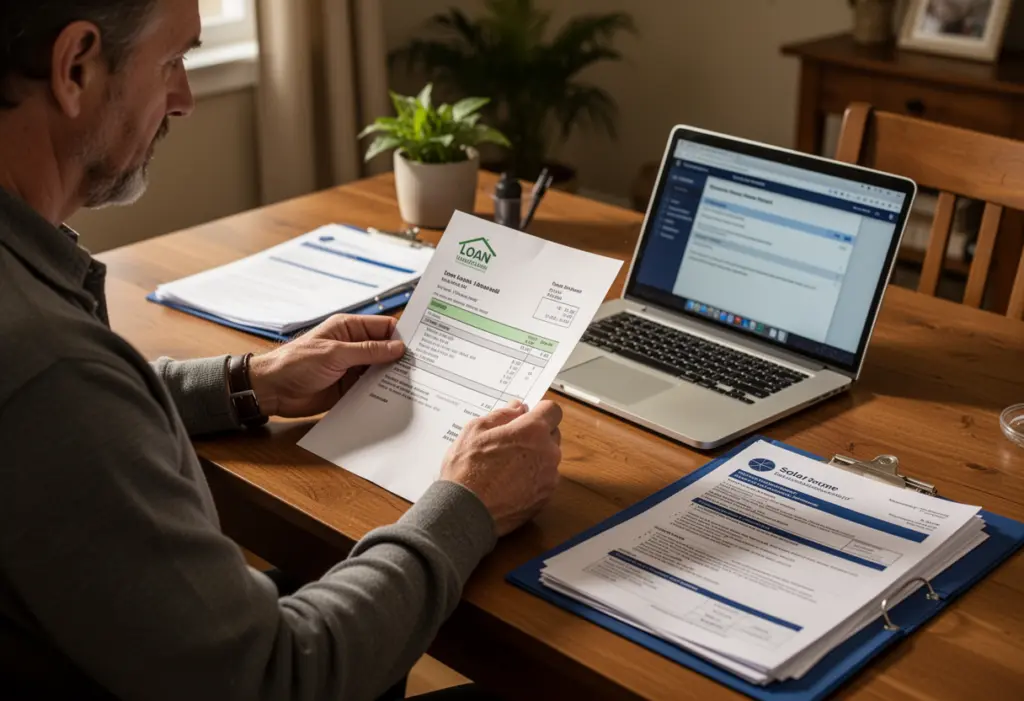
Most people who go looking for a solar refinance are reacting to one of two things: a payment that went up, or a rate that looks worse than what they could get today. They are different problems and only one of them is solved by refinancing. Start by reading your own note before you talk to anybody.
First: find out whether your payment was always going to step up
Solar loans are frequently written with a lower payment for the first sixteen to eighteen months, calculated on the assumption that a lump sum will be applied to principal inside that window. If the balance is not reduced by the target amount by the stated date, the loan re-amortises over the remaining term and the payment rises — as designed, and disclosed somewhere in the paperwork.
For a very large number of borrowers that lump sum was going to be the 30% federal residential credit. That credit is gone. Section 25D was terminated for expenditures made after 31 December 2025, with an expenditure treated as made when the original installation is completed, so a system finished in 2026 earns nothing federally — no phase-down and no transition. Anyone who signed a loan structured around a credit they will not receive should find the target principal payment and its deadline in the note, and call the lender before the date rather than after it.
New York's own credit does not fill that hole. It is 25% of qualified expenditure capped at $5,000 on Form IT-255, it requires a principal residence in the state, it is limited by your actual New York State tax liability, and it arrives when you file rather than at closing. Useful, considerably smaller, and on a different calendar.
Second: understand what refinancing cannot recover
A solar loan advertised well below ordinary unsecured rates is usually funded by a fee added to the system price. That fee was borrowed on day one and it sits inside your principal balance. Refinancing replaces the interest rate; it does not claw the fee back. Knowing this does not change the decision, but it changes the expectation — the savings from a refinance are the interest difference on the remaining balance, and nothing else.
What to establish before you apply anywhere
- Prepayment penalty. Ask the current lender directly and get it in writing. A payoff quote that includes unaccrued interest or a fee changes the arithmetic of the whole exercise.
- The lien. Solar loans are commonly secured by a filing recorded against the property or the equipment. A refinance must discharge the old filing, and a title search on a future sale will find it if nobody does. Ask for the discharge in writing when the payoff clears.
- The exact payoff figure and date. Interest accrues to the day. A quote from three weeks ago is not a payoff.
- Whether the equipment warranty or monitoring contract is tied to the loan. Occasionally a bundled service ends with the finance agreement rather than with the hardware.
The routes New York homeowners actually have
- A home equity loan or line of credit. Typically the lowest cost, because it is secured by the house — which is also the reason to be careful. Moving unsecured debt onto the property changes what happens if you cannot pay.
- A credit union personal loan. Unsecured, usually simpler, often available on shorter terms that cut total interest even when the headline rate is not dramatic.
- A cash-out refinance of the mortgage. Only sensible if you were refinancing the mortgage anyway, since closing costs on a whole mortgage to move a solar balance rarely pay for themselves.
- NYSERDA financing through Energy Finance Solutions, which offers the Smart Energy Loan and the On-Bill Recovery Loan, the latter repaid through your utility bill. Whether either can be used to retire an existing solar loan is a programme eligibility question — ask Energy Finance Solutions directly rather than assuming it, because the answer depends on the programme terms in force when you apply.
Compare the total, not the rate
Take the payoff figure and, for each option, multiply the monthly payment by the number of payments. That total, plus any fees to close, is the real cost of the option. A lower rate over a longer term routinely produces a bigger total than a higher rate over a shorter one, and a solar loan that already ran for two years has a shorter remaining life than any fresh twenty-year product will offer.
What refinancing does not change
Refinancing does not touch the state equipment credit. That credit attaches to the qualified expenditure on the equipment at your principal residence, not to how you paid for it, so replacing the loan neither creates a new credit nor forfeits one already claimed or carried forward. It does not change the Customer Benefit Contribution, which is charged monthly on the DC size of the array regardless of financing — $1.19 per kW-month on NYSEG and $1.67 on Central Hudson at 2026 residential rates. It does not change RPTL 487, the 15-year property tax exemption on the added value, which depends on the municipality, the county and the school district having each not opted out. And whether loan interest is deductible in your situation is a question for your accountant, not for a lender's marketing page. Verify programme terms at NYSERDA and the Department of Taxation and Finance before acting on any of it.
Frequently Asked Questions
Why did my solar loan payment suddenly increase?
Many solar loans carry a low payment for the first sixteen to eighteen months, assuming a lump sum reduces principal by a set date. If it does not, the loan re-amortises and the payment rises.
Can refinancing recover the dealer fee in my solar loan?
No. A fee that funded a below-market rate was added to the system price and borrowed on day one. Refinancing changes the interest on the remaining balance and nothing else.
Does refinancing affect my New York solar tax credit?
No. The IT-255 credit attaches to the qualified equipment expenditure at your principal residence, not to how it was financed, so replacing the loan neither creates nor forfeits it.
Is there a lien on my house from a solar loan?
Often there is a filing recorded against the property or the equipment. Ask your lender, and make sure any refinance discharges the old filing in writing, or a title search will find it at sale.
This article is general information, not tax, legal or financial advice. Incentive amounts, eligibility rules and deadlines change and depend on your utility, your tax situation and your property. Confirm current terms with NYSERDA, your utility and a qualified tax professional before making a decision.
NY Solar Incentives
Independent New York solar research. We summarise NYSERDA, NY-Sun and federal programme rules from published sources and state plainly when a figure is an estimate. We are not a government agency and do not sell equipment.
Run the arithmetic on your own system
Check the dated program table and your arrangement before counting an incentive. Standard residential NY-Sun blocks are closed; Long Island Affordable Solar has a conditional income-verification route. The NY credit depends on qualified costs and tax liability, while the NYC abatement reduces future property-tax bills. The estimator keeps those timings separate.