NYSERDA EmPower+ Eligibility, Explained Without the Jargon
EmPower+ eligibility runs through two doors: a qualifying benefit you already receive, or documented household income. Here is how each works, what the assessment covers, and where Clean Heat takes over.
On this page 8 sections
- 01Understanding NYSERDA EmPower+ eligibility: the two doors
- 02Why this page does not print an income limit
- 03Renters, landlords and small multifamily
- 04What the assessment actually involves
- 05Where EmPower+ stops and NYS Clean Heat starts
- 06The federal money is gone — plan without it
- 07If EmPower+ turns you down
- 08What to do next
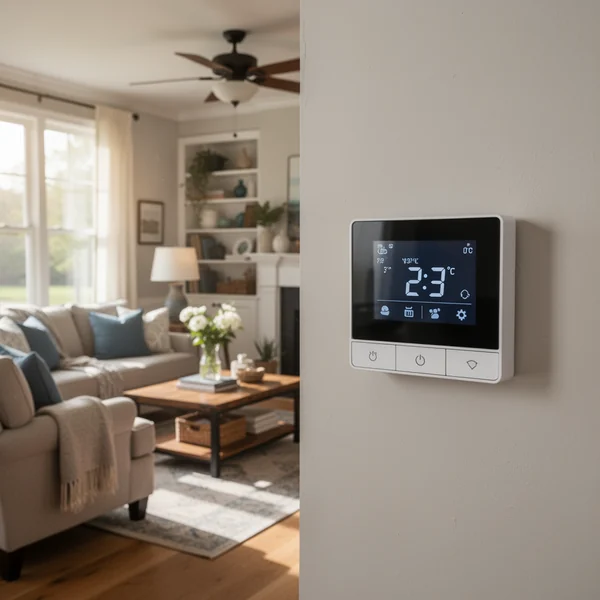
NYSERDA EmPower+ eligibility is decided at the household level, by income or by the benefits you already receive, and it is assessed for the address you live at rather than for you personally. If you qualify, the programme pays for a home energy assessment and covers eligible efficiency work — insulation, air sealing, health-and-safety fixes — at no cost or heavily reduced cost, through contractors in NYSERDA’s network.
That is the whole idea in two sentences. The rest of this page is about the parts that trip New Yorkers up: which door you go through, what happens at the assessment, where EmPower+ stops and NYS Clean Heat begins, and why nobody should be building a 2026 budget around a federal tax credit.
Understanding NYSERDA EmPower+ eligibility: the two doors
Almost every income-qualified programme in New York is built the same way, and EmPower+ is no exception. There are two routes in, and you only need one of them.
- Categorical eligibility. If your household already receives certain assistance — the kind of benefit that has already put your income through a state verification process — the programme can accept that determination instead of re-checking your paperwork from scratch. Which benefits count is set by NYSERDA and does change, so ask which ones are on the current list before you assume yours is or is not there.
- Income documentation. If no categorical route applies, you document household income against the threshold that applies to your county and household size. Thresholds are not a single statewide number; they move with household size, and they are revised.
Two practical points people miss. First, “household” means everyone living in the dwelling unit, not everyone on the deed or the lease — a grown child living at home counts. Second, the assessment is per unit: in a two-family house, the upstairs and downstairs are separate households with separate determinations, even though the roof and the boiler are shared.
Why this page does not print an income limit
Because a stale number here would cost somebody a programme they qualify for. Income thresholds and per-measure caps in New York’s income-qualified programmes get revised, and half the pages ranking for this query are quoting figures from a previous version of the programme under a previous name. You will still see the retired names — EmPower New York, Assisted Home Performance with ENERGY STAR — on contractor sites and in old forum threads, attached to old numbers.
The live figures come from NYSERDA directly. Call 1-866-NYSERDA or go to the EmPower+ page on nyserda.ny.gov and read the current eligibility table there. If a contractor tells you a threshold from memory, treat it as a guess and confirm it — an installer who is wrong about your eligibility costs you nothing until the paperwork is refused, at which point you own the invoice.
Renters, landlords and small multifamily
Renting does not disqualify you. The programme is built around one-to-four-unit residential buildings and there is a route for tenants, but the building owner has to sign on, because the work is being fixed to somebody else’s asset. In practice that means a conversation with your landlord before you get far into the application, and it is worth framing it the way a landlord hears it: insulation and air sealing reduce turnover complaints and boiler run time, and the owner is not paying for it.
Buildings above four units go through a different NYSERDA multifamily route entirely, with the owner as the applicant. If you live in a 12-unit building in Yonkers or a 30-unit building in Buffalo, your route is your building’s management, not a homeowner application.
What the assessment actually involves
Expect a couple of hours and a technician who will be more interested in your basement and attic than in your thermostat. A proper assessment includes a blower door test to measure how leaky the building envelope is, a look at insulation depth and coverage in the attic and rim joists, and combustion safety testing on any gas or oil appliance — which is the part that quietly matters most, because a house that is air-sealed without checking draft on an atmospheric water heater is a house with a new backdrafting problem.
The report you get out of it is useful even if you never do the work: it names the actual defects in your specific house, in order, which is exactly the information a contractor’s free “estimate” is not designed to give you. Health and safety issues found during the assessment — knob-and-tube wiring in a cavity you were about to insulate, a cracked heat exchanger, standing water in the crawl space — usually have to be resolved before the efficiency work proceeds. That is not the programme being difficult; it is the reason the work is allowed to be free.
Where EmPower+ stops and NYS Clean Heat starts
These are two different programmes and people blur them constantly. EmPower+ is income-qualified and is mostly about the shell of the building — the insulation, the leaks, the safety issues. NYS Clean Heat is not income-qualified: it is the statewide heat pump incentive, administered by NYSERDA together with seven sponsoring utilities — Central Hudson, Con Edison, National Fuel Gas, National Grid, NYSEG, Orange & Rockland and RG&E.
Note who is not on that list: PSEG Long Island is not a NYS Clean Heat sponsor. Nassau and Suffolk electric customers have their own separate PSEG-LI efficiency and heat pump offerings, and any page that tells a Long Islander to claim a Clean Heat rebate through PSEG-LI is wrong.
Clean Heat rebate amounts are not published as one statewide table — they differ by utility and by equipment type. The only address-accurate answer comes from the official finder at cleanheat.ny.gov/find-available-rebates/. Anyone quoting you a single per-ton figure that supposedly applies across New York is quoting something they made up or something out of date.
The sensible sequence is envelope first, equipment second. A heat pump sized for a leaky house is a bigger, louder, more expensive heat pump that runs at partial load badly. If you are income-qualified, doing EmPower+ work before you size the heat pump is the single highest-return decision in the whole project.
The federal money is gone — plan without it
This is the part most competing pages still have wrong. Both federal residential credits ended for property placed in service after 31 December 2025. Section 25C, the Energy Efficient Home Improvement Credit, was allowed for qualifying property placed in service before that date; while it existed it capped the general bucket at $1,200 a year and heat pumps, heat pump water heaters and biomass systems at $2,000. Section 25D, the Residential Clean Energy Credit, terminated for expenditures after the same date.
A New York household installing in 2026 gets nothing federal. If a contractor’s proposal shows a 30% federal credit line, that proposal was written against last year’s rules and every number below it is wrong. The IRS page for 25C is the source to check it against, not a sales sheet.
What survives at the state level is real, but read what it applies to. New York’s solar equipment credit — Form IT-255, 25% of system cost capped at $5,000, carried forward up to five years — is for solar energy system equipment. It is not a heat pump credit and not an insulation credit. Our walkthrough of how Form IT-255 is actually claimed covers what does and does not go on it, and the wider list of NYSERDA incentives still available in 2026 is worth reading before you commit to a sequence of projects.
If EmPower+ turns you down
An income determination above the threshold is not the end of it. Market-rate households still get Clean Heat through their utility, and the NYSERDA On-Bill Recovery Loan lets the repayment ride on your utility bill rather than requiring a home equity draw — which matters if you are trying to do envelope work and equipment in the same year. New York’s broader renewable and efficiency incentive set has routes that do not test income at all.
What to do next
- Call 1-866-NYSERDA and ask two questions only: which categorical benefits currently qualify, and what the income threshold is for your county and household size. Write down the date you asked.
- Have your last 12 months of utility bills and your household’s income documents in one place before the call.
- Run your address through cleanheat.ny.gov/find-available-rebates/ so you know which of the seven sponsoring utilities you sit under, before any contractor tells you.
- Book the assessment before you book any contractor. The blower door number is your leverage in every quote that follows.
- Delete any federal credit line from a 2026 budget until the IRS page for that specific section says otherwise.
NY Solar Incentives
Independent New York solar research. We summarise NYSERDA, NY-Sun and federal programme rules from published sources and state plainly when a figure is an estimate. We are not a government agency and do not sell equipment.
Run the arithmetic on your own system
Check the dated program table and your arrangement before counting an incentive. Standard residential NY-Sun blocks are closed; Long Island Affordable Solar has a conditional income-verification route. The NY credit depends on qualified costs and tax liability, while the NYC abatement reduces future property-tax bills. The estimator keeps those timings separate.