The NYSEG CBC Charge on Solar, With the Arithmetic
The Customer Benefit Contribution follows the size of your array, not its output. On NYSEG that is $1.19 for every DC kilowatt, every month.
On this page 7 sections
- 01The arithmetic on sizes people actually install
- 02The three exclusions that matter more than the rate
- 03The comparison that catches farms and side businesses out
- 04Why this is an argument against a bigger array
- 05One more reason to read the name on the bill
- 06What offsets the charge in 2026
- 07Frequently Asked Questions
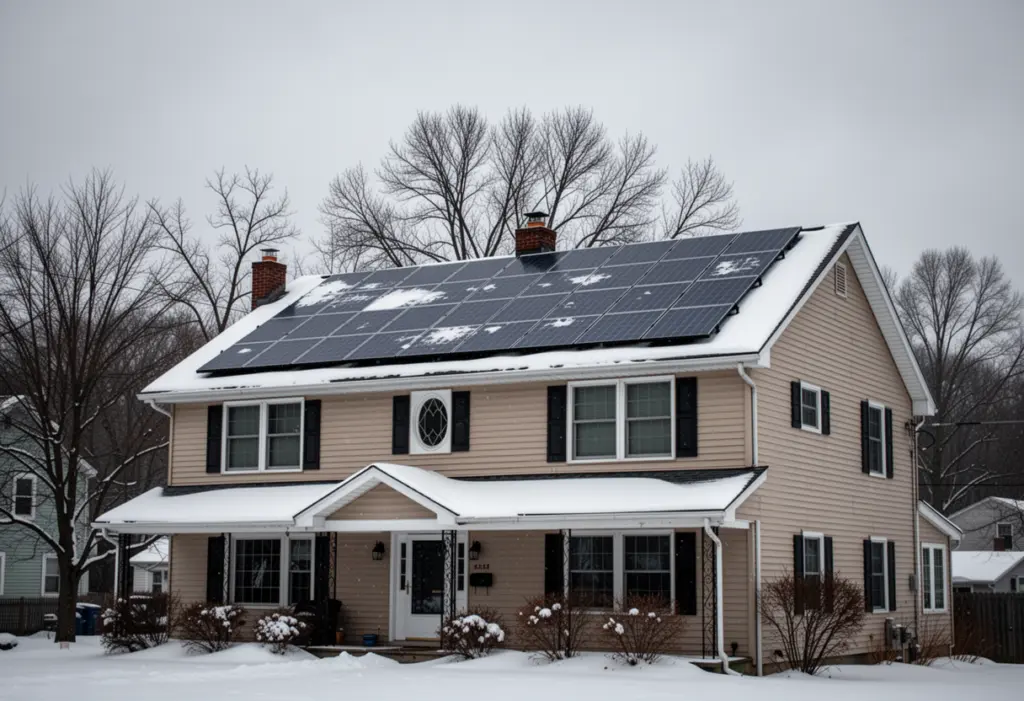
NYSEG’s 2026 residential Customer Benefit Contribution is $1.19 per kW-month, calculated on the DC size of your array. That word capacity is doing all the work: the charge is identical in a February week when the panels are under six inches of snow and in a cloudless June, because it has nothing to do with production at all.
The arithmetic on sizes people actually install
- 4.8 kW — $5.71 a month, about $68.54 a year
- 8.6 kW — $10.23 a month, about $122.81 a year
- 11.4 kW — $13.57 a month, about $162.79 a year
Set that against the state as a whole and NYSEG sits mid-table. The 2026 residential rates run from $0.97 at National Grid up to $1.67 at Central Hudson, with Orange and Rockland at $1.00, LIPA and PSEG Long Island at $1.13, Con Edison at $1.29 and RG&E at $1.31. The 8.6 kW array above would cost about $100 a year under National Grid and about $172 under Central Hudson — a spread of roughly $72 a year created by nothing but which company’s name is printed on the bill.
The three exclusions that matter more than the rate
Interconnection date. The charge applies only to systems interconnected on or after 1 January 2022. It is not a levy on solar customers generally, and a system connected in 2020 does not owe it. The current NYSERDA fact sheet also treats later expansions of a pre-2022 system as staying outside the charge; an earlier version of that same document said the opposite and the superseded wording still circulates widely, so verify against the current fact sheet for your own case rather than trusting a blog.
Community solar. Subscribers pay none of it. These are front-of-the-meter projects, so the capacity charge simply does not arise. A household choosing a subscription over an 8.6 kW roof array is not paying that $122.81 a year.
Commercial accounts with a demand charge. They are billed on a different basis entirely.
The comparison that catches farms and side businesses out
NYSEG’s 2026 small commercial rate is $1.14, which is lower than its residential $1.19. That inversion holds at exactly three New York utilities — NYSEG, RG&E and Orange and Rockland — and everywhere else the small commercial figure is the higher of the two. It matters in the Southern Tier and around the Finger Lakes, where a farmhouse and a farm shop frequently sit on separate accounts and people assume the two rates move together. They do not, and the direction is not the one intuition suggests.
There is also a separate Value Stack column, where the NYSEG residential figure is $0.60 per kW-month, roughly half the net metered rate. Do not read that as an option to choose. The Value Stack, or VDER, is the compensation framework for community distributed generation and for larger and commercial projects, while mass-market residential rooftop sits on Phase One net metering. A residential proposal quoting the Value Stack number is describing a framework you are probably not in.
Why this is an argument against a bigger array
Every additional DC kilowatt adds $1.19 a month here for as long as the array exists, whether or not you ever use what it makes. An array deliberately built beyond your consumption generates export credits at the full retail rate that you then never draw down, and you pay the capacity charge on that surplus capacity every single month. Size to the load you will genuinely have, including a heat pump or an EV charger if either is actually planned, and stop there.
The practical version of that advice: the DC figure on your interconnection application is the figure your bill is built from. Ask what number is going on the form, check it against the module count and rating in your contract, and query any change made late in the design.
One more reason to read the name on the bill
NYSEG’s territory covers much of the Southern Tier, the fringe of the Finger Lakes and parts of the Hudson Valley and the North Country, and its boundaries do not follow county lines cleanly. Several villages inside that footprint run their own electric systems — Andover, Angelica and Wellsville in Allegany County, Bath in Steuben, Penn Yan in Yates among them. Municipal electric customers are outside Public Service Commission jurisdiction, which means no Customer Benefit Contribution, no PSC net metering and no state interconnection process. Whatever applies to them is set locally and has to be asked for at the counter.
What offsets the charge in 2026
Weighed against a purchase, this charge is small but permanent, and it is not offset by anything federal — the 30% residential credit ended for expenditures made after 31 December 2025. What remains is the state sales tax exemption on residential solar equipment, with localities free to elect their own share separately; the 25% state credit capped at $5,000 on Form IT-255 for a principal residence; and RPTL 487, a 15-year exemption on the added property value where the municipality, the county and the school district have each not opted out, for systems constructed before 1 January 2030. NY-Sun, which your installer reduces from the contract price when a block is open, is not on that list for now: as of September 2026 NYSERDA has no open NY-Sun block for homes in any utility territory; check NYSERDA’s NY-Sun dashboard for a new one. The capacity rates themselves are recalculated every year and are not locked in at interconnection, so treat any figure on this page as the 2026 position and confirm the current one in NYSERDA’s published rate sheet before budgeting on it.
Frequently Asked Questions
What is the NYSEG CBC rate for 2026?
$1.19 per kW-month for residential net metered solar, billed on DC system size. An 8.6 kW array pays about $10.23 a month, roughly $122.81 a year, whatever the weather does.
Is the charge based on how much electricity I generate?
No. It is a capacity charge on the DC size of the array, so it is the same in a snowed-in February as in June. That is why an oversized system costs you every month even when you never consume what it produces.
Who is exempt from the CBC?
Systems interconnected before 1 January 2022, community solar subscribers, and commercial accounts with a demand charge. The current NYSERDA fact sheet also keeps later expansions of a pre-2022 system outside the charge, though an earlier version said otherwise, so check the current document.
Is NYSEG's small commercial rate higher than residential?
No, it is lower — $1.14 against $1.19 for 2026. NYSEG is one of only three New York utilities where that is true, alongside RG&E and Orange & Rockland. Do not assume the pattern from another utility.
This article is general information, not tax, legal or financial advice. Incentive amounts, eligibility rules and deadlines change and depend on your utility, your tax situation and your property. Confirm current terms with NYSERDA, your utility and a qualified tax professional before making a decision.
NY Solar Incentives
Independent New York solar research. We summarise NYSERDA, NY-Sun and federal programme rules from published sources and state plainly when a figure is an estimate. We are not a government agency and do not sell equipment.
Run the arithmetic on your own system
Check the dated program table and your arrangement before counting an incentive. Standard residential NY-Sun blocks are closed; Long Island Affordable Solar has a conditional income-verification route. The NY credit depends on qualified costs and tax liability, while the NYC abatement reduces future property-tax bills. The estimator keeps those timings separate.