Keeping the Boiler as Backup When You Add a Heat Pump
Keeping the boiler as backup is the default New York heat pump retrofit, not a compromise. The design question is where the switchover temperature sits, and why.
On this page 7 sections
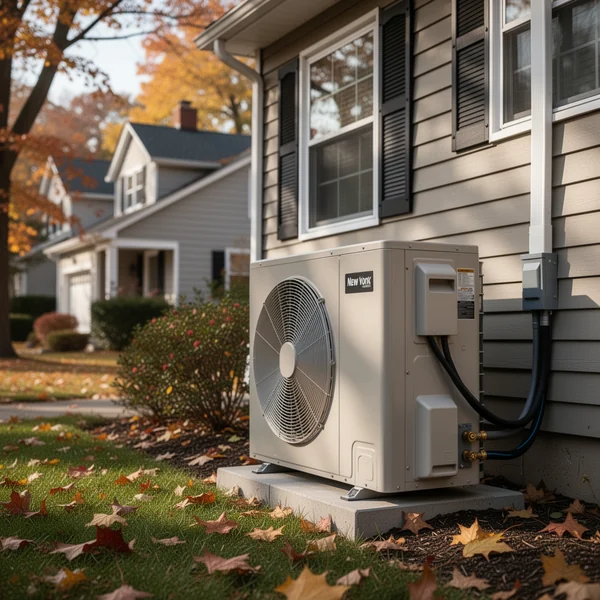
You can keep the boiler as backup when you add a heat pump, and in most New York retrofits that is the cheaper, lower-risk choice rather than a compromise. The configuration has a name — dual fuel, or hybrid heating — and the design question is not whether to keep the boiler but at what outdoor temperature the controls should hand heating back to it.
Get that handover point right and you have a system that runs on the heat pump for the great majority of the heating season and falls back to the boiler on the handful of days that actually punish an air source machine. Get it wrong and you either burn fuel you did not need to burn, or you watch a January electric bill you did not budget for.
Why keeping the boiler as backup is the default in New York retrofits
Three things push New York houses toward hybrid rather than full changeover. The first is that the boiler is usually not dead. If it has years left in it, removing a functioning appliance to buy a larger heat pump is spending money to reduce your own redundancy.
The second is sizing. A heat pump sized to carry the whole house at the coldest hour of a Watertown or Old Forge winter is a bigger, more expensive machine that then spends most of the season heavily oversized for the load — which is its own problem, because an oversized unit short cycles, dehumidifies poorly in summer and wears its compressor. Sizing to a milder point and letting the boiler cover the tail lets you buy a smaller, better-matched machine.
The third is the distribution system. If your house is heated by cast-iron radiators or baseboard fed by a boiler, the pipework is already there and already works. Adding ductless heads or a ducted air handler alongside it gives you a second, independent heating path — and, as a bonus most homeowners underrate, gives a radiator-heated house real air conditioning for the first time.
The switchover point is the entire design
There are two different temperatures people confuse here, and a good contractor will name both.
The balance point is the outdoor temperature at which the heat pump’s declining output exactly meets the house’s rising heat loss. Above it the heat pump can hold the house alone. Below it, something has to help. This is a physical property of your specific machine in your specific house, and it comes out of the load calculation and the manufacturer’s capacity tables.
The economic crossover is different: the outdoor temperature below which a unit of heat from the boiler costs less than a unit of heat from the heat pump. That one depends entirely on what you pay for electricity and what you pay for oil, propane or gas — and those move. A house on National Grid electricity burning oil has a different crossover from one on NYSEG burning natural gas, and the same house has a different crossover in a year when heating oil spikes.
The mistake to avoid is setting the switchover at the balance point and never touching it again. The balance point is a capacity fact; the crossover is a price fact. Good hybrid controls let you move the switchover setting, and it is worth revisiting when fuel prices move materially.
Three ways this actually gets wired
- Integrated dual-fuel control. One thermostat, one control board, an outdoor sensor, and a lockout temperature you set. Below the lockout the heat pump stops and the boiler runs; above it the boiler is locked out. Cleanest option, and the one that behaves predictably when you are not home. It usually requires equipment from a manufacturer whose controls are built for it.
- Thermostat-level lockout. A capable thermostat with an outdoor temperature input drives the two systems. Cheaper, more flexible on equipment pairing, but the integration is only as good as the thermostat and the wiring — and some smart thermostats handle heat pumps badly. Ask specifically, do not assume.
- Parallel and manual. Ductless heads on their own remotes, boiler on its own thermostat, and a human deciding. This is very common in real New York houses and it does work, but it depends on somebody paying attention. Left alone, both systems fight each other: the heads satisfy the room, the radiators fire anyway, and you pay twice.
If you are running the parallel arrangement, the practical trick is to set the boiler thermostat several degrees below your target and let it act as a floor rather than a partner. The heat pump does the heating; the boiler only wakes up if the house is actually losing ground.
What hybrid does to your Clean Heat rebate
NYS Clean Heat — NYSERDA together with Central Hudson, Con Edison, National Fuel Gas, National Grid, NYSEG, Orange & Rockland and RG&E — structures its incentives around equipment category, and it generally distinguishes between a system that carries the whole house and one that carries part of it. A partial-load installation with a fossil-fuel system retained is a recognised category; it is simply not the same category as a full changeover, and the incentive level reflects that.
Do not accept a per-ton or per-unit dollar figure from any page, including this one. Clean Heat amounts are not published as one statewide table, they differ by sponsoring utility and equipment type, and they change. Run your service address through the official finder at cleanheat.ny.gov/find-available-rebates and take the number it returns. If you are in Nassau or Suffolk, note that PSEG Long Island is not a Clean Heat sponsor and runs its own separate programmes.
And be clear about the federal side before anyone builds it into a quote. Section 25C, which carried a $2,000 annual cap for qualifying heat pumps, applied to property placed in service through 31 December 2025, and Section 25D terminated for expenditures after that date. A New York household installing in 2026 receives nothing federal. Any quote that still shows a 30 per cent federal credit is wrong.
The chimney problem nobody mentions until the install
This one catches older New York houses regularly. If your existing boiler is an atmospheric-draft appliance sharing a masonry chimney with a gas or oil water heater, that chimney was sized for the combined flue gases of both. Change what the boiler does — or replace it with something that vents differently — and the water heater can be left “orphaned” on a flue that is now too large and too cold for it to draft properly. The result is condensation inside the chimney, deteriorating masonry, and in the worst case spillage of combustion products into the basement.
You are not changing the boiler in a hybrid retrofit, so this often does not arise. But it does arise the moment someone suggests you also swap the water heater for a heat pump water heater, which is a very common pairing. The moment both combustion appliances stop sharing that chimney, the venting has to be re-evaluated. Ask about it before the work is scheduled, not after.
Two related items to settle in the same conversation: if you heat with oil, decide what happens to the tank, because an oil tank that sits half full and rarely cycles is a different maintenance proposition from one that empties every winter. And if the boiler is your only backup, it needs to keep running — a hybrid system depends on annual service on both machines, not just the new one.
Paying for it
Because a hybrid retrofit is usually smaller than a full changeover, it is also the version most likely to fit inside a financing envelope rather than a savings account. NYSERDA’s financing options are worth understanding before you sign a contractor’s own finance paper; the explainer on the NYSERDA On-Bill Recovery Loan covers how repayment through the utility bill works and where it fits. For the wider picture of what New York State still funds outside the solar programmes, see New York State renewable energy incentives beyond solar.
What to do next
- Find out how old your boiler actually is and what shape it is in. That answer, not a preference, decides whether hybrid is the right call.
- Ask any contractor quoting you for the Manual J printout, the design temperature it was run at, and the calculated balance point of the machine they are proposing.
- Work out your own economic crossover from your last twelve months of electric and fuel bills, and ask that the switchover be set to it rather than to a default.
- Run your address through the Clean Heat rebate finder before you take quotes, and confirm which equipment category a partial-load hybrid falls into for your utility.
- If a heat pump water heater is in the same conversation, get the chimney and venting assessed as part of the design, not as a change order.
NY Solar Incentives
Independent New York solar research. We summarise NYSERDA, NY-Sun and federal programme rules from published sources and state plainly when a figure is an estimate. We are not a government agency and do not sell equipment.
Run the arithmetic on your own system
Check the dated program table and your arrangement before counting an incentive. Standard residential NY-Sun blocks are closed; Long Island Affordable Solar has a conditional income-verification route. The NY credit depends on qualified costs and tax liability, while the NYC abatement reduces future property-tax bills. The estimator keeps those timings separate.