Red Flags in a Heat Pump Quote
A 30% federal credit line on a 2026 proposal is the loudest warning sign. The things to check in a New York heat pump quote before you sign anything.
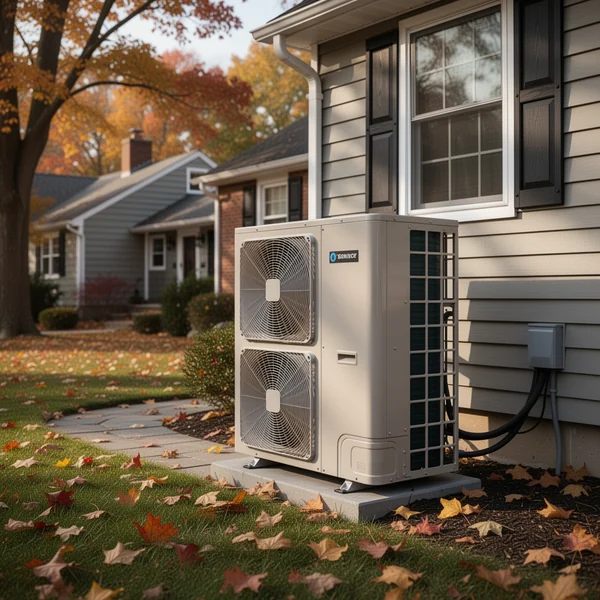
The single loudest red flag in a heat pump quote in 2026 is a line for a 30% federal tax credit. Both federal residential credits are gone — Section 25C applied to property placed in service through 31 December 2025, and Section 25D terminated for expenditures after that date — so a New York household installing this year gets nothing federal, and a contractor still printing that credit on a proposal is either not paying attention or is padding your perceived savings.
The rest of the heat pump quote red flags are quieter, and they are the ones that decide whether the system actually heats your house in February. Here is what to look for, roughly in order of how much money each one costs you.
The heat pump quote red flags that cost the most
1. No Manual J load calculation
If the proposal does not include a room-by-room load calculation for your specific house, the tonnage in it is a guess. The two most common substitutes are both wrong: sizing from square footage with a rule-of-thumb multiplier, and sizing from the nameplate of the boiler or furnace being replaced. The second is worse than it looks, because the equipment being replaced was itself almost certainly oversized when it went in.
Ask for the load calculation as a document, and check that it used the design temperature for your county. A Buffalo or Watertown design temperature is far colder than a Nassau County one; a contractor working off a single statewide assumption will oversize on Long Island and undersize in the North Country.
2. A tonnage but no model numbers
“3-ton cold climate heat pump” is not a specification. You need the outdoor unit model, every indoor unit or air handler model, the coil, and ideally the AHRI reference number for that matched combination — because the published efficiency and capacity ratings belong to the combination, not to the outdoor unit alone. Without model numbers you cannot compare two quotes, and you cannot verify anything the salesperson told you.
3. No capacity figure at low outdoor temperature
A heat pump’s rated capacity is stated at a mild condition. What matters in New York is what it produces at 17°F and at 5°F, which is in the manufacturer’s submittal or engineering data, and in the cold-climate listings maintained for exactly this purpose. A quote that never mentions capacity at your design temperature has not answered the only question that matters about whether it will keep up in a Syracuse January.
4. Silence on backup heat
Every quote should say plainly what happens on the coldest nights: electric resistance strips, the existing boiler or furnace retained as backup, or nothing because the system is sized to carry the load alone. Each is defensible. What is not defensible is leaving it unstated, because “we’ll leave the boiler in” and “we’ll add strip heat” have very different running costs, and a strip-heat backup on a high electric rate can produce a bill that makes the homeowner regret the whole project.
If the boiler stays, ask what controls the switchover and at what outdoor temperature. If nobody can answer that, the control strategy has not been designed.
5. No electrical scope
A heat pump needs a disconnect, a correctly sized breaker, and a circuit that your panel can actually carry. On older New York services — a Queens rowhouse on 100 amps, an upstate farmhouse with a fuse panel replaced once in 1978 — that can mean a subpanel, a load management device, or a full service upgrade with its own utility application and its own queue. A quote with no electrical line is a quote that has not looked in your basement, and it is the most common source of a mid-project change order.
6. No permit line
Mechanical and electrical permits are the norm across New York municipalities, and in New York City the filing requirements are stricter again. A contractor offering to skip the permit is offering you an uninspected install, a problem at resale, and in most cases a disqualification from any rebate that requires code-compliant work.
Red flags in how the rebate is described
7. “Up to $X in rebates”
NYS Clean Heat rebate amounts are not published as one statewide table. They vary by utility and by equipment type, and the official route is the address-based finder at cleanheat.ny.gov. A headline “up to” figure taken from a marketing page is not a number you can bank. Put your own address into the finder and see what your utility currently offers before you accept a bottom line that depends on it.
8. Confusion about which utility you are on
NYS Clean Heat is NYSERDA plus seven sponsoring utilities: Central Hudson, Con Edison, National Fuel Gas, National Grid, NYSEG, Orange & Rockland and RG&E. PSEG Long Island is not one of them — it runs its own separate programmes. A contractor quoting Clean Heat money for a Nassau or Suffolk address has made a basic error, and it is fair to ask what else they have assumed.
9. Vagueness about who processes the rebate
Ask directly: is your company able to process this rebate through my utility, and will it come off my invoice or will I be filing something? Then verify the answer against cleanheat.ny.gov rather than taking it on trust. The same due-diligence logic we set out for solar in what a NYSERDA-qualified contractor actually is applies here: participation status is checkable, and a company that resists the question is telling you something.
10. A savings projection with no inputs
“You’ll save 40% on heating” is not a calculation. A credible projection shows your current fuel use, your current electric supply and delivery rates from your own bill, the modelled heat pump consumption, and the assumptions behind all three. Ask to see the inputs. If there are none, the number was chosen, not computed.
Red flags in the paperwork and the pressure
- A deadline that only exists in the room. “This price is good today” is a sales technique. Clean Heat rebate levels do change, but they change by programme announcement, not by the end of your appointment.
- A large deposit. Equipment deposits are normal; most of the contract price up front is not.
- No written scope for removal. Decommissioning a boiler, removing an oil tank, or capping a gas line are separate jobs with separate rules. If they are assumed rather than written, they will be billed later.
- No line-set length, condensate plan or snow stand. Condensate that freezes at the base of an outdoor unit in a Utica winter is a service call every year. A stand that lifts the unit above expected snow depth is not optional north of the city.
- Warranty conditions buried. Many manufacturers require online registration within a set window for the extended warranty, and many limit coverage on coastal installations unless corrosion-protected equipment is used. Ask which applies and who is responsible for registering.
- Only one quote. Three is the working minimum, and they must be comparable — same load calculation, same model-number detail — or you are comparing sales writing, not systems. We make the same argument for solar in how to vet a solar installer in New York, and the failure modes are close cousins.
The one thing to check before anything else
Read the incentive section of every quote first, before the equipment section. It is the fastest tell. If it claims a federal credit for a 2026 install, or names a Clean Heat rebate for a PSEG Long Island address, or gives an “up to” figure with no source, you have learned something about how the rest of the document was written. Our page on the federal solar tax credit and New York: what changed covers the same 2025 cutoff on the solar side, and the misinformation pattern is identical.
What to do next
- Ask each bidder, in writing, for the Manual J, the model numbers, the AHRI match, and the capacity at your design temperature.
- Delete any federal tax credit line from your own budget spreadsheet before comparing quotes.
- Run your service address through cleanheat.ny.gov yourself and use that number, not the one on the proposal.
- Get the electrical scope, the permit responsibility and the backup-heat control strategy stated explicitly on all three quotes.
- Confirm the contractor’s ability to process your utility’s rebate independently of what they told you in the kitchen.
NY Solar Incentives
Independent New York solar research. We summarise NYSERDA, NY-Sun and federal programme rules from published sources and state plainly when a figure is an estimate. We are not a government agency and do not sell equipment.
Run the arithmetic on your own system
Check the dated program table and your arrangement before counting an incentive. Standard residential NY-Sun blocks are closed; Long Island Affordable Solar has a conditional income-verification route. The NY credit depends on qualified costs and tax liability, while the NYC abatement reduces future property-tax bills. The estimator keeps those timings separate.