Horizontal or Vertical Ground Loop, on a New York Lot
Land, bedrock and setbacks usually decide the loop for you. How the choice changes from Long Island sand to Adirondack granite, and what to ask a driller first.
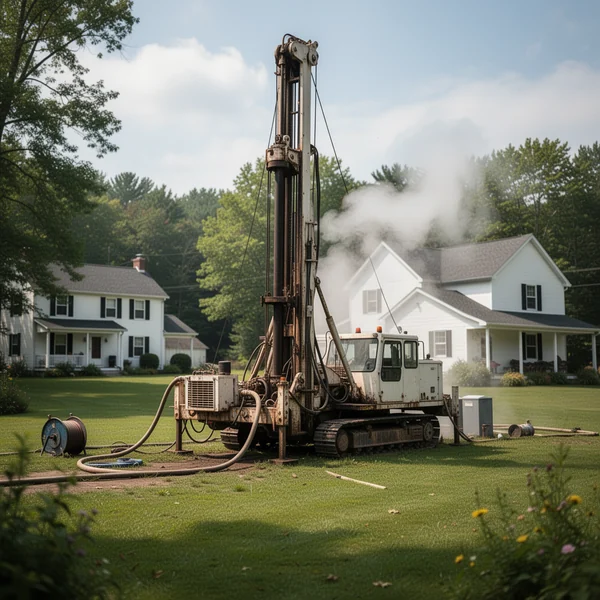
The horizontal vs vertical ground loop decision is almost never a preference — on most New York lots the land, the bedrock and the setbacks make it for you. Horizontal loops are trenched into open ground and are cheaper per ton because digging costs less than drilling; vertical loops are bored straight down and are what you use when you do not have the yard, cannot disturb it, or hit rock too close to the surface for trenching to be worth it.
Both are closed loops: the same sealed circuit of high-density polyethylene pipe carrying a water-antifreeze mix, exchanging heat with the ground rather than with outdoor air. That is the whole point of a ground-source system in New York — the earth a few feet down does not care that it is 5°F in Watertown in January, so the heat pump’s efficiency does not collapse the way an air-source unit’s does at design conditions.
Horizontal vs vertical ground loop: what each one needs from your lot
A horizontal loop needs open, diggable land and machine access to it. Trenches are cut well below the frost line — your building department publishes the local frost depth, and it is deeper in the Adirondacks than it is in Suffolk County — and the pipe is laid either as straight runs in long trenches or as overlapping “slinky” coils in shorter, wider ones. Slinky coils fit more pipe into less trench length and are the common choice where land is adequate but not generous.
The practical constraints are unglamorous. Can an excavator get to the back yard, or is there a fence, a retaining wall and a neighbour’s driveway in the way? Where is the septic field, and what is the required separation from it? Where is the drinking water well, if you have one? Where do the gas and electric services run, and has the site been marked? Are there mature trees whose root plates you are about to cut through? And are you prepared for the yard to look like a construction site until it grows back, because it will.
A vertical loop needs a drill rig to reach the boreholes and very little else. Boreholes are sunk to depth, a U-bend of pipe is dropped in, and the hole is grouted from the bottom up with a thermally-conductive grout. Several boreholes are spaced apart and manifolded together. The footprint at the surface is small enough that vertical loops are installed on tight suburban lots in Westchester and Nassau where a horizontal field is simply impossible.
What a vertical loop needs instead is access for a drilling rig — which is heavy, tall and wide — plus somewhere to manage the cuttings and drilling water, and a route for the header trench back to the house.
New York geology, and why the answer changes by region
New York is not one ground condition, and the same design decision flips as you move across the state.
- Long Island is deep unconsolidated sand and gravel — easy digging and straightforward drilling, with a high water table in places. It is also a designated sole-source aquifer, and Nassau and Suffolk county health departments take a close interest in anything that penetrates the ground. That regulatory layer, not the geology, is usually the constraint.
- The Hudson Valley — Dutchess, Ulster, Orange, Putnam — is shale and limestone, often with thin soil over rock. Trenching can hit refusal a few feet down, which is how a lot on paper big enough for a horizontal field ends up vertical in practice.
- The Hudson Highlands and the Adirondacks are hard crystalline bedrock at or near the surface. Drilling is slower and therefore dearer per foot, but trenching may not be possible at all.
- Central and western New York — the Finger Lakes, Onondaga, Monroe, Erie counties — is largely glacial till over shale and limestone, with drumlins and variable depth to rock. Two houses on the same street can get different answers.
None of this is guesswork on the installer’s side. Well completion reports for existing water wells in your area are on file, and a driller who works your county knows what he hits and at what depth. Ask. A contractor who cannot tell you what the local geology does is not local.
Performance: is one loop better than the other?
Done right, both meet the same design load — the loop is sized to the building’s heating and cooling load, so it is not a question of one being “stronger”. The differences are in stability and risk.
A vertical loop reaches ground that stays close to a constant temperature year-round, so its performance is more predictable across a long New York heating season. A horizontal loop sits in shallower ground that does swing seasonally, and in a genuinely severe winter the ground around a horizontal field cools progressively as the season runs — which is exactly when you need it most. That is manageable with correct sizing and adequate trench spacing, and it is a real failure mode when a field is undersized to save money on excavation.
Soil moisture matters more than most homeowners expect. Damp soil conducts heat far better than dry sand, so the same trench length performs differently on a wet clay lot than on a droughty sandy one. A properly designed job accounts for this; a job priced off a rule of thumb does not.
The variants worth asking about
- Directional boring. A middle path — pipe pulled horizontally underground from a small entry pit, without opening the whole yard. It preserves mature landscaping and driveways, and it is used on lots where an open trench would be unacceptable.
- Pond or lake loop. If you have a pond on the property that is deep enough not to freeze through, coils can be sunk in it. It is the cheapest loop field of all where the water body genuinely qualifies, and it brings its own permitting questions.
- Open loop and standing column wells. These draw groundwater and return it rather than circulating a sealed fluid. They can be excellent where the aquifer supports them and they carry a much heavier regulatory burden, because you are now withdrawing and discharging water rather than just putting pipe in the ground. Treat an open-loop proposal as a different project, not a variation.
Money, honestly
Two things are true and neither is a number. First, a vertical field generally costs more per ton of capacity than a horizontal one, because a drill rig and a driller cost more per hour than an excavator and an operator, and hard rock costs more per foot than glacial till. Second, the loop is only part of the job — the heat pump itself, the interior distribution (ducts or hydronic), the electrical work and the restoration of your yard all sit alongside it, and on retrofits the interior work is frequently the larger half.
On incentives, be precise about what is available in 2026. The federal Section 25D credit, which covered ground-source heat pumps at 30%, terminated for expenditures after 31 December 2025 — so a geothermal system installed in New York in 2026 receives nothing federal. NYS Clean Heat treats ground-source as its own measure category with its own incentive path, through NYSERDA and the seven sponsoring utilities (Central Hudson, Con Edison, National Fuel Gas, National Grid, NYSEG, Orange & Rockland and RG&E); amounts are not published as a single statewide table, and the address finder at cleanheat.ny.gov/find-available-rebates is the live source. New York also maintains a separate state tax credit for geothermal systems, claimed on Form IT-267 rather than the solar credit’s IT-255. It is 25% of qualified expenditure, capped at $5,000 for systems placed in service on or before 30 June 2025 and $10,000 for systems placed in service on or after 1 July 2025, and unused credit carries forward five years. The property has to be your residence when the system is placed in service, and you cannot claim it for a year in which the property was rented. Our overview of New York State renewable energy incentives beyond solar sets out where geothermal sits in the wider picture.
If you have acreage, the calculus changes again — a horizontal field on land you are not otherwise using is close to the cheapest heat you can buy in this state, and the same land-use thinking runs through farm solar incentives and land leases in New York.
What to do next
- Measure your usable open yard, then subtract the septic field, the well, the leach lines, the drive and anything you refuse to lose. What is left is what a horizontal loop has to fit into.
- Ask two local drillers what depth to bedrock is on your street. If it is shallow, the horizontal option is probably already gone.
- Get the loop design shown as trench length or borehole count and depth, tied to a Manual J load calculation — not “a 4-ton system”.
- Ask whether the proposal is closed loop or open loop. If open, ask which permits apply before anything else.
- Check access early: gate widths, overhead wires, soft ground, and where the rig or excavator will sit.
- Confirm restoration is in the contract — topsoil, grading and seed — and who is responsible if the trench settles next spring.
- Verify the contractor’s credentials before pricing; what a NYSERDA-qualified contractor actually means is worth five minutes.
NY Solar Incentives
Independent New York solar research. We summarise NYSERDA, NY-Sun and federal programme rules from published sources and state plainly when a figure is an estimate. We are not a government agency and do not sell equipment.
Run the arithmetic on your own system
Check the dated program table and your arrangement before counting an incentive. Standard residential NY-Sun blocks are closed; Long Island Affordable Solar has a conditional income-verification route. The NY credit depends on qualified costs and tax liability, while the NYC abatement reduces future property-tax bills. The estimator keeps those timings separate.