Gas Furnace as Backup: Dual Fuel Heating in New York
A dual fuel system keeps the existing gas furnace as backup and lets a heat pump carry the mild-weather load. The switchover setting is the whole design.
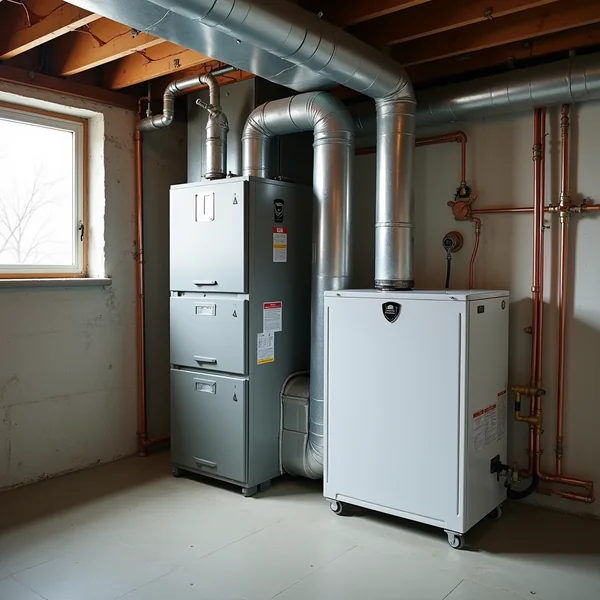
How a New York heat pump and an existing gas furnace share one duct system, and how to decide the temperature at which control passes from one to the other.
Most New York homes that add a heat pump already have a gas furnace in the basement, and it usually still works. The real question is rarely whether the heat pump can heat the house — a properly sized cold-climate unit can — but whether there is a reason to leave the furnace in place.
The arrangement has a name in the trade: dual fuel, or hybrid heating. One thermostat, two heat sources, and a control decision about which one may run at any given outdoor temperature. That decision is the entire subject — it separates a furnace that is a sensible hedge from one that is an expensive object taking up floor space.
Gas Furnace as Backup: How Dual Fuel Heating Works in a New York Home
In a dual fuel system the heat pump is the primary heat source and the furnace is locked out until conditions call for it. The indoor coil sits in the same duct system, normally directly above the furnace in an upflow arrangement, and a compatible thermostat decides which appliance may run. They never run together: the furnace would be pushing hot air across a coil trying to add heat to it, and return air temperature would climb out of the heat pump’s operating range.
That is why a dual fuel retrofit is not simply “a heat pump plus the old furnace.” The thermostat, the outdoor sensor and the furnace control board have to agree on who is in charge.
Three different things people mean by backup
Separate the jobs first; they call for different settings.
- Capacity backup. The heat pump cannot meet the load on the coldest days, so a second source covers the shortfall. This is a sizing outcome, not a law of physics: it happens when equipment was sized to the cooling load or to a budget.
- Economic backup. The heat pump can meet the load, but below some outdoor temperature its efficiency has fallen far enough that gas delivers the same heat for less. Nothing is failing; the arithmetic flips.
- Failure backup. A hedge against the heat pump being down in February while a part is on order. Note that this is not an outage plan: a gas furnace needs electricity for its blower, igniter and controls, so it goes dark with the house.
The switchover point is the whole design
Two methods are in common use, and they produce noticeably different bills.
Fixed temperature switchover
Below a set outdoor temperature the thermostat locks out the compressor and hands the house to the furnace. Easy to configure, easy to explain, and crude, because it ignores what energy costs on the day. Installers often leave a conservative default that starts the furnace earlier than it needs to, quietly turning a heat pump into an expensive air conditioner.
Economic balance point
The better method compares the delivered cost of a unit of heat from each source. A heat pump’s coefficient of performance falls as outdoor temperature drops; a gas furnace’s efficiency is roughly flat. Plot both and they cross: above the crossing the heat pump makes heat for less, below it the furnace does.
The important property of that crossing is that it moves. It depends on your delivered electric price per kilowatt-hour and your delivered gas price per therm — delivered meaning the whole bill divided by the units used, supply and delivery together, not the supply line alone. Because both change with season and rate structure, the switchover temperature is a setting to revisit, not a number stamped on the install paperwork. On a time-of-use rate the crossing even differs by hour, which argues for setting it against your average winter rate.
Where the balance point tends to land in New York
New York is not one climate. The winter design temperature on Long Island and in the lower Hudson Valley is far milder than the North Country or the western Southern Tier, so a switchover setting that is sensible in one is wasteful in the other.
In the milder downstate counties a cold-climate heat pump spends most of the heating season above any plausible balance point, so the furnace runs on a handful of days. That argues for keeping a healthy one — and equally against buying a new one when it dies. Upstate the furnace does real work, which strengthens the case for keeping it and, at the same time, the case for sizing the heat pump properly: a system that hands off at a mild temperature is a system you paid for twice. Sizing is where the money is won or lost, so read how heat pump and solar sizing interact in New York before ordering equipment, not after.
Keeping the furnace or removing it
| Consideration | Keep the furnace as backup | Remove it, full electric |
|---|---|---|
| Heat pump sizing | Can sit nearer the average load; the furnace covers the tail | Sized to the design heating load, electric resistance the only fallback |
| Electrical service | Lower peak draw, so a panel upgrade is less often triggered | Higher winter peak; panel and service capacity need checking first |
| Coldest-day comfort | Unaffected; the furnace has margin | Rests on correct load calculation and low-temperature capacity data |
| Ongoing cost | Two accounts, including the fixed monthly gas charge in summer | One account, no standing gas charge |
| Safety and maintenance | Combustion stays in the house: annual service, flue and CO checks | No combustion in the building |
| Incentives | Partial displacement is often treated differently from full | Usually the tier aimed at full fossil displacement |
| Best fit | Healthy furnace, upstate design temperatures, tight budget | Furnace at end of life, milder downstate climate, gas service closing anyway |
What the choice does to your electrical service
Removing the furnace makes the coldest hour of the year an electrical peak, because the fallback for a heat pump with nothing behind it is electric resistance heat, which draws far more current than the compressor it backs up. Keeping the furnace caps that peak — sometimes the difference between a service that copes and one that does not.
If a battery or an EV charger is also in the plan, map the interaction first: these decisions constrain each other in a fixed order. Our walkthrough of electrifying a New York home around solar covers that sequence, and when a panel upgrade is actually triggered covers the panel decision.
Venting and combustion details people forget
A furnace kept as backup is still a combustion appliance in the house, and running it a fraction as often changes two things.
- Shared flues become oversized. If the furnace and a gas water heater vent into one masonry chimney, removing most of the furnace’s runtime removes most of the heat that kept that flue drafting, leaving the water heater venting into a cold, oversized chimney. A liner sized for the remaining appliance is the standard fix, and a real line item on the quote.
- Idle equipment still needs inspection. Annual combustion safety checks and working carbon monoxide alarms do not become optional because the furnace runs less. An appliance that sits idle for months, then fires on the coldest night, is the one you most want tested in the fall.
How to check this for your own house
Four questions answer it, all of them on paper before you sign.
- What is the design heating load? Ask for a room-by-room Manual J calculation, not a rule of thumb from the old furnace’s size — old furnaces here are routinely oversized, so sizing from one repeats the error.
- What does the heat pump deliver at low outdoor temperatures? Ask for the extended capacity table, not the nameplate tonnage — capacity at the mild rating point says nothing about a January night.
- What switchover temperature is being programmed, and why? If the answer is a default rather than a calculation from your own delivered energy prices, ask for the calculation.
- How many years does the furnace have left? Heat exchanger condition and age decide it. Keeping a sound furnace is thrift; keeping a failing one defers a decision you will make anyway, in a worse month.
New York heat pump programs commonly draw a line between partial and full displacement of fossil heating, and the paperwork for a hybrid system is not always the paperwork for a full changeover. Confirm the current rules and tiers with the program administrator or your utility before equipment is ordered: eligibility is judged on what is installed.
Frequently Asked Questions
Can a heat pump and a gas furnace run at the same time?
No, and they should be wired so that they cannot. In a properly configured dual fuel system the thermostat locks out one appliance whenever the other is running. If the furnace runs while the indoor coil is trying to add heat, the return air temperature rises past what the heat pump is designed to work against, which hurts efficiency and can trip the unit on high pressure.
What outdoor temperature should the switchover be set to?
There is no single correct number, because the right setting depends on your delivered electricity price per kilowatt-hour, your delivered gas price per therm and how your particular heat pump’s efficiency falls with outdoor temperature. Ask the installer to calculate the economic balance point from those inputs rather than accepting the thermostat’s factory default, and revisit it when your rates change.
Does keeping a gas furnace as backup mean I still pay a gas bill in summer?
If the gas service stays connected, the fixed monthly charge that comes with having the meter generally continues year-round regardless of how little gas you burn. That standing charge is part of the honest comparison between hybrid and full electrification, and it is easy to overlook because it does not appear as a heating cost.
Will a gas furnace keep my heat on during a power outage?
Not on its own. A gas furnace needs electricity for its blower motor, ignition and control board, so it stops when the house loses power. Backup heat during an outage is a separate problem that needs a generator or a battery sized to carry the blower, and that is a different design conversation from dual fuel switchover.
Can I size the heat pump smaller if the furnace is staying?
You can, and that is one of the genuine advantages of a hybrid system: the heat pump covers the bulk of the hours while the furnace covers the extreme tail. The trade-off is that a smaller heat pump hands off to gas at a milder temperature, so more of the season is heated by combustion. Decide deliberately where you want that line rather than letting equipment availability decide it.
Do I need a new chimney liner if the furnace becomes backup?
Often yes, when the furnace shares a masonry chimney with a gas water heater. The furnace’s runtime is what kept that flue warm enough to draft properly, and removing most of it leaves an oversized, cold flue serving one small appliance. A correctly sized liner is the usual remedy and should appear on the quote rather than surfacing later.
Is a dual fuel system eligible for New York heat pump incentives?
It depends on the program and on how much of the heating load the heat pump takes over. Incentive structures in New York commonly distinguish partial displacement from full displacement of fossil heating, and the two are not treated identically. Confirm the current requirements with the program administrator or your utility before ordering equipment, since eligibility is judged on what is installed.
NY Solar Incentives
Independent New York solar research. We summarise NYSERDA, NY-Sun and federal programme rules from published sources and state plainly when a figure is an estimate. We are not a government agency and do not sell equipment.
Run the arithmetic on your own system
Check the dated program table and your arrangement before counting an incentive. Standard residential NY-Sun blocks are closed; Long Island Affordable Solar has a conditional income-verification route. The NY credit depends on qualified costs and tax liability, while the NYC abatement reduces future property-tax bills. The estimator keeps those timings separate.