Do Induction Stoves Have Ovens? What Comes in the Box
A freestanding induction range includes an oven. A drop-in induction cooktop does not. The oven is never induction either way, and the difference decides how many circuits the kitchen needs.
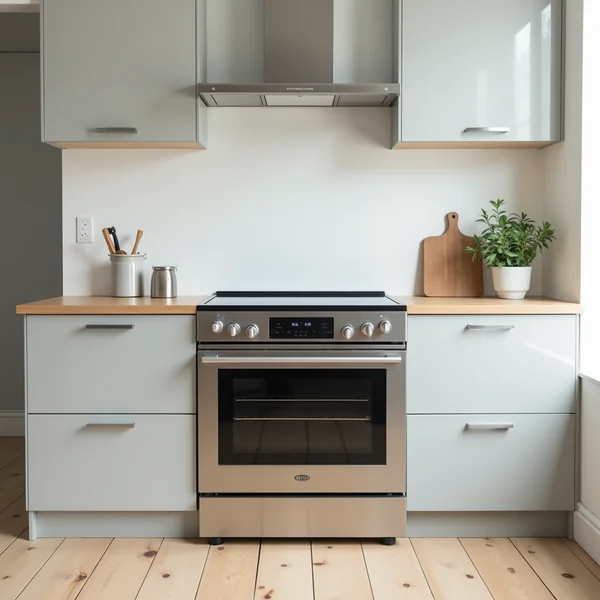
Whether an induction appliance includes an oven depends entirely on which of three products you are actually buying, and the answer changes the wiring behind it.
The question comes up because the vocabulary is genuinely confusing. Showrooms, listings and spec sheets use stove, range, cooktop and hob as if they were interchangeable, and they are not. Whether the appliance you are looking at includes an oven depends on which of those words the manufacturer actually meant.
Do Induction Stoves Have Ovens? It Depends Which Appliance You Mean
The short version: a freestanding induction range includes an oven, built into the same cabinet below the cooking surface. A drop-in induction cooktop does not — it is a cooking surface only, set into the counter, with cabinet space underneath. Both are commonly called induction stoves in conversation, and that single word is doing all the damage.
The three things being described
A freestanding induction range
One appliance, roughly the width of a standard cabinet opening, that slides into the gap where an old gas or electric range stood. Induction elements on top, an oven cavity below, one set of controls, one power connection. This is the direct replacement most people picture, and it is the configuration that answers the question with a straightforward yes.
A slide-in or drop-in range
The same combination of cooktop and oven, styled to sit flush with the surrounding counter rather than standing proud of it. Functionally identical for this question: the oven is included. The difference is cosmetic and dimensional, and it matters when a counter has already been cut.
An induction cooktop
A glass panel that drops into a hole in the counter, with no oven attached and no cabinet of its own. If the kitchen needs baking capability, it comes from a separate wall oven installed elsewhere in the run, or from a countertop oven, or from nothing at all. Listings for these often say induction stove in the title and only reveal the truth in the dimensions.
Why the oven is never actually induction
Even in a full induction range, the oven underneath is a conventional electric oven. It heats with resistance elements, usually with a fan for convection, exactly as an electric oven has always done. Induction cannot be used to heat an oven cavity, because the mechanism requires a magnetic field to couple into a piece of ferrous metal placed directly on the coil. There is nothing in a bread pan sitting on a wire rack in the middle of a hot box for that field to work on, and no way to heat the air around it magnetically.
So an induction range is a hybrid by nature: an induction surface for the pans, and a familiar radiant electric oven below. Anyone expecting the oven to preheat with the same startling speed as the cooktop will be disappointed. It preheats like an electric oven, because it is one.
The configurations side by side
| Configuration | Oven included | Power connections | Counter work |
|---|---|---|---|
| Freestanding induction range | Yes, conventional electric | One 240-volt circuit | None, it slots into the gap |
| Slide-in induction range | Yes, conventional electric | One 240-volt circuit | Opening must match the appliance |
| Induction cooktop alone | No | One 240-volt circuit | Counter cut to the manufacturer template |
| Induction cooktop plus wall oven | Yes, separate appliance | Usually two 240-volt circuits | Counter cut and a cabinet given up |
| Induction cooktop plus countertop oven | Small oven only | One 240-volt plus a 120-volt outlet | Counter cut, and surface space lost |
What the choice does to the electrical work
A single range is one appliance on one dedicated 240-volt circuit, sized to the nameplate on the back of the unit. Splitting the same functions into a separate cooktop and wall oven usually means two dedicated circuits instead of one, each pulled from the service panel to a different part of the kitchen.
That distinction has real consequences in older New York housing stock, where kitchens were wired for a gas range and a couple of small-appliance circuits. Two new 240-volt runs cost more than one, need more space in the panel, and add more to the calculated demand on the service. Where the panel is already close to full, the split configuration is sometimes what tips a kitchen project into a service upgrade. The panel side of that question is set out in when solar needs an electrical panel upgrade.
Layout consequences people underestimate
A wall oven has to live somewhere. It occupies a full cabinet, at a height chosen deliberately, and that cabinet is no longer storage. In a narrow apartment kitchen or a rowhouse galley, giving up a run of base cabinets to gain a wall oven is a bigger sacrifice than the appliance budget suggests.
Against that, a wall oven at eye level means no bending to lift a heavy roasting pan, and the separated cooktop can go on an island where a range with a hot oven door would be awkward with children around. Neither layout is better in the abstract. The question is which constraint the kitchen actually has.
Reading the specification before ordering
Three fields settle it every time. Look at the product category: range means an oven is included, cooktop means it is not. Look at the overall height: anything around counter height is a range, anything a few inches deep is a cooktop. Look at the oven capacity field: a cooktop listing leaves it blank.
Then check the nameplate electrical rating and hand it to the electrician before the appliance ships, not on installation day. The rating determines the circuit, and the circuit determines whether the job is an afternoon or a week.
Where this sits in a New York upgrade
Kitchen appliances are usually not the first move in an electrification plan, and they should not be treated as one. Heating, hot water and the building envelope carry far more energy than cooking does, and they are the loads that decide how large a heat pump and a service need to be. But a kitchen renovation is a rare opportunity to open walls and pull circuits while the room is already apart, which makes it a natural moment to run capacity you will want later even if the appliance goes in today.
The sensible order of operations across a whole house, and why the panel deserves to be planned once rather than three times, is covered in electrifying a New York home around solar. New York State runs residential incentive and financing programs through NYSERDA, and the utilities administer efficiency programs alongside them; what each covers moves between funding cycles, so check the current program pages rather than a figure quoted elsewhere, and ask the contractor to name the program on the proposal.
Deciding between them
Take the range if you are replacing an existing range, the budget is finite, or the kitchen cannot spare a cabinet. It is one appliance, one circuit, one delivery and one thing to service. Take the split configuration if you bake often enough to want an oven at eye level, the layout has a wall to give, and the panel has capacity for a second circuit without a fight.
What should not drive the decision is a belief that a separate wall oven will somehow be an induction oven. It will not be. Both routes give you the same kind of electric oven, and the induction part of the appliance stays where it can work, which is under the pan.
Frequently Asked Questions
Does an induction range come with an oven?
Yes. A freestanding or slide-in induction range is one appliance with induction elements on top and an oven cavity below, sharing a single cabinet and one power connection. It is the direct replacement for an old gas or electric range.
Is the oven in an induction range also induction?
No. It is a conventional electric oven with resistance elements, usually with convection. Induction needs a magnetic field coupling directly into ferrous metal placed on the coil, which cannot work on a pan sitting on a rack in the middle of a hot cavity.
What is the difference between an induction cooktop and an induction range?
A cooktop is a cooking surface only, dropped into a hole cut in the counter, with no oven. A range is a full-height appliance containing both the cooking surface and an oven. Listings often call both an induction stove, so check the height and the oven capacity field.
Does the oven preheat faster on an induction range?
No. The cooktop responds much faster than gas or a radiant element, but the oven behaves like any electric oven because that is what it is. Preheat time is set by the oven elements and the cavity, not by the induction surface above it.
How many circuits do I need if I buy a cooktop and a wall oven separately?
Usually two dedicated 240-volt circuits, one for each appliance, each sized to its own nameplate rating. A single range needs only one. That difference matters most in older homes where the panel has limited space and the service is already loaded.
Can I put an induction cooktop over my existing wall oven?
Only if the oven cabinet and the counter both suit it, and only after an electrician confirms each appliance gets its own correctly sized circuit. Manufacturers also specify clearances between a cooktop and anything installed directly beneath it, which an older cabinet may not meet.
Do I need special pans for the oven part?
No. Only the induction cooking surface requires magnetic cookware. The oven takes any ovenproof bakeware, including glass, ceramic and aluminium, exactly as an electric oven always has.
Should a kitchen appliance be the first step in electrifying a New York home?
Usually not. Heating, hot water and the building envelope account for far more energy and determine how large a heat pump and electrical service need to be. A kitchen renovation is still a good moment to run circuit capacity you will want later, while the walls are open.
NY Solar Incentives
Independent New York solar research. We summarise NYSERDA, NY-Sun and federal programme rules from published sources and state plainly when a figure is an estimate. We are not a government agency and do not sell equipment.
Run the arithmetic on your own system
Check the dated program table and your arrangement before counting an incentive. Standard residential NY-Sun blocks are closed; Long Island Affordable Solar has a conditional income-verification route. The NY credit depends on qualified costs and tax liability, while the NYC abatement reduces future property-tax bills. The estimator keeps those timings separate.