Sealing gable vents in a New York attic: when it helps
Gable vents sit high and wide, and on a roof with soffit intake and a ridge vent they let air take a shortcut past the coldest part of the deck. When closing them is an improvement, and when it starts a moisture problem.
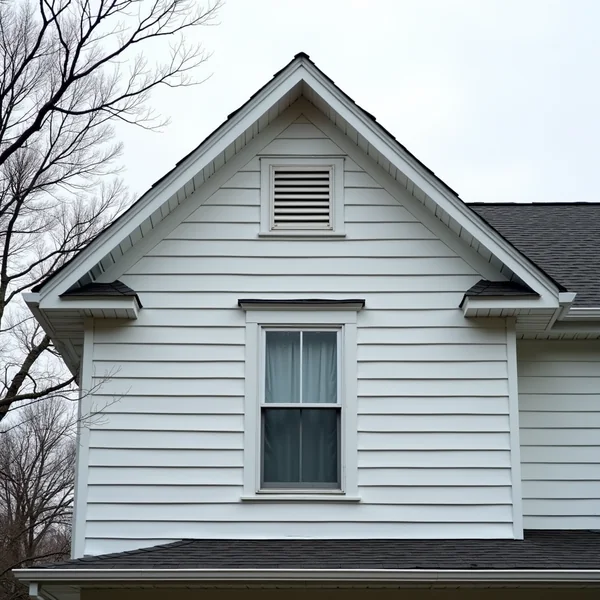
How to tell whether your gable vents are helping the roof breathe or letting air skip the part of the deck that needs it most.
Somewhere in the middle of an insulation quote, a New York homeowner is told that the two louvered triangles at either end of the attic are going to be closed up. It sounds like a mistake. Those vents have been there since the house was framed, they are the only daylight in the attic, and the instinct is that covering them will trap heat and rot the roof.
Sometimes that instinct is right. More often the vents are already doing very little, and in a specific set of cases they are actively working against the ventilation path the roof was later given. Sealing gable vents is not a rule of thumb; it is a decision that depends on what else the attic has, how the ceiling below it is air sealed, and whether the attic is meant to stay vented at all.
What sealing gable vents actually changes in a New York attic
A vented attic in this climate is doing three separate jobs, and they are worth separating because a gable vent is good at one of them and mediocre at the other two.
The three jobs a vent is asked to do
- Carrying moisture back outside. Warm indoor air leaks up through ceiling penetrations, hits a cold roof deck in January and condenses. Ventilation air dilutes that moisture and takes it away before it soaks the sheathing.
- Keeping the roof deck cold in winter. A cold deck means snow melts from the sun rather than from the house, which is the mechanism behind ice damming at the eaves.
- Dumping summer heat. The one job that gets talked about most and matters least, because attic insulation, not attic air temperature, is what governs how much heat reaches the rooms below.
Jobs one and two are both driven by air moving from the eaves upward. That is where the tension comes from.
Why gable vents and a ridge-and-soffit system interfere with each other
A soffit-to-ridge system is designed to wash the whole underside of the roof deck: cool air enters low at the eaves, warms, rises along the sheathing and leaves at the peak. It works because the inlet is at the bottom and the outlet is at the top, and because there is nothing easier in between.
An open gable vent is easier. It sits high on the wall, close to the ridge, and it is a large opening compared with the perforated strips at the eaves. Air takes the short path: in one gable, out the ridge or the opposite gable, never touching the lower third of the roof deck. The eave bays go still. In a New York winter, still air at the coldest part of the assembly is exactly where condensation and, in a bad year, frost on the underside of the sheathing shows up.
That is the standard argument for sealing gable vents on a house that has since been given continuous soffit intake and a ridge vent. You are not removing ventilation. You are removing a shortcut so that the ventilation you paid for actually runs the full length of the deck.
When leaving them open is the better call
Plenty of older houses across the state have no functioning soffit intake at all. Closed rafter tails, boxed eaves, a porch roof running into the wall, or thirty years of blown-in insulation packed hard against the top plate will all block it. On that house the gable vents are not a shortcut, they are the entire ventilation system, and closing them turns a vented attic into an unvented one by accident, without any of the design work that an intentional unvented assembly requires.
Two other cases argue for leaving them alone: a gable vent that a powered attic fan or a whole-house fan depends on for makeup air, and a roof with no ridge vent where the gables are the only high outlet. In both, the correct sequence is to fix the intake first and revisit the gables afterward.
Three attic strategies, compared
| Approach | What it does | Where it fits a New York house | What has to be true first |
|---|---|---|---|
| Leave gable vents open | Keeps the existing high-and-wide outlet; airflow tends to bypass the lower deck | Houses with no usable soffit intake and no ridge vent | Nothing — it is the default, and often the honest one |
| Seal gable vents, keep soffit and ridge | Forces intake air to enter at the eaves and wash the whole deck before leaving at the peak | Roofs that already have continuous soffit intake and a working ridge vent | Verified open soffit bays, baffles at each rafter, ridge vent cut through the sheathing rather than just capped |
| Unvented, conditioned attic | Moves the air and thermal boundary to the roofline; the attic becomes part of the house | Complicated roofs, attic mechanicals or ductwork, finished space above | A designed assembly with the right insulation strategy at the deck, and a code official who has reviewed it |
Moisture is the failure mode, not comfort
Sealing gable vents on a leaky ceiling is the version of this that goes wrong. The vents were removing the moisture that the ceiling was letting up; take the outlet away without reducing the supply and the attic simply gets damper. The order that holds up in this climate is: air seal the ceiling plane first, insulate second, and only then decide what the roof ventilation should look like.
The ceiling plane work is unglamorous and it is where the result comes from — top plates, wire and pipe penetrations, the chase above a soffited kitchen cabinet run, the hatch, recessed light housings, and the bypass around a chimney or flue, which has clearance rules of its own and is not a place for spray foam. A blower door test before and after is the only way to know whether any of it landed.
Where this sits in an electrification project
Attic work is usually the first thing a contractor recommends and the first thing a homeowner postpones, because it is invisible. It is worth doing first anyway, for a reason that has nothing to do with the attic: everything sized after it gets smaller. A heat pump specified against a leaky envelope is specified against a load that no longer exists once the envelope is fixed, and an oversized cold-climate unit cycles badly and costs more to install. If a heat pump is anywhere in the plan, the envelope work belongs ahead of the equipment selection, which is the same argument behind sizing a heat pump and a solar array together rather than one at a time.
The same logic sets the order for the rest of the project. Envelope, then equipment, then generation and storage — the sequence laid out in this guide to electrifying a New York home around solar. And if the roof is old enough to be replaced within a few years, gable vents, ridge vents and soffit intake are all cheaper to sort out during the roof job than after it, which is the same timing argument installers make about roof age before a solar install.
How to find out what your attic actually has
Before deciding anything, go up on a cold, still morning with a light and look at four things: whether daylight is visible at the eaves between the insulation and the roof deck, whether there are baffles holding the insulation back from the soffit, whether the ridge is cut open under its cap or merely capped, and whether the underside of the sheathing shows dark staining, rust on the nail points or frost. Staining at the north slope and clear sheathing elsewhere tells you the moisture is coming from below, not from the vents.
A home energy assessment does that inspection with instruments rather than a flashlight, and New York’s energy programs are built around one as the starting point for envelope work. It is also the document a contractor will want before quoting anything, because it establishes what the attic was doing beforehand.
The short version
Seal the gable vents when the roof has a real soffit-to-ridge path and the gables are letting air skip it. Leave them open when they are the only ventilation the attic has. Do neither until the ceiling below is air sealed, because in a New York winter the moisture that damages a roof deck almost always arrives from inside the house rather than from the weather.
Frequently Asked Questions
Does sealing gable vents cause moisture problems in the attic?
It can, if the vents were the only outlet the attic had or if the ceiling below is leaking indoor air upward. Closing them on a roof that already has continuous soffit intake and a working ridge vent usually improves the situation, because air is forced to travel the full length of the deck instead of taking a shortcut near the peak. The deciding factor is what the rest of the ventilation path looks like and how airtight the ceiling is.
Should I seal gable vents if I have a ridge vent?
That is the most common case for sealing them, but only when the soffit intake is genuinely open. A ridge vent with blocked eaves and open gables is still moving air; close the gables without fixing the intake and the ridge vent has very little to draw from. Check that the insulation is held back from the soffit by baffles and that daylight is visible at the eaves before deciding.
Do gable vents help with ice dams in New York?
Only indirectly. Ice dams form when heat from the house melts snow on the upper roof and the meltwater refreezes at the cold eave. Ventilation helps by keeping the deck cold, but it cannot compensate for heat leaking up through the ceiling. Air sealing and insulating the ceiling plane addresses the cause; ventilation manages what is left over.
Is sealing gable vents something a homeowner can do?
The physical work is straightforward, and that is what makes it risky — it is easy to close a vent and never learn that it was the only intake the attic had. Treat the diagnosis as the hard part. An energy assessment or an insulation contractor who inspects the eaves, the ridge and the underside of the sheathing will tell you whether sealing is an improvement or the start of a moisture problem.
What about a powered attic fan mounted in the gable?
A powered fan changes the question, because it will pull its makeup air from wherever the path of least resistance is — often through ceiling leaks, drawing conditioned air out of the house. If a gable fan is present, the sealing decision has to be made together with a decision about the fan itself rather than around it.
Does an unvented attic make gable vents irrelevant?
Yes, but that is a different project rather than a shortcut. In an unvented, conditioned attic the insulation and air barrier move to the roof deck and the attic becomes part of the conditioned house, so every vent in the assembly is closed by design. It is an engineered assembly, it interacts with combustion appliances and fire code requirements, and it needs a permit and a code official’s review in New York — not a weekend with a caulk gun.
Will closing gable vents void a roof warranty?
It can, because many roofing manufacturers write a minimum ventilation requirement into their warranty terms and calculate it from the total opening area at the eaves and the ridge. If the roof is under warranty, ask the roofer to confirm in writing that the remaining ventilation still satisfies the terms before anything is sealed.
NY Solar Incentives
Independent New York solar research. We summarise NYSERDA, NY-Sun and federal programme rules from published sources and state plainly when a figure is an estimate. We are not a government agency and do not sell equipment.
Run the arithmetic on your own system
Check the dated program table and your arrangement before counting an incentive. Standard residential NY-Sun blocks are closed; Long Island Affordable Solar has a conditional income-verification route. The NY credit depends on qualified costs and tax liability, while the NYC abatement reduces future property-tax bills. The estimator keeps those timings separate.