Off-Grid Solar in New York: What It Actually Takes
Off-grid is not solar with a battery attached. It is a different design problem, and in New York the binding month is January.
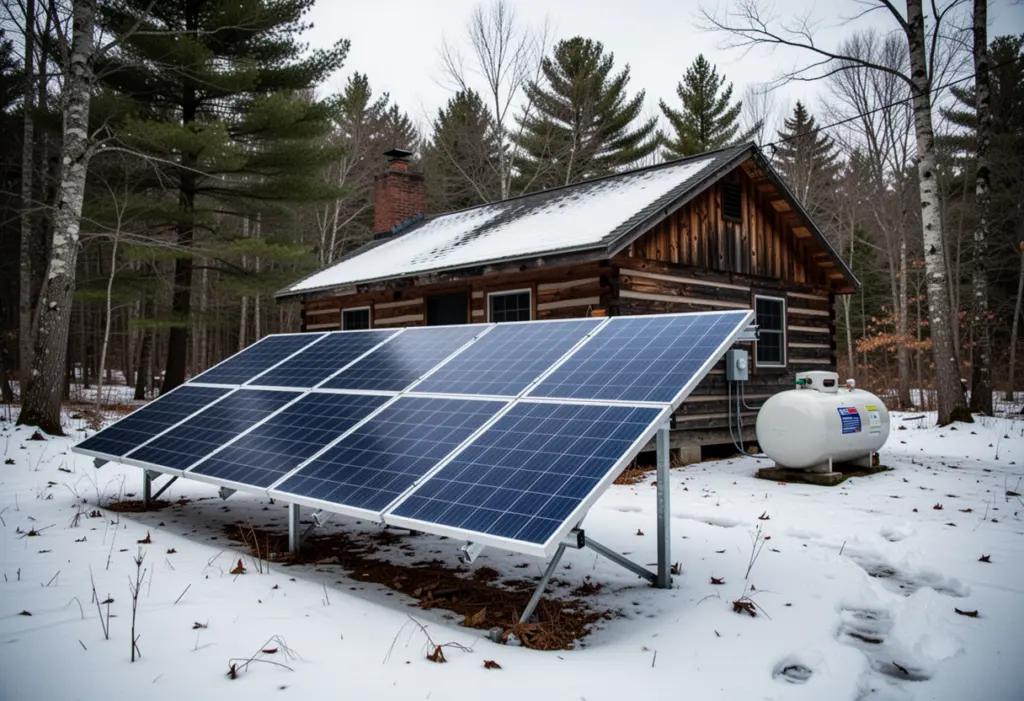
Off-grid solar comes up in New York for one practical reason far more often than for any philosophical one: the property is a long way from a line, and the utility’s quote to extend service is larger than the cost of a standalone system. Where that is true, off-grid is the cheaper answer rather than the romantic one.
It is also a genuinely different discipline from the rooftop solar the rest of this site describes, and treating it as grid-tied solar with a battery attached is how people end up cold in February.
The design problem inverts
A grid-tied system is sized against annual consumption. Surplus in July pays for the deficit in January through net metering, and the grid absorbs every mismatch in between.
An off-grid system has no such backstop. It must carry the house through the worst stretch — a week of December cloud after a snowfall, when daylight is shortest, the sun is lowest and the array may be covered. That is the number the whole system is sized against, and in New York it is a demanding one.
The consequence is that off-grid systems are much larger, in both array and storage, than the same house would need grid-tied. Anyone quoting an off-grid system from an annual-average calculation has not done the work.
What the system actually consists of
- An array, usually ground-mounted so it can be oriented and tilted properly and cleared safely — and tilted steeply, because a covered array in January produces nothing at the exact moment it matters most.
- Substantial storage, sized for consecutive low-production days rather than for one night.
- A generator. Nearly every practical New York off-grid system has one. It is not a failure of the design; it is the honest way to cover the worst week without oversizing the array for a condition that occurs a few times a year.
- An inverter/charger that manages all three.
What changes about the house
This is the part people underestimate. Off-grid design starts with reducing the load, because every watt is capital.
Electric resistance heat, electric hot water, an electric range and an electric dryer are all extremely difficult off-grid in a New York winter. Propane or wood for heat, cooking and hot water is the normal answer, and it is why an off-grid property is usually a mixed-fuel property rather than an all-electric one.
A heat pump is possible but it is a serious design conversation, not an assumption.
What does not apply
Everything on this site about net metering, the Customer Benefit Contribution, interconnection applications and permission to operate is about being connected to a utility. None of it reaches an off-grid system. There is no export, no credit, no meter and no utility relationship.
Building and electrical permits still apply, and so do the fire code requirements governing where battery storage may be installed.
The incentive position
The 30% federal residential credit is gone — section 25D was terminated for expenditures made after 31 December 2025, with an expenditure treated as made when the original installation is completed.
New York’s 25% credit, capped at $5,000 on Form IT-255, is for solar energy system equipment installed and used at your principal residence in New York State — which is the question to settle first, because a remote off-grid property is frequently a camp rather than a principal residence, and a camp does not qualify.
NYSERDA’s programmes are generally built around grid-connected systems, so do not assume NY-Sun applies; ask directly rather than letting a proposal assume it.
When it makes sense, and when it does not
It makes sense when the utility’s cost to extend service is large, when the property is genuinely remote, and when the household is prepared to design its energy use around the system rather than the reverse.
It does not make sense as a way to save money on a property that already has service. A grid connection in New York is worth a great deal: full-retail net metering, no storage required, and no worst-week design problem. Leaving it to go off-grid is a choice that costs money rather than saving it.
Frequently Asked Questions
When does off-grid solar make sense in New York?
Mainly when a property is remote and the utility's cost to extend service exceeds the cost of a standalone system. It rarely makes financial sense on a property that already has service, because full-retail net metering is worth a great deal.
How is an off-grid system sized differently?
Against the worst stretch rather than the annual average — a week of December cloud after snowfall, when daylight is shortest and the array may be covered. That makes off-grid systems much larger in both array and storage than the same house would need grid-tied.
Do off-grid systems need a generator?
Nearly every practical New York off-grid system has one. It is not a design failure; it is the honest way to cover the worst week without oversizing the array for a condition that occurs a few times a year.
Does net metering or the CBC apply off-grid?
No. Net metering, the Customer Benefit Contribution, interconnection and permission to operate all concern being connected to a utility, and none of them reaches an off-grid system. Building and electrical permits and battery fire code requirements still apply.
This article is general information, not tax, legal or financial advice. Incentive amounts, eligibility rules and deadlines change and depend on your utility, your tax situation and your property. Confirm current terms with NYSERDA, your utility and a qualified tax professional before making a decision.
NY Solar Incentives
Independent New York solar research. We summarise NYSERDA, NY-Sun and federal programme rules from published sources and state plainly when a figure is an estimate. We are not a government agency and do not sell equipment.
Run the arithmetic on your own system
Check the dated program table and your arrangement before counting an incentive. Standard residential NY-Sun blocks are closed; Long Island Affordable Solar has a conditional income-verification route. The NY credit depends on qualified costs and tax liability, while the NYC abatement reduces future property-tax bills. The estimator keeps those timings separate.