Adding a Battery to an Existing Solar System
Adding storage later is entirely normal, but whether it is simple or expensive depends on an inverter decision made years ago.
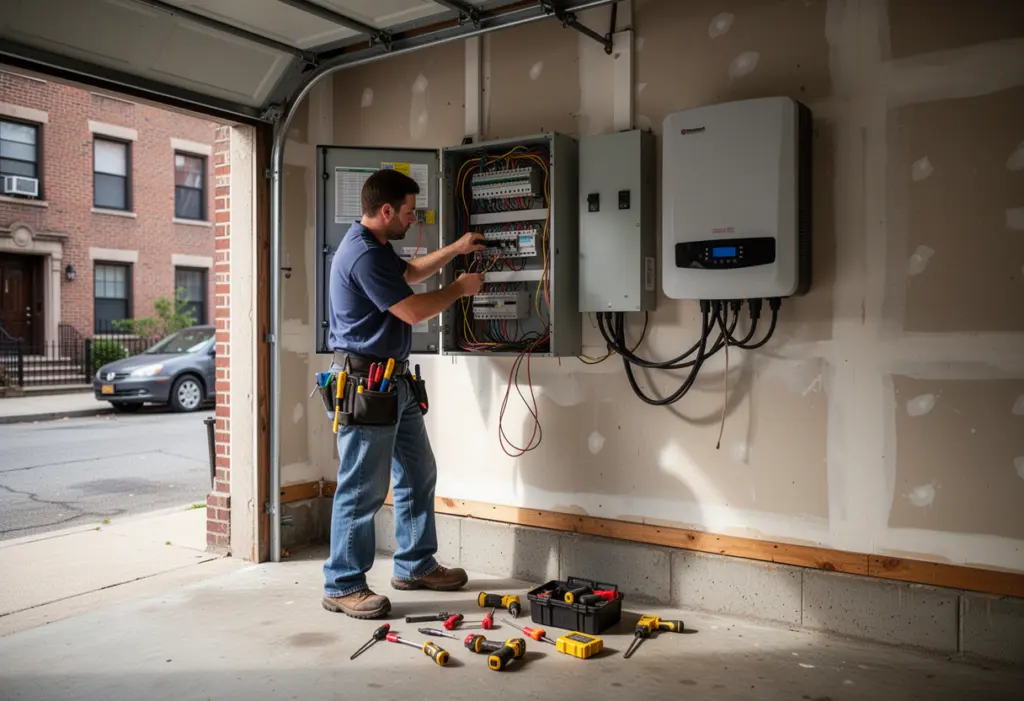
Plenty of New York households installed solar without storage and are now reconsidering — usually after an outage. Retrofitting is entirely normal. Whether it is straightforward or expensive comes down to one decision made when the original system was designed.
AC coupling or DC coupling
DC coupling connects the battery on the DC side, before conversion. It is more efficient because the solar output is stored without an extra conversion step, and it is the usual choice when solar and storage are installed together.
AC coupling connects the battery on the AC side, after your existing inverter. It adds a conversion step and loses a little efficiency, but it works with almost any existing array — which is why it is the normal answer for a retrofit.
The practical consequence: your existing system does not need replacing. An AC-coupled battery has its own inverter and sits alongside what you already have.
Can your existing inverter do it?
Some hybrid inverters are storage-ready and simply need the battery added. Most older string inverters and most microinverter installations are not, and take an AC-coupled battery with its own inverter instead.
Find the make and model of your inverter — it is on a label on the unit — before you ask for quotes. It is the single piece of information that determines what your options are and what they cost.
The switchgear is the part that gets forgotten
A battery alone does not keep your house running in an outage. You also need equipment that disconnects the house from the grid and lets the battery and solar run it as an island — an automatic transfer switch and, in almost every New York installation, a critical loads sub-panel carrying the circuits you want backed up.
Creating that sub-panel means an electrician moving circuits, and in an older house with a crowded or undersized panel that can be a larger job than the battery. Ask for the electrical work to be itemised separately in the quote rather than folded into one number.
What the utility needs to know
Adding storage changes what is connected behind your meter, so it goes through your utility. Expect an application, and expect the same discipline as the original installation: nothing is energised before authorisation.
Two New York-specific points:
- Your net metering is not disturbed. A system interconnected today holds Phase One net metering for 20 years, and adding storage does not restart that clock or change the arrangement.
- The Customer Benefit Contribution does not increase. It is calculated on the DC size of the PV system, not on battery capacity. Adding a battery to an existing array leaves the charge where it was.
That second point is worth knowing, because it is the one thing about a retrofit that people reasonably expect to cost them and does not.
Permits and code
Battery storage carries its own requirements — where the unit may be installed, separation from living space, and clearances. Requirements differ between a detached garage, an attached garage, a basement and an exterior wall, and your municipality applies them. Your installer should raise this before you choose a location; if they have not, ask.
Questions to ask before you commit
- What is my existing inverter, and does it support DC coupling or do I need an AC-coupled battery?
- What electrical work does the critical loads sub-panel require, itemised separately?
- Which circuits will be on it, and does the battery’s power output cover their surges?
- Where will the unit be installed, and what does the code require for that location?
- Will the solar recharge the battery during an outage, and what does that look like in December?
- Does any figure in this quote assume a federal tax credit? It should not — section 25D ended for expenditures made after 31 December 2025.
Frequently Asked Questions
Can I add a battery to solar panels I already have?
Yes. An AC-coupled battery has its own inverter and works alongside almost any existing array, so the original system does not need replacing. It loses a little efficiency to the extra conversion step compared with DC coupling.
Will adding a battery change my net metering?
No. A system interconnected today holds Phase One net metering for 20 years and adding storage does not restart that clock or alter the arrangement.
Does a battery increase the Customer Benefit Contribution?
No. The charge is calculated on the DC size of the PV system rather than on battery capacity, so adding storage to an existing array leaves it unchanged.
What is the hidden cost of a battery retrofit?
Usually the electrical work rather than the battery — creating a critical loads sub-panel means an electrician moving circuits, and in an older house with a crowded or undersized panel that can exceed the cost of the battery itself. Ask for it to be itemised separately.
This article is general information, not tax, legal or financial advice. Incentive amounts, eligibility rules and deadlines change and depend on your utility, your tax situation and your property. Confirm current terms with NYSERDA, your utility and a qualified tax professional before making a decision.
NY Solar Incentives
Independent New York solar research. We summarise NYSERDA, NY-Sun and federal programme rules from published sources and state plainly when a figure is an estimate. We are not a government agency and do not sell equipment.
Run the arithmetic on your own system
Check the dated program table and your arrangement before counting an incentive. Standard residential NY-Sun blocks are closed; Long Island Affordable Solar has a conditional income-verification route. The NY credit depends on qualified costs and tax liability, while the NYC abatement reduces future property-tax bills. The estimator keeps those timings separate.