Microinverters or String Inverters for a New York Roof?
New York roofs are small, complicated and often shaded, which is exactly the condition where the inverter choice stops being a detail.
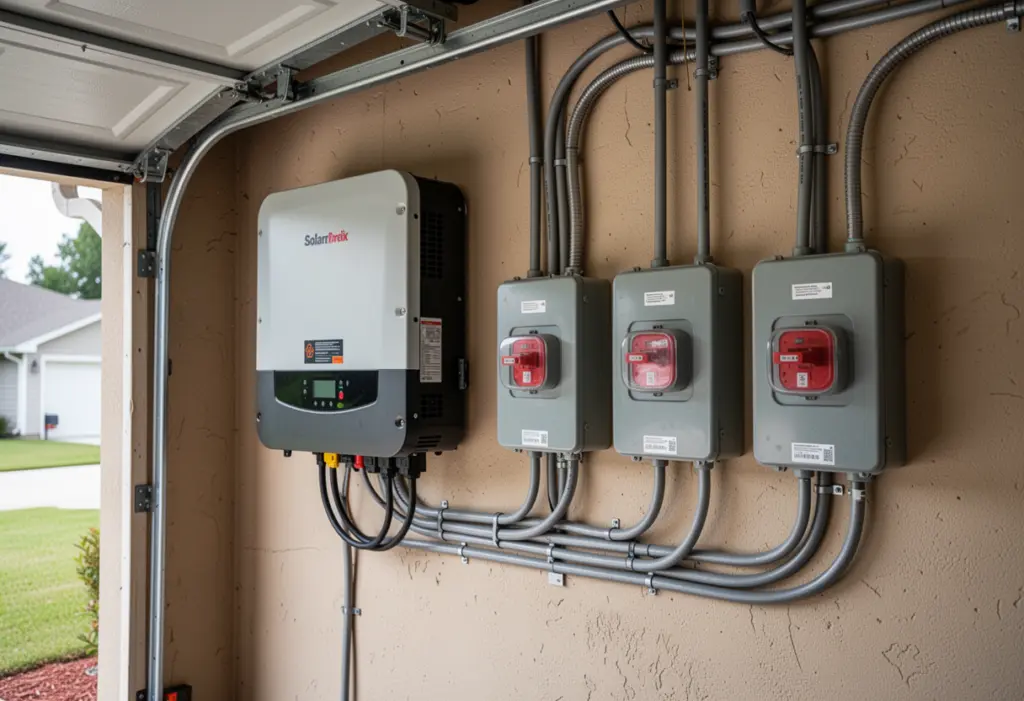
On a large, simple, unshaded roof in Arizona the inverter choice barely matters. On a New York roof — smaller, often cut up by dormers and chimneys, frequently overhung by a mature tree, and covered in snow for part of the year — it matters considerably more.
The three architectures
String inverter. Panels are wired in series into a string, and one inverter converts the whole string’s DC output to AC. It is the oldest and usually the cheapest arrangement. The characteristic weakness: the string behaves somewhat like the weakest panel in it, so shading on one module drags on its neighbours.
String inverter plus optimizers. A small device on each panel conditions that panel’s output before it joins the string. This recovers most of the shading behaviour of the next option while keeping a single central inverter. Panel-level monitoring usually comes with it.
Microinverters. A small inverter on each panel, converting to AC on the roof. Every panel operates independently, so shade on one affects only that one. Panel-level monitoring is inherent.
What actually decides it on a New York roof
Shading. This is the dominant factor in most of the state. Hudson Valley and Westchester tree cover, Southern Tier hillsides, dense Brooklyn and Queens blocks with neighbouring buildings — all produce partial shading that moves across the array through the day and worsens at the low winter sun angle. Where shading is real and unavoidable, module-level electronics (microinverters or optimizers) earn their cost.
Multiple roof planes. New York housing stock is old and complicated: dormers, hips, additions, valleys. An array split across planes facing different directions produces different amounts at different times, which is the same problem shading creates. Module-level electronics handle it cleanly; a single string across mismatched planes does not.
Snow. Partial snow cover is functionally partial shading, and it is a New York constant from December to February. Panels clear unevenly — the bottom row first, the top row last. With a plain string, that uneven clearing holds back the whole string; with module-level electronics the cleared panels get on with it.
Small arrays. Many New York roofs support only eight to fourteen panels. On a small array, losing a meaningful fraction of output to a single shaded module is proportionally worse than it would be on a large one.
The honest case for a plain string inverter
It is cheaper, and on the right roof it is the right answer. If your array sits on one unshaded south-facing plane with a clear horizon — which does exist in New York, particularly in newer suburban development and on rural properties — a string inverter will produce very close to what a microinverter system produces, for less money.
There is also a maintenance argument in both directions. A central inverter is a single point of failure, but it is on a wall at eye level and is straightforward to replace. Microinverters are redundant, but a failure is on the roof and replacing one means going up there.
Lifespan and warranty
Modules routinely carry warranties measured in decades. Inverters do not. A central string inverter is generally expected to need replacement at least once in the system’s life, and that replacement is a real future cost that belongs in your arithmetic. Microinverter warranties are typically longer, which is part of what you are paying for.
Ask for the inverter warranty term in writing, and ask what it covers — the unit only, or labour as well. That second half is where warranties differ most and where the cost actually falls.
Rapid shutdown, which is not optional
New York’s electrical code requires rapid shutdown capability for rooftop PV, which brings module-level voltage down quickly for firefighter safety. Microinverters and optimizers satisfy this inherently. A plain string inverter needs additional equipment to comply. In practice this narrows the price gap between the architectures and is a reason microinverters and optimizers are now the common choice on New York roofs.
What to ask
- What is the shading analysis for this roof, and does the design respond to it?
- How many roof planes and orientations does this array use?
- What is the inverter warranty term, and does it include labour?
- How is rapid shutdown achieved, and is that equipment in the quoted price?
- Does the system provide panel-level monitoring? On a complicated roof it is how you find a problem before the annual total tells you.
If two quotes differ in architecture, they are not really quotes for the same system, and comparing their prices without comparing their production estimates and warranties will mislead you.
Frequently Asked Questions
Are microinverters worth it in New York?
On a shaded roof, a roof split across several planes, or a small array, yes — module-level electronics recover output that a plain string would lose. On a single unshaded south-facing plane with a clear horizon, a string inverter produces nearly as much for less.
Do microinverters help with snow?
Yes, because partial snow cover behaves like partial shading. Panels clear unevenly, bottom row first, and with module-level electronics the cleared panels keep producing instead of being held back by the covered ones.
How long do solar inverters last?
Shorter than the panels. A central string inverter is generally expected to need replacement at least once during the system's life, which is a real future cost. Microinverter warranties are typically longer, which is part of the price difference.
What is rapid shutdown and does it affect the inverter choice?
New York's electrical code requires rooftop PV to bring module-level voltage down quickly for firefighter safety. Microinverters and optimizers satisfy this inherently while a plain string inverter needs extra equipment, which narrows the price gap between the options.
This article is general information, not tax, legal or financial advice. Incentive amounts, eligibility rules and deadlines change and depend on your utility, your tax situation and your property. Confirm current terms with NYSERDA, your utility and a qualified tax professional before making a decision.
NY Solar Incentives
Independent New York solar research. We summarise NYSERDA, NY-Sun and federal programme rules from published sources and state plainly when a figure is an estimate. We are not a government agency and do not sell equipment.
Run the arithmetic on your own system
Check the dated program table and your arrangement before counting an incentive. Standard residential NY-Sun blocks are closed; Long Island Affordable Solar has a conditional income-verification route. The NY credit depends on qualified costs and tax liability, while the NYC abatement reduces future property-tax bills. The estimator keeps those timings separate.